Get Full Government Meeting Transcripts, Videos, & Alerts Forever!
Get email alerts on the Charitable Gambling E Tabs topic
No spam. Unsubscribe anytime.
Committee re‑refers contested e‑pull tab bill after hours of testimony from charities, tribes and opponents
Summary
House File 733, which would relax restrictions on electronic pull‑tab features and reverse aspects of 2023 clarifications, was sent to the Commerce Committee after testimony from charities reporting revenue declines, tribal gaming representatives opposing the change, and advocacy groups concerned about expansion of slot‑like devices.
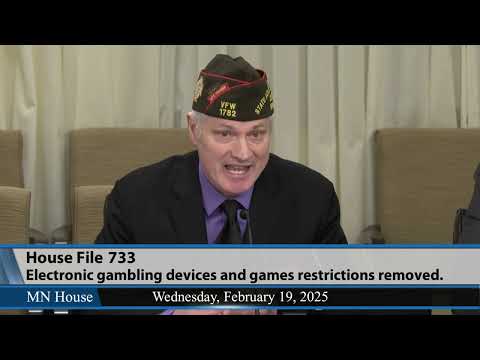
ST. PAUL, Minn. — After more than three hours of testimony, the House Veterans and Military Affairs Division on Feb. 19 re‑referred House File 733 to the Commerce Committee. The bill, presented by Vice Chair Olsen, would alter rules governing electronic pull‑tab (e‑tab or e‑pull tab) games, restoring game features that were limited by legislation in 2023.
Vice Chair Olsen said the bill seeks to “fix” restrictions adopted after 2023 changes and argued those restrictions have reduced revenue for charities that use charitable gambling to fund local programs. Several charity leaders and veterans organizations told the committee that e‑tab revenue fell sharply after the January implementation of the 2023 rules.
Rachel Jenner, executive director of Allied Charities of Minnesota, said the change has led to declines in participation and revenue and cited an example packet showing the Claremont Chamber of Commerce raising $232,000 a year through four charitable‑gambling sites. Jenner said the new rules removed features such as "open all, free play and bonus games," and that some charities reported revenue drops of 20% or more from December to January.
Tim Engstrom, gambling manager for Bloomington American Legion Post 550 and communications director for the American Legion Department of Minnesota, told the committee his post’s overall net receipts were down 29% year‑over‑year for January, and that e‑tab receipts were down 44%. He said posts continue to pay a 33% tax on net receipts and urged relief for charities.
Opponents included Jack Meeks, chairman of Citizens Against Gambling Expansion (CAGE), who testified the bill would allow “slot machine‑like gambling in almost 2,000 locations” and raise social harms and youth exposure. Andy Plato, executive director of the Minnesota Indian Gaming Association, urged the committee to oppose the bill, asserting that the 2023 clarifications corrected regulatory departures from the 2012 e‑tab statute and that tribes rely on slot revenue to fund tribal services.
Laura Wade, executive director of the Minnesota Gambling Control Board, told the committee the court and administrative rulings focused on the "open all" feature; she said the litigation and rulemaking history led to the 2023 legislative action.
Committee debate ranged from members urging bipartisan solutions to help veterans and charities to members warning about broken agreements with Minnesota tribes. Representative Ray Rower and others noted a lost court case and legislative response in 2023. Representative Hemmingson Yeager requested a roll call; the committee twice took recorded votes: an initial roll call on a motion to table failed (5 yes, 6 no), and a final roll call approved re‑referral to Commerce (6 ayes, 5 nays). The transcript records the final yes votes as Chair Bliss, Vice Chair Olsen, Representative Bennett, Representative Davis, Representative Duran and Representative Repinski; no votes were recorded for Representatives Clardy, Feist, Hemmingson Yeager, Hill and Ray Rauer.
Why it matters: Testimony presented conflicting claims about revenue and regulatory effects. Charities said the 2023 restrictions caused steep revenue declines; tribal representatives and some committee members said the 2023 clarifications were needed to honor the law’s limits and tribal‑state agreements and that relaxing them risks legal and treaty conflicts.
Next steps: House File 733 will be considered next in the Commerce Committee. Committee members and stakeholders said they intend to pursue bipartisan alternatives, including targeted tax relief and other measures to support charitable missions without reintroducing slot‑like features.