Get Full Government Meeting Transcripts, Videos, & Alerts Forever!
Get email alerts on the Reinsurance topic
No spam. Unsubscribe anytime.
Lawmakers weigh funding options as Minnesota reinsurance program nears expiration
Summary
The Minnesota House Commerce Committee heard testimony on proposals to fund the state's reinsurance program, which officials say stabilizes premiums for roughly 187,000 people on the individual market and faces expiration at the end of 2025 unless lawmakers act.
The Minnesota House Commerce Committee on Wednesday heard more than an hour of testimony on proposals to fund the state's reinsurance program, known as the Minnesota Premium Security Plan, which officials say could leave individual-market premiums 25% higher if funding lapses.
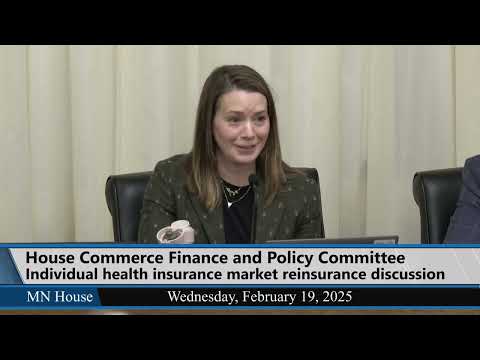
Deputy Commissioner of Insurance Julia Dreyer told the committee the program's reserves will be exhausted without legislative action and warned of broad effects if the program lapses. "Without action this year the premium security plan will be depleted and the Minnesotans on the individual market are at significant risk of a 25% or more premium increase on the individual market," Dreyer said.
The hearing reviewed the governor's funding proposal and alternatives. The governor's plan would create a roughly 2% assessment on health insurers, administered by the Minnesota Comprehensive Health Association (MCHA), to provide a stable state match that draws federal pass-through funds under the state's Section 1332 waiver. Dreyer said the assessment would apply broadly to carriers writing health products and that MCHA would continue to administer the reinsurance payments.
Why it matters: Minnesota's reinsurance program reimburses a portion of very large claims to lower premiums for everyone who buys coverage on the individual market. Commerce estimated about 187,000 Minnesotans get coverage through that market. Deputy Commissioner Dreyer said the state's program has helped reduce premiums on average by about 20% and that the state has received more than $650 million in federal pass-through funds to date.
How the program works: Testimony said the program reimburses a share of claims in a cost band (historically 80% of claims between $50,000 and $250,000; the coinsurance rate was reduced to 60% in 2022 for budget reasons). Health plans submit verified eligible claims to MCHA on a quarterly basis; payments to plans are typically made 12 to 18 months after the claim is paid, but the expectation of reinsurance is reflected in premium rates.
Positions and concerns: Trade groups representing insurers, employers and business owners urged continuation of reinsurance. Dan Andreessen of the Minnesota Council of Health Plans said the program is "one of the most audited programs in the state" and that "all reinsurance funds are being used to pay for medical claims for chronic conditions." Bentley Graves of the Minnesota Chamber of Commerce and Anne Newbrindley of the Minnesota Business Partnership said ending the program would raise premiums, reduce enrollment and threaten provider finances.
Opponents and cautions included the Minnesota Nurses Association and the advocacy group ISAIAH. Ben Baglio of the Minnesota Nurses Association urged lawmakers to fund any extension through fees on insurers rather than general-tax dollars and asked for stronger accountability requirements for carriers receiving public dollars. ISAIAH's Lars Nystad urged caution about the state's fiscal exposure, noting the state has spent "over a billion dollars" on reinsurance since 2017 and that a recent proposal carries an estimated $850 million price tag over three years.
Federal interaction and budget risks: Several witnesses and committee members flagged two looming federal changes that could amplify costs. American Rescue Plan Act (ARPA) enhanced premium tax credits that have been reducing out-of-pocket premiums for many individuals are set to expire at the end of 2025; separately, the state's draw of federal dollars under the Section 1332 waiver depends on a federal funding formula. Elyse Bailey, budget director for the Department of Human Services, told the committee that if the federal formula's "hold harmless" treatment were removed the state could face roughly $140 million in additional annual costs.
Other technical questions raised by committee members included why the program uses a $50,000 attachment point, how the attachment point and coinsurance levels were chosen, and whether alternative models'such as direct premium subsidies or different assessment bases'would be more transparent or sustainable. Dreyer and other witnesses said states design reinsurance differently; Minnesota is one of the few that uses general funds for the state share, while other states rely on insurer assessments, exchange fees, or other targeted revenue sources.
Next steps: Committee members said any reinsurance legislation will likely move to the House Ways and Means Committee and be packaged into broader budget negotiations later in the session. Chair O'Driscoll told members funding ultimately may be resolved in end-of-session bargaining and urged members to prepare for that timeline.
The committee did not take formal action at the hearing. Lawmakers and agency staff said they will supply additional technical estimates and that the committee will weigh design choices, funding sources and protections for MinnesotaCare as deliberations continue.