Get Full Government Meeting Transcripts, Videos, & Alerts Forever!
Get email alerts on the First Responder Mental Health topic
No spam. Unsubscribe anytime.
Minn. committee hears bill to expand equine therapy for first responders; bill laid over
Summary
Lawmakers heard testimony on House File 261, which would expand a pilot equine-assisted clinical therapy program for first responders. Supporters cited a 98% retention rate among participating first responders; the committee laid the bill over for possible further inclusion.
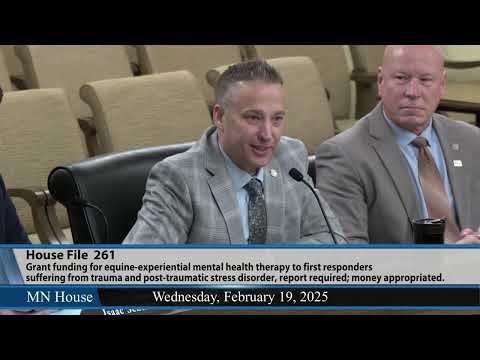
Representative Spencer Kosnick introduced House File 261 to the House Workforce, Labor, and Economic Development Finance and Policy Committee, asking members to consider expanding a pilot equine-assisted clinical therapy program for first responders.
Kosnick told the committee the measure “builds off of a pilot program that we did 2 years ago” and would extend eligibility to active and retired police officers, full-time and volunteer firefighters, ambulance service personnel, 911 communicators and correctional officers. He said the therapy targets “the unique traumas and significant traumas” first responders face and that reporting tied to the earlier pilot shows a 98 percent retention rate for participants remaining in their jobs.
Sally Mixon, founder of Abijah’s, testified about the program’s clinical approach and reach. Mixon said the program began serving first responders in earnest after moving activities to Canterbury Park in 2021 and later formed a nonprofit; she told the committee, “we have a 98 percent success rate.”
Lakeville Police Officer Nick Jacobson, a program participant, described combat-related trauma dating to his Marine Corps deployments and credited the equine therapy with helping him be “more present as a father, a husband, and just a general police officer.” Jacobson recounted an early comment from Mixon he said stayed with him: “you can always lie to us as therapists, but you can never lie to the horses.” He said the therapy reduced his urge to return to combat and helped his transition back to everyday life.
Members asked about how Abijah’s is funded and organized. A co‑founder and business-development representative told the committee Abijah’s originally registered as an LLC in 2021, used a fiscal sponsor while scaling up, and established its own 501(c)(3) in 2024; the organization expects to file its first Form 990 soon. Lawmakers also discussed whether the program overlaps or could coordinate with other first‑responder mental‑health efforts, such as Hometown Hero Outdoors; Mixon said the organizations could complement one another by exchanging referrals.
Representative Pete Johnson, a career firefighter, asked why program services are not billed to insurance. Mixon replied that many first responders decline traditional insurance‑based mental‑health care because formal diagnostic coding can follow an individual and affect their career; Abijah’s instead relies heavily on fundraising to remove access barriers. Danny Palmer (business/coordinator for Abijah’s) told the committee the program served 106 officers under a prior funding round and that 102 of those participants remain on active duty.
Committee members praised the testimony and encouraged colleagues to visit Canterbury Park to see the program. Chair Baker closed the discussion by saying House File 261 would be “laid over for possible further inclusion.”
Votes or formal committee action on the bill were not taken; the recorded committee outcome was the bill was laid over for possible further inclusion.