Get Full Government Meeting Transcripts, Videos, & Alerts Forever!
Get email alerts on the Long Term Care Pace topic
No spam. Unsubscribe anytime.
DHS outlines steps, questions for Minnesota PACE program; RFI to close this month
Summary
The Minnesota Department of Human Services presented a legislative report on implementing the Program of All‑Inclusive Care for the Elderly (PACE), describing federal requirements, state implementation choices, actuarial work and outstanding questions about provider interest, timelines, staffing and Medicaid mechanics.
The Minnesota Department of Human Services briefed the House Human Services Finance and Policy Committee on a legislative report about the Program of All‑Inclusive Care for the Elderly (PACE), a federally authorized model that integrates Medicare, Medicaid and long‑term services and supports for people aged 55 and older.
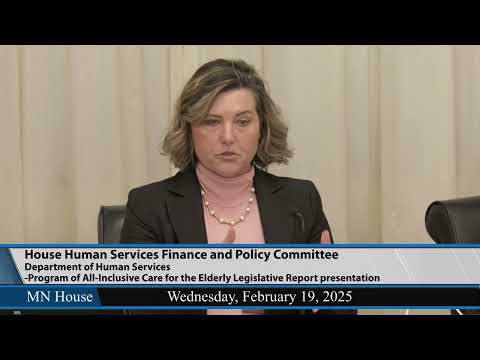
DHS Assistant Commissioner Natasha Merz told the committee that PACE “is a model of delivering home and community based services for people age 55 and older,” and said the program is intended to keep eligible participants in their communities through an interdisciplinary, coordinated approach that combines Medicare and Medicaid services. Merz said PACE enrollees must meet a nursing facility level of care and be able to live safely in the community at the time of enrollment.
The session emphasized that PACE is financed through a monthly capitation payment covering Medicare and Medicaid services, and that federal rules require the capitation rate to be no higher than the cost of care if the enrollee remained outside PACE. DHS noted Minnesota already operates integrated dual‑eligibles products, including Minnesota Senior Health Options (MSHO) for people 65 and older, and that PACE would differ principally by offering a site‑based, adult‑day‑center model and extending a fully integrated option to people aged 55–64.
DHS staff told lawmakers the department contracted with consultants for two pieces of work requested by the Legislature: an implementation analysis (Barry Dunn) and an actuarial report (Milliman). The department also issued a request for information (RFI) to gauge provider interest; staff said the RFI closes at the end of the month and DHS will summarize responses for the committee.
Committee members focused their questions on the program’s likely uptake, provider capacity, how quickly PACE could be stood up, staffing needs at DHS to oversee the program, the state/federal Medicaid match and differences between PACE and Minnesota’s existing integrated plans. Rachel Shands, Deputy Director of Aging and Adult Services at DHS, said DHS would likely need additional staff to implement and oversee PACE and ballparked 5–10 FTEs as an initial estimate for department staffing to stand up and manage the program.
DHS declined to give a single definitive estimate of net savings or the cost per enrollee without further actuarial and fiscal modeling, saying national experience shows costs for integrated dual models are often similar and that Minnesota’s existing MSHO program reduces the magnitude of additional statewide savings that PACE might produce. DHS said the fiscal‑note process and further actuarial work would be the appropriate vehicle to quantify state costs and federal match implications.
Members also raised operational concerns for Greater Minnesota, including transportation and availability of licensed clinicians (PT, OT, RNs). Merz and Shands said those are important implementation considerations and that capacity and geography of applying providers would shape enrollment and timelines. DHS cautioned that federal approval steps, a state plan amendment and readiness reviews by CMS and the state would be required before any PACE organization could begin serving enrollees.
DHS emphasized several outstanding decisions for Minnesota policymakers: whether to add state‑specific eligibility or program requirements beyond federal rules; how to preserve enrollee choice for people currently in MSHO; how to set capitation bands and acuity levels for rates; and how to treat private buy‑in options and long‑term care insurance. Shands said buy‑in/private‑pay options exist under the PACE model nationally but are rarely used, and that DHS would need to clarify how a buy‑in would be modeled in any Minnesota fiscal analysis.
The committee did not take action on PACE during the hearing. DHS staff said they will return with RFI summaries and more detailed fiscal scenarios if the committee pursues legislation.