Get Full Government Meeting Transcripts, Videos, & Alerts Forever!
Get email alerts on the Childcare Licensing topic
No spam. Unsubscribe anytime.
Parent—video prompts child-care licensing briefing as DHS outlines enforcement changes and draft rule revisions
Summary
A parent—whose child appears in a viral video of alleged mistreatment testified before the Minnesota House Children and Families Finance and Policy Committee as Department of Human Services officials described existing enforcement tools, program-integrity work and a multi-part licensing modernization project that will continue into 2026.
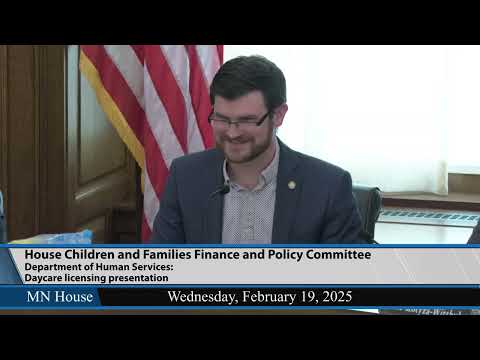
A parent whose son appears in a viral video of alleged mistreatment urged the Minnesota House Children and Families Finance and Policy Committee on Feb. 19 to press for "stricter oversight, stronger protections, and real consequences" for child-care providers, then Department of Human Services officials gave the committee a detailed briefing on licensing, enforcement and a multi-part rule modernization project.
Joshua Truax, a parent who said his son was filmed being "picked up, slammed ... aggressively pushed" and having toys forcibly taken during an incident at a Plymouth preschool, told the committee: "My son went viral 13 days ago because he was innocently drumming in the corner ... [he] was subjected to emotional abuse, physically manhandled." He called on lawmakers to "demand stricter oversight, stronger protections, and real consequences for those who fail our children."
Truax spoke immediately before the Department of Human Services presentation and said the testimony was meant to "frame" the committee's review of licensing standards, enforcement and program integrity. Committee leadership invited the parent to testify at the start of the DHS agenda item.
The context: The Department of Human Services (DHS) licensing division said it issues and monitors licenses for a broad set of programs serving children and vulnerable adults, including child-care centers and family child-care homes. "The baseline of what we do in licensing is to ensure that programs can meet a minimum level of health and safety standards, to ensure the well-being of children and vulnerable adults in care," said Alyssa Dodson, deputy inspector general for the Licensing Division, Office of Inspector General, DHS.
Why it matters: Committee members pressed DHS staff about how licensing and program-integrity tools protect children, whether parents are notified of maltreatment findings and what authority the state has to stop subsidy payments. Those concerns came against a backdrop of proposed rule changes, a federal requirement to post compliance items, and an ongoing transfer of some DHS licensing functions to a new Department of Children, Youth, and Families (DCYF) slated for June.
Key details and enforcement tools
DHS described its tiered enforcement framework and staffing that handle licensing inspections and complaint or maltreatment investigations. Dodson outlined a range of responses to noncompliance: - "Fix it" tickets (statutorily authorized correction items) that must be corrected within 48 hours for certain non-imminent violations; - Correction orders for violations that take longer to fix; - Monetary fines (statutory fines for maltreatment can be $1,000 or $5,000 depending on severity; family child-care providers are generally capped at $1,000 by statute); - Conditional licenses with required corrective terms and additional monitoring; and - Temporary immediate suspensions (used where an imminent risk cannot be mitigated) and license revocations.
Dodson told the committee that the division evaluates violations by "nature, severity and chronicity" and tailors actions accordingly. She said licensors conduct annual unannounced visits in compliance with the federal Child Care and Development Fund (CCDF) requirements and that DHS operates an "early and often" unit that visits new centers multiple times in their first year to provide technical assistance and identify issues early.
Program-integrity and CCAP investigations
DHS staff described the separate program-integrity unit that investigates potential fraud in the Child Care Assistance Program (CCAP). The presentation said the CCAP investigations team has four investigators with open caseloads and that, since 2020, the unit has recovered about $2.4 million. DHS reported that roughly 20% of program-integrity investigations indicate intentional or criminal fraud; the remainder involve administrative errors or billing issues. Since 2021 the agency has averaged about five law-enforcement referrals per year and has stopped payments to 79 providers.
On stopping subsidy payments: Dodson told the committee that licensing violations alone do not automatically trigger a stop payment. "There is not authority to just stop payment for those licensing violations ... Those are things that we would [stop payments for] if they are indicative of fraud," she said. Committee members asked DHS to provide additional detail in writing about how program-integrity investigators verify non-electronic attendance records and when payments are withheld.
Rule modernization, revised standards and public engagement
DHS outlined a multi-component modernization project that will affect both centers and family child-care providers. Components described by Dodson included: - A "weighted risk" or tiered framework to categorize standards by risk to children (low- to high-risk items), with lower-risk items eligible for documented technical assistance and higher-risk items triggering correction orders or sanctions; - "Abbreviated inspections," a shorter checklist for providers who meet predictive indicators of compliance, with a system that escalates to a full checklist if violations are found; - Revised licensing standards for family child care and centers; and - New interpretive guidance to promote consistent application.
Dodson said the first draft of revised standards was released in April 2024 and that a second draft was released Feb. 13, 2025 after extensive outreach, including more than 23 listening sessions and more than 1,600 survey responses. She said a third draft will be issued after the licensing functions transfer to DCYF in June and before the 2026 legislative session to allow additional stakeholder engagement.
Background studies and fingerprinting
Dawn Davis, deputy inspector general for the Background Studies Division, described the state's background-study process and federal requirements under the Child Care and Development Block Grant (CCDBG). She said DHS—conducted approximately 538,000 background-study applications in calendar year 2024; of those, 73,556 (about 14%) were for childcare providers. Davis said DHS has covered the application and fingerprinting costs for childcare study subjects since Oct. 4, 2018.
Davis also noted that disqualifying crimes and conduct are set out in Minnesota law (referenced in committee testimony as Minnesota Statutes chapter 245C.15) and include categories such as maltreatment, assault and certain sexual and violent offenses; some disqualifications are time-limited, others are permanent.
Numbers and administrative context
DHS told the committee that as of February 2025 there were 1,791 licensed child-care centers and 5,756 licensed family child-care providers in Minnesota. DHS said the state has seen a long-term decline in the number of programs (a national as well as state trend), and the agency reported work with Wilder Research and other partners to explore alternative models such as small centers, "umbrella" or shared-site family-care models and other approaches to build capacity.
Committee follow-up and next steps
Committee members asked written follow-up questions about program-integrity processes, county-delegated licensing consistency, stop-payment authority and details of background-study timelines and referrals to law enforcement. DHS staff said they would provide written responses and additional materials.
The committee approved its minutes for Feb. 18 at the start of the meeting; Vice Chair Hanson moved approval and the motion prevailed without recorded roll-call tallies.
The hearing combined parental testimony about an alleged abuse incident with an operational briefing from DHS; members repeatedly pressed DHS staff to provide more detail in writing on enforcement timelines, county-delegated processes and how CCAP investigations are escalated.
Dawn Davis and Alyssa Dodson told members the modernization work will continue through public sessions and additional drafts, and that some licensing functions move to the newly created DCYF in June. Both DHS speakers said they welcome continued input from providers and families as the agency refines draft rules and implementation plans.