Get Full Government Meeting Transcripts, Videos, & Alerts Forever!
Get email alerts on the Homelessness Oversight Structure topic
No spam. Unsubscribe anytime.
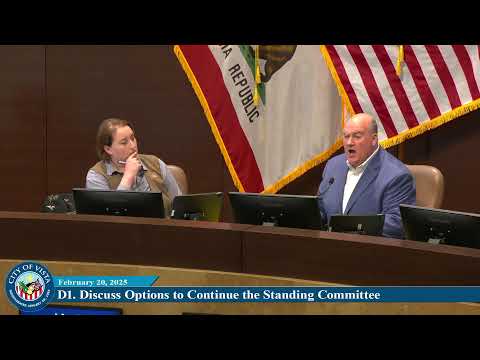
Vista committee debates whether to keep standing committee or create homelessness commission
Summary
City staff presented five organizational options for oversight of Vista’s homelessness strategic plan; councilmembers debated retaining the standing committee, forming a commission of appointed community members, or increasing council strategic-workshop frequency. No formal change was decided; minutes were approved unanimously.
City staff presented five organizational options to the Standing Committee on Homelessness on a proposal first directed by the City Council on Jan. 14, 2025, asking the committee to recommend an oversight structure for the city’s strategic plan to address homelessness.
“This item provides different organizational options for the standing committee on homelessness to consider and provide a recommendation to city council for adoption at a later date,” City staff member Jonathan said during the presentation. Staff noted the standing committee was created on Jan. 23, 2024, currently meets the third Thursday of each month at 8:30 a.m., and that meetings have been cancelled several months in 2024 and January 2025.
The options presented were: continue the standing committee in its current configuration; add appointed community members with voting authority; form a homelessness commission comprised entirely of appointed community members; consolidate the standing committee with quarterly strategic-plan workshops to allow fuller council attendance and formal actions; or retain only semiannual strategic-plan update workshops and bring intermediate items to regular council meetings. Staff also described venue and accessibility considerations: the Morris V. Vance Community Room now has a single camera with lower video quality than the City Council Chambers but can seat more than five committee members, while the chambers limit committee seating to five.
The committee’s chair recommended forming a homelessness commission of appointed community members while increasing the number and focus of council workshops to allow longer-term strategic planning. The chair said the commission should include philanthropic stakeholders and people with lived experience and that the working group of contracted service providers should be retained to execute the plan.
Mayor John Franklin strongly opposed forming a separate commission, saying the authority to set policy and approve spending belongs to elected councilmembers. “I don't see why this form that we're holding right now is insufficient,” Mayor Franklin said, adding that commissions can create extra workload for staff and that commissioners’ recommendations are often reversed by the council. Franklin also raised concerns about appointing people primarily because of lived experience without clear evidence of their decision-making qualifications.
Mayor Franklin cited several operational details and attendance patterns as reasons to retain council authority: he noted that the standing committee has had low external turnout at meetings, that the city funds 32 homeless service providers of which only a few were present at the meeting, and that incoming grant dollars will increase oversight responsibilities. He urged the city to keep a direct connection between council funding authority and the people who question service providers about performance.
Committee members asked staff to clarify differences among the options. Jonathan confirmed the distinction between option 1 (continue current standing committee) and option 5 (only semiannual workshops): option 5 would discontinue the standing committee, whereas current practice resembles a hybrid of options 1 and 5.
No formal change to the committee’s structure was adopted at the meeting. The committee did approve the minutes from the previous session; the motion was moved, seconded and “unanimously approved,” according to the record. Staff will return with additional information and options for the City Council to consider at a later date.
Partners from service organizations were in the room and committee members invited them to submit public comment or speaker slips at future meetings. Staff also reported results from a scheduling survey of strategic-plan partners that ranked preferred meeting start times as 10:30 a.m., then 5:30 p.m., then 8:30 a.m., then 2:30 p.m.