Get Full Government Meeting Transcripts, Videos, & Alerts Forever!
Get email alerts on the Local Government Investments topic
No spam. Unsubscribe anytime.
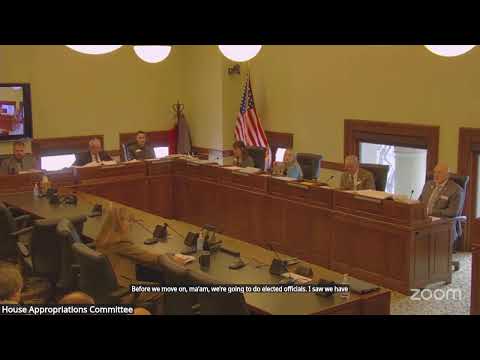
Committee hears proposal to let local governments invest in equities; WyoStar 3 and safeguards discussed
Summary
House Appropriations heard Senate File 145, which would authorize local governments to invest in equities subject to policies set by the State Loan and Investment Board. State Treasury staff, the CIO and several municipal leaders testified; the committee recessed before final action.
The House Appropriations Committee heard testimony on Senate File 145, a bill that would authorize political subdivisions to invest public funds in equities and require the State Loan and Investment Board (SLIB) to adopt investment policy statements and sideboards for those investments.
Why it matters: Backers said allowing local governments to allocate a portion of long‑term reserves to equities could increase returns for capital projects such as landfill closure and wastewater infrastructure. Treasury staff and the State Treasurer’s office emphasized safeguards — minimum holding periods, expense limits and SLIB oversight — intended to protect smaller local entities from excessive risk and fees.
The committee’s Majority Floor Leader introduced the bill, explaining it implements the 2022 constitutional amendment that allowed local governments to invest in equities. The sponsor said the measure authorizes political subdivisions to invest in equities while requiring compliance with investment policy statements adopted by the State Loan and Investment Board and makes clear that all risk remains with the investing entity.
Deputy State Treasurer Dawn Williams and Chief Investment Officer Patrick Fleming briefed the committee on how the Treasurer’s Office sees the proposal interacting with existing WyoStar pooled vehicles. Fleming said the treasurer’s office will implement WildStar 3 as a possible option for smaller entities that want a managed, indexed equity allocation. He explained the approach: indexing broad U.S. large‑cap exposure to keep costs low and noting why that matters for outcomes. “If you look at the majority of mutual fund managers, 80 percent of those managers do not beat the index,” Fleming said, arguing indexing reduces manager risk and fees.
Fleming described guardrails the office is considering for equity allocations, including minimum holding periods (he cited roughly a 5‑ to‑7‑year horizon as appropriate for equity exposure), minimum account sizes and limits on allowable instruments to avoid high‑risk or exotic allocations. He said the State Treasurer’s Office and SLIB would write rules and procedures to protect local entities and to define allowable investment vehicles and fees.
Local elected officials testified in support. Matt Murdock, mayor of Pinedale, said his town has long‑term funds tied to water and sewer infrastructure and long planning horizons; he argued a partial equity allocation could boost returns for a planned $20 million wastewater project. “Being able to take advantage of this fund and possibly increasing our return by 40 to 50% would be significant for the town of Pinedale,” Murdock said. Cheyenne Mayor Patrick Collins said his city already uses an investment committee and contracted managers and urged the committee to allow local discretion; he described using long‑term investment returns to reduce future ratepayer costs for landfill closure.
Committee members pressed treasury staff on operational details, how WyoStar 3 would differ from existing pooled options (WyoStar 1 and 2), and how to protect smaller jurisdictions from liquidity mismatch or high fees. Treasury staff said WyoStar 1 is a money‑market‑style short‑term vehicle, WyoStar 2 is a short‑term bond strategy, and WyoStar 3 is being designed to offer diversified equity exposure with rules intended to prevent inappropriate short‑term use.
The session included discussion of consumer‑protection features in the bill: SLIB would adopt investment policy statements, and the bill explicitly places investment risk with the local entity. The committee heard requests for flexibility so local governments could establish an advisory board or contract professional managers where local capacity was limited.
Public testimony continued with support from the Wyoming Association of Municipalities and county commissioners’ associations. Because of the volume of testimony and time, the committee recessed and planned to resume consideration after the lunch recess. No vote on Senate File 145 was recorded during this session.
What’s next: The committee scheduled additional testimony and deliberation after recess; if advanced, SLIB would be tasked with adopting implementing policies and the Treasurer’s Office would develop a WyoStar 3 vehicle and rules to implement protections discussed in committee.