Get Full Government Meeting Transcripts, Videos, & Alerts Forever!
Get email alerts on the Elections topic
No spam. Unsubscribe anytime.
Board hears technical briefing and public debate on ranked-choice voting
Summary
Loudoun County elections staff briefed the Board of Supervisors on how ranked‑choice voting would work in county contests, including equipment limits and likely operational impacts. Dozens of residents and representatives of Arlington, which has implemented the system, spoke for and against during public comment.
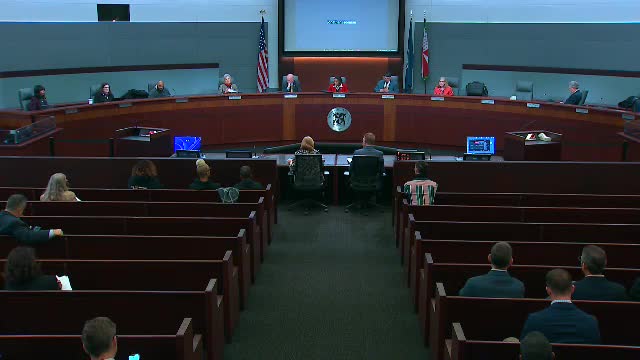
Loudoun County elections officials gave the Board of Supervisors a technical briefing Feb. 19 on ranked‑choice voting and the operational steps the county would have to take if the board chose to use it for future supervisor races.
The Office of Elections explained that, under current Virginia certification, the county's voting system can record and tabulate up to three ranked choices per voter; a later certified upgrade would allow five. Elections staff said rank processing could not begin until all ballots are tallied, including mail and provisional ballots, which would likely delay a final result by roughly a week after Election Day.
"If a candidate receives a majority, that candidate is declared the winner," said an elections presenter. "If no candidate receives a majority, the candidate with the fewest votes is eliminated and those ballots are redistributed by next choices until someone has more than 50 percent." The presentation also noted that the board must adopt an ordinance for each election in which it wants ranked choice used and that the current enabling law sunsets in 2031 unless the legislature renews it.
Elections staff outlined several operational concerns: likely need for two physical ballot cards in many Loudoun contests, additional printing and storage costs, increased processing time, the need for a specific voter education campaign at least 60 days before any election using ranked choice and the requirement that the board consult with the electoral board and registrar before moving forward.
Arlington County's Gretchen Rennermeyer, who advised the board by phone about Arlington's experience, said education was "a big lift" the first year but that voters adjusted. "By the general election it was basically a non‑issue," Rennermeyer said of Arlington's implementation. She added that Arlington saw broad voter comprehension after sustained outreach and that, in Arlington's recent use, ranked choice nominated and elected candidates who were women and people of color.
Public commenters were divided. Supporters said ranked choice can prevent the "spoiler" effect and encourage broader campaigning; opponents said the method is complex and can result in ballots that are not counted in final rounds. Some speakers said the system can disenfranchise voters whose ballots become exhausted during multi‑round transfers; others cited national examples where implementation problems delayed certification.
Board members asked about legal authority, the interaction with partisan primaries, and where the method could be used. Elections staff said the current state law permits only boards of supervisors to use ranked choice and that it would apply only to local supervisor races selected by ordinance. They noted that primaries run by the state would raise additional coordination issues and that, if the board adopted ranked choice, the county would have to decide by statutory deadlines (90 days before the relevant election) for each contest.
Supervisor Sainz, who requested the briefing, told colleagues the session was intended to give the public and board members a chance to inform themselves. "This will provide a high level overview about how rank choice voting works, and the technical and operational considerations related to implementation," he said during the introduction.
The briefing was informational only; the board did not vote on adopting ranked choice voting. Several supervisors said they wanted more time to weigh costs, legal questions and the scale of outreach required before considering an ordinance.
What's next: Elections staff said they could prepare a fiscal impact analysis, a voter‑education plan and draft ordinance language if the board chooses to proceed toward using ranked choice in a future election cycle.