Get Full Government Meeting Transcripts, Videos, & Alerts Forever!
Get email alerts on the Solar Panel Recycling topic
No spam. Unsubscribe anytime.
Committee approves bill requiring recycling of utility-scale solar panels, sets per-panel penalty
Summary
The Natural Resources & Environment Committee voted to pass House Bill 320, which requires owners/operators of solar power facilities to recycle photovoltaic panels at end of life and establishes a civil penalty intended to discourage landfill disposal.
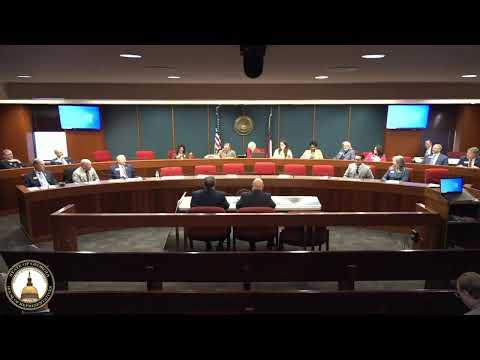
The Natural Resources & Environment Committee voted to pass House Bill 320 at a committee meeting, approving a measure that would require owners and operators of large solar power facilities to recycle photovoltaic panels at the end of their operational life and imposes a civil penalty for improper landfill disposal.
The bill, introduced by Representative Trey Kelly (LC 550508S), aims to keep decommissioned solar panels out of landfills and to encourage development of a local recycling market. "What this bill simply does is say for solar panels that exist in our solar power facilities, our large solar projects, when they reach the end of their life, we don't want them going in our landfills. We want them to be recycled," Kelly said during his presentation.
Kelly told the committee that Georgia currently has about 7,300 megawatts of solar capacity and that the state is expected to add roughly 3,600 megawatts in the next five years, reaching about 10,800 megawatts. He said one megawatt requires approximately 3,500 panels, which translates to an estimated 25 million panels currently in the state and roughly 38 million panels within five years. Kelly estimated that by 2050 the state could face the disposal of about 425,000 tons of panel material if recycling is not expanded.
The bill text places responsibility for disposal on the owner or operator of a solar power facility rather than on the landowner leasing property to a developer. "So it is clearly on the person who actually owns the solar power facility, not the landowner they may be leasing," Kelly said. He said the provision is designed to protect agricultural land and ensure leased farmland is returned to its prior condition when projects are decommissioned.
HB 320 establishes a civil penalty measured on a per-panel basis; the version presented to the committee sets that penalty at $20 per panel. Kelly said the figure was chosen so there would be no financial incentive to dump panels in landfills and that the sponsor is open to committee input on the amount. "You can recycle one of these panels for somewhere in the $10 range," he said. "We wanted to pick a penalty that wouldn't make financial sense for someone to risk the penalty."
Kelly and other presenters cited the emergence of a local recycling ecosystem — including manufacturers and recyclers in northwest Georgia — as an economic justification. He said the local industry could recover metal, glass and some rare minerals for reuse and reduce panel production costs.
After a short question-and-answer period on responsibility for removal and the penalty level, a committee member moved to pass the bill and the committee approved it by voice vote; the committee chair announced to Kelly, "you have your bill." The record before the committee shows the passage occurred by voice vote; no roll-call tally was recorded in the transcript.
No floor date or subsequent procedural steps were recorded in the committee discussion.
Representative Kelly closed his remarks by noting his appreciation for the committee's consideration. "This is my first time in 13 years getting to come before the Natural Resources & Environment Committee and I'll say it's a pleasure and an honor," he said.