Get Full Government Meeting Transcripts, Videos, & Alerts Forever!
Get email alerts on the Federal Politics Democracy topic
No spam. Unsubscribe anytime.
Rep. Joyce Beatty warns of 'constitutional crisis,' urges legal and civic pushback
Summary
At a Columbus Metropolitan Club forum, U.S. Rep. Joyce Beatty said recent White House firings and executive actions threaten democratic norms and urged litigation, legislation and constituent pressure to protect programs including Medicare, Social Security and federal agencies.
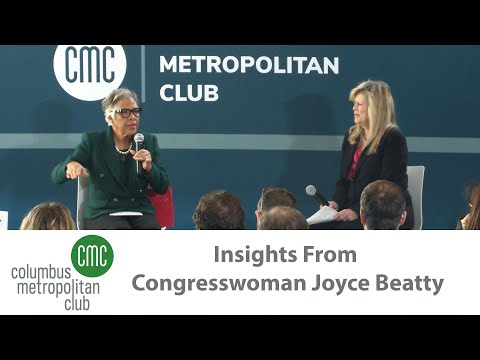
Rep. Joyce Beatty, U.S. representative for Ohio's Third Congressional District, told a Columbus Metropolitan Club audience that recent executive actions and firings amount to a threat to democratic norms and that voters must respond with legal and civic pressure.
Beatty spoke Wednesday at the Ellis in Columbus' Victorian Village about what she called a mounting constitutional crisis and the steps Democrats are taking through litigation, legislation and grassroots outreach. "If we don't speak up, write up, educate up, legislate up, litigate up, we're gonna go back in history," she said.
The congresswoman warned that recent executive orders and personnel moves at the federal level have real effects for Central Ohio residents. She cited broad agency actions the audience would recognize — including impacts on Medicare, Social Security, education and consumer protections — and said the consequences extend to local jobs and services. "It has effect on the number of people who will lose their jobs here," she said, adding that price increases and disruptions to everyday services are already being felt.
Beatty said Democrats are pursuing three tactics: communication to inform the public, litigation and legislation. She described recent litigation by multistate attorney generals and said Democratic members have drafted bills to block harmful moves; she also said impeachment and other remedies were "not off the table." She described an intensified public messaging effort, announcing a Democratic "strike team" on messaging formed by House leaders and a separate task force on legislation that pairs her with Rep. Sean Casten of Illinois.
She appealed directly for constituent action: calling, emailing and writing members of Congress and local officials to register opposition to policy changes. "You need to call those folks and call them out," Beatty said, urging listeners to contact both parties' offices and to use legacy and social media to sustain pressure.
Beatty gave specific examples she said illustrate stakes and progress: she told the audience she recently held a tele-town hall that drew about 24,000 online viewers and about 8,400 who stayed for most of the session, and she cited the Consumer Financial Protection Bureau(CFPB) findings of roughly $21,000,000,000 returned to consumers since the agency's inception. She also said there have been "90-some" executive orders and cited 34 indictments involving a former president as part of the broader context of political polarization.
On the fiscal front, Beatty warned that Congress faces a hard deadline to reach agreement on funding and the debt ceiling and said the House margin makes the outcome dependent on a small number of GOP defections. "We only need 3 Republicans," she said, adding that without bipartisan votes the government could face a shutdown and that such a disruption would affect federal workers, mortgage and loan markets and everyday commerce.
Beatty emphasized the role of litigation: she said attorney generals from multiple states have filed suits to unfreeze funds or block actions, and she described ongoing court victories in several cases. She urged continued legal challenges alongside public pressure.
Audience members asked about whether congressional remedies would be effective when Republicans control the House. Beatty responded that public pressure remains essential and that litigation and messaging are complementary strategies while Democrats work to win back legislative power in future elections.
The forum moved to audience questions after Beatty's remarks; she took questions on Ukraine, impeachment, how to contact elected officials and how people with disabilities can engage. She repeatedly urged attendees to contact members of Congress, state officials and local organizations to press for protection of federal programs and institutions.
Beatty closed by saying Democratic leaders and allied state attorneys general are actively litigating and legislating in response to the actions she criticized, and that ongoing public engagement will be crucial to outcomes affecting Central Ohio residents.