Get Full Government Meeting Transcripts, Videos, & Alerts Forever!
Get email alerts on the Budget Forecast topic
No spam. Unsubscribe anytime.
OCFO warns federal workforce changes and WMATA capital ‘cliff’ complicate revenue forecasting
Summary
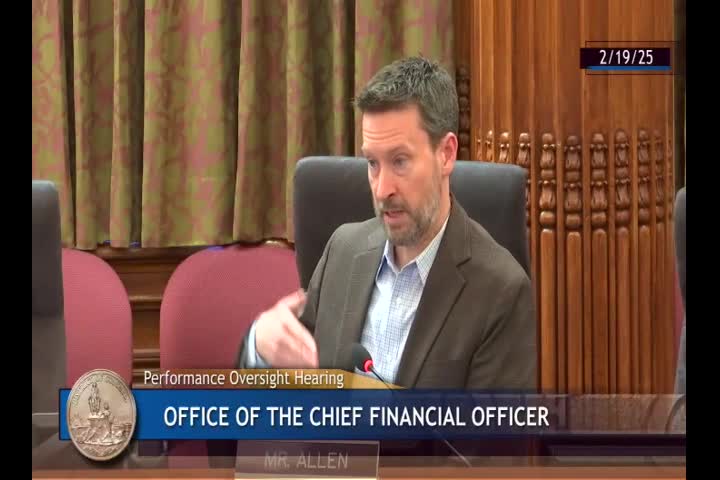
Committee members questioned OCFO about the fiscal impact of federal workforce reductions, unemployment claim trends and the long‑term capital funding gap facing WMATA. OCFO said forecasting is unusually difficult given rapid federal decisions and that WMATA’s capital financing faces a structural cliff in the late 2020s.
Councilmembers pressed OCFO officials about the near‑term revenue outlook for the District amid reported federal workforce reductions and the potential for rising unemployment claims. The office also discussed regional transit funding pressures tied to WMATA’s multi‑jurisdictional capital plan.
Forecasting uncertainty: OCFO officials told the committee that forecasting revenue and employment changes for the financial plan is unusually difficult. The CFO cautioned that the federal government accounts for roughly one‑quarter of District employment and that actions to reduce federal staff or shift headquarters or operations could reduce District revenue through direct and indirect channels. Chief Economist Fitzroy Lee said staff were tracking national and regional indicators and that the office uses an average compliance approach for property tax forecasts, but that predicting detailed job loss timing or agency‑level cuts is not possible absent granular agency information.
Unemployment claims and trust fund mechanics: OCFO said weekly unemployment claims had “ticked up somewhat,” and that federal workers who are laid off typically are treated under a separate federal reimbursement program so the District’s unemployment trust fund may be reimbursed for payments to federal workers; contractors and other private workers would make claims on the state trust fund. Committee members requested the most recent weekly claims figures and OCFO said it would provide them.
WMATA capital cliff: Committee discussion also focused on WMATA’s capital financing. OCFO staff said three jurisdictions (the District, Maryland and Virginia) have jointly funded $500 million per year to support capital borrowing that has allowed large near‑term capital work. OCFO warned that by about 2028 much of that $500 million will be committed to debt service on previously issued bonds, reducing the jurisdictions’ ability to fund future capital borrowing — a structural “capital cliff.” The CFO said the District and its partners need detailed, multi‑year capital plans from WMATA to understand year‑by‑year needs and the magnitude of the cliff.
WMATA operating funding: On the operating side, OCFO said the District’s FY26 financial plan had included a commitment to continue jurisdictional contributions and that the office’s planning baseline reflects continuing support; staff noted, however, that each year the three jurisdictions must decide how to respond to evolving WMATA needs and whether to fill remaining operating gaps.
Quote: “One of the most challenging that I’ve experienced in my career…is estimating our economic and revenue expectations for the next four years,” the CFO said, citing both federal employment changes and larger economic uncertainty.
Follow up: OCFO will provide the committee more detailed figures requested for weekly unemployment claims and targeted revenue forecast assumptions as the office completes its next quarterly forecast.