Lifetime Citizen Portal Access — AI Briefings, Alerts & Unlimited Follows
DC CFO highlights clean audit, DIFS stabilization and major fiscal outputs in FY24 oversight hearing
Loading...
Summary
Chief Financial Officer Lehi Lee told the Council’s Committee on Business and Economic Development that OCFO closed fiscal 2024 with a clean audit, has stabilized its new enterprise financial system (DIFS) in year two, and reported a list of operational metrics including tax returns processed, bond issuances and trust balances.
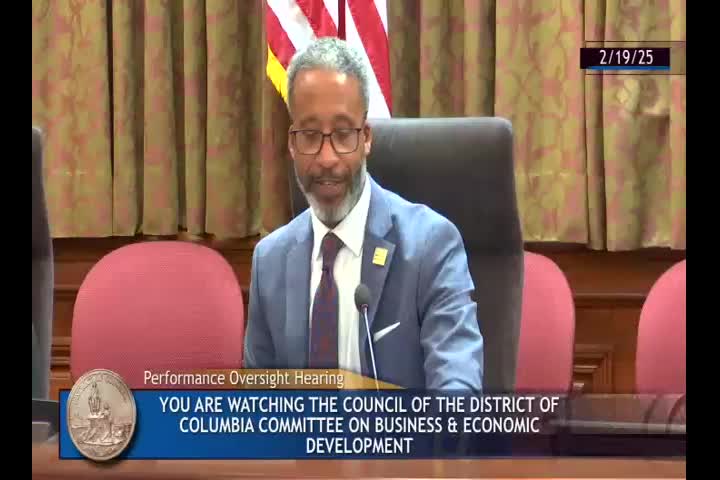
Lehi Lee, the District of Columbia’s Chief Financial Officer, told the Council’s Committee on Business and Economic Development on Feb. 19 that the Office of the Chief Financial Officer completed the fiscal year 2024 annual comprehensive financial report (ACFR) with “an unmodified or clean audit opinion and no yellow book findings.”
The clean audit came as OCFO continued second-year operations of the District’s enterprise financial system (DIFS), which the CFO described as the principal platform for most accounting and reporting; Lee said stabilizing the system was central to completing the audit on time.
Why it matters: The ACFR and audit opinion are foundational to the city’s fiscal transparency and its ability to borrow and manage capital. Lee emphasized that a stable core financial system and timely, auditable financial statements underpin credit ratings, capital planning and everyday agency operations.
OCFO metrics and accomplishments: Lee and his leadership team described a long list of fiscal-year outputs and system upgrades: - Tax administration: OCFO-oversight tax units processed almost 1.3 million tax returns, handled roughly 350,000 taxpayer calls and responded to more than 83,000 written tax inquiries. - Real property and transaction activity: OCFO recorded roughly 12,000–13,000 deeds and assessed about 2,008–2,010 properties in the reporting year. - Collections and debt: Delinquent-payment collections tied to tax and other obligations were reported between $275 million and $288 million; the office also collected roughly $48 million in receivables in one of the cited transaction lines. - Bond markets and trusts: OCFO reported issuing about $1.2 billion in general obligation bonds (with $726 million in new-money issuance), achieving refinancings with net present value savings of about $50 million, and managing roughly $12.5 billion in outstanding bond obligations. The office also manages several trusts with a combined value the CFO cited at about $7.3 billion. - Payroll and vendor payments: OCFO processed “over a million payroll payments,” issued roughly 45,000 1099s, and executed millions of wire and ACH transactions used to operate the government.
Systems and process work: Lee listed ongoing system and control priorities for FY25: - DIFS stabilization and an ad-hoc reporting tool to empower agency users to run self-service reports; - a budget formulation cloud module tied to DIFS to streamline budget development and integrate accounting data; - continued work to reconcile DIFS with the procurement system and to modernize procurement-related reconciliation processes; - redesign of the P‑card (purchase card) workflow to improve efficiency while preserving internal controls; - a cloud-based tax contact center (multimedia voice, email, chat and messaging) and a mobile assessor data-collection tool to boost taxpayer service and field efficiency.
Bond ratings and capital planning: Lee told the committee the District maintained strong bond ratings in FY24, noting general obligation ratings and a rise in income-tax-secured bond ratings to AAA from Moody’s during the year. He also described the capital planning tool CARS and said the office identifies about $15 billion in state‑of‑good‑repair needs, approximately $12 billion of which are addressed in the current capital improvement program (CIP).
Quote: “That we were able to successfully manage and account for the district’s resources, complete the financial audit, and prepare and timely issue the fiscal year 20 24 ACFR with an unmodified or clean audit opinion and no yellow book findings is a remarkable accomplishment,” Lee said.
Context and next steps: Lee emphasized that the tasks of consolidating and improving financial processes following a major enterprise system implementation are multi‑year efforts. He said OCFO’s priorities for the coming year are completing the budget module work, improving procurement-system integrations, expanding ad‑hoc reporting capabilities and progressing cloud-based taxpayer service options.
The CFO’s presentation was followed by committee questions on system performance, service levels and revenue forecasting; OCFO officials committed to follow-ups on some items requested by the committee.