Lifetime Citizen Portal Access — AI Briefings, Alerts & Unlimited Follows
CUC consultants recommend utility-scale solar, battery projects and RFPs as cheaper alternative to diesel
Loading...
Summary
Saipan — Consultants updating the Commonwealth Utilities Corporation’s Integrated Resource Plan told the CNMI Senate that utility-scale solar paired with battery storage would reduce long-term costs compared with continuing to rely primarily on aging diesel generators, and staff outlined near-term procurement and grid-improvement steps including requests for proposals for independent power providers.
Saipan — Consultants updating the Commonwealth Utilities Corporation’s Integrated Resource Plan told the CNMI Senate that utility-scale solar paired with battery storage would reduce long-term costs compared with continuing to rely primarily on aging diesel generators, and staff outlined near-term procurement and grid-improvement steps including requests for proposals for independent power providers.
The IRP presentation by Mr. Tenorio, a consultant with GHD, showed that under the firm’s techno-economic modeling large solar-plus-storage portfolios reduced projected net present-value losses versus a “business as usual” diesel scenario for Saipan, Tinian and Rota. Tenorio said, “the net present value, we're looking at, negative 86,000,000 with the solar,” while “business as usual with... diesel generators, we're looking at negative $202,000,000.”
Why it matters: CUC’s electricity rates are driven largely by fuel costs. Committee members were shown historic swings in the fuel-adjustment charge — the presentation noted a low of roughly 8¢ per kilowatt-hour in June 2020, a peak near 43¢ in June 2022, and about 23¢ in February 2025 — and were warned that replacing fuel with lower-cost solar energy and batteries can substantially reduce future exposure to oil-price volatility.
Key findings and near-term steps
GHD’s update recommended large-scale solar PV with battery energy storage as the preferred option for the three islands. The firm modeled specific target capacities to reach a 40% renewable penetration by 2030: Saipan — 60 megawatts (MW) solar and 48 MW battery energy storage (BES); Tinian — 8 MW solar and 3 MW BES; Rota — 3 MW solar and 2 MW BES. Tenorio also described SCADA and grid‑controller staffing and infrastructure needs, recommending fiber, wireless redundancy and a central control location to integrate solar and potential IPPs.
CUC executive director Kevin Watson told senators the utility is preparing procurement documents: staff plan to issue RFPs for renewable projects and an invitation for bids (IFB) for new diesel generation where required by law. Watson said, “The total estimated cost, is 700,000,000 for all 3 islands.” He described two financing pathways under consideration: (1) public‑private partnerships where a private developer finances, builds and operates projects under long‑term contracts; and (2) a U.S. Department of Energy line of credit to finance staged engine replacements and other capital needs (which would require legislative approval).
Project status and operational risks
- A 20 MW solar-plus-storage design intended to support an IPP procurement is about 40–50% complete; survey work is finished and design completion was scheduled for April 2025. The planned site near the airport (Ascono/Nafton area) has a CUC designation for one parcel and CUC is seeking designation from the Department of Public Lands for another site. The design is being prepared so the utility can solicit IPP bids for a 25‑year contract.
- Temporary leased generation (Greco) provides roughly 12 MW for Saipan; that lease expires in May 2025. Watson said CUC is preparing an IFB so the replacement capacity will be available when the lease ends.
- Several existing diesel engines are old and derated; recent overhaul work on a Rota engine resulted in a fire and left limited spare capacity. Watson reported one newly installed generator (8.3–8.7 MW) at power plant No. 1 was in commissioning and expected online soon.
Costs, grants and funding
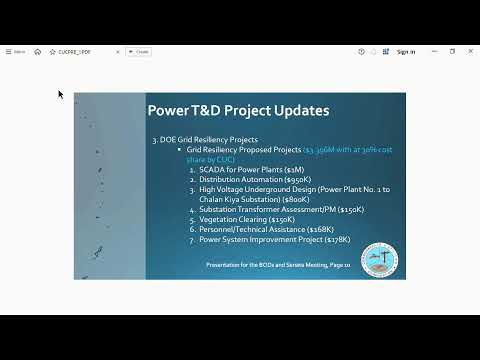
The presentation included high-level cost comparisons and NPV projections showing solar-plus-storage scenarios produce smaller cumulative losses than continued diesel reliance. Watson said the utility estimates roughly $700 million to implement the full recommended portfolio across the three islands, and noted an alternative phased diesel-replacement-only option at about $432 million. CUC reported a $3,396,000 Department of Energy grid‑resiliency award (with roughly a one‑third local match) and said the utility will submit project lists for that funding once DOE guidance is confirmed. Additional potential funding sources discussed included FEMA for anaerobic digestion feasibility at wastewater plants, CDBG for Tinian underground distribution to critical loads, and federal tax credits that have affected recent bid pricing.
Procurement and legal context
Watson and Tenorio explained that Public Law 17‑34 (which amends Public Law 16‑17) governs the procurement pathways available to CUC: renewable procurements require an RFP; new diesel generation is procured via an IFB, and some arrangements may be structured as public‑private assistance agreements. The utility is working with NREL to review draft procurement documents and expects to issue RFPs and IFBs within the coming months.
Questions and concerns from senators
Senators raised points about data vintage, siting, customer impacts and consumer education. Senator Castro asked whether the plan incorporated lessons from Guam and Hawaii and urged attention to distributed options such as rooftop solar and microgrids; Tenorio acknowledged those tradeoffs and noted Guam’s experience with combining utility-scale solar and batteries. Senator Frank Cruz and others pressed on the age of the source data (GHD used data through 2022, received in April 2023) and how updated 2023–2024 data might affect projections; Tenorio said the team had just received newer data and would review any impacts.
Board member Simon Sanchez, who addressed the committee as a CUC board member and drew on Guam’s experience, told senators utility-scale solar with batteries is feasible for the islands and can sharply cut fuel consumption and long‑term costs. “To the degree we can work together and find the right sites... utility scale solar will fit into here, and it will be a hedge against oil,” he said.
What did not change: no formal procurement awards or votes were taken during the hearing; the presentation and staff Q&A were informational. CUC staff described planned next steps — issuing procurement documents, completing the IRP update, holding additional stakeholder workshops, and developing SCADA and grid‑controller requirements — and asked the Legislature for any statutory or financial support necessary for lines of credit or loan agreements.
Ending note
CUC officials told the committee they will seek to structure procurements to limit near‑term rate impacts, work with federal technical partners to strengthen procurement documents, and return to the Legislature if a loan or other binding financial instrument requires approval. The committee scheduled follow‑up briefings and additional stakeholder outreach as CUC finalizes procurement documents and public comment on the draft IRP is planned.