Get Full Government Meeting Transcripts, Videos, & Alerts Forever!
Get email alerts on the Water Infrastructure Pipes topic
No spam. Unsubscribe anytime.
San Dieguito Water District receives asbestos-cement pipe risk assessment, plans phased replacements
Summary
Consultants recommended a dynamic risk model and prioritized replacements, identifying Faith & McKinnon and downtown Encinitas as early project areas; board received and filed the plan.
The San Dieguito Water District board received and filed an asbestos-cement (AC) pipeline condition assessment and replacement plan at its Feb. 19 meeting, following a technical presentation from district staff and consultants.
Principal Engineer Elmer Alex and consultants from Hope Consulting and HDR presented a risk-based, dynamic model that combines likelihood of failure and consequence of failure to prioritize AC pipe replacement over a 10-year capital improvement program. The district owns about 168 miles of water main; consultants estimated roughly 67% of that mileage is asbestos-cement pipe.
“AC pipe is commonly used as a pipe material from 1960 to 1990… Our district owns and operates approximately 168 miles of water main. Approximately 67% of that is constructed of AC pipe,” Alex said. Adam Hope of Hope Consulting described the project risk model as “dynamic,” meaning the district can update it as new sampling, break history, or operational data arrive.
Hope said the district’s main break rate is “just over 1 break per hundred miles of pipe operated per year,” a performance the consultants contrasted with other agencies in the study that average closer to 10 breaks per 100 miles per year. The analysis combined break history, physical sampling, soil data and operational history to assign project risk scores across pipeline segments.
The assessment identified two primary project areas recommended for early replacement: Faith and McKinnon (6- and 12-inch lines) and Downtown Encinitas (segments totaling more than 10,000 linear feet of 4-, 6-, and 12-inch pipe). The Faith and McKinnon segment showed two breaks within a 2.3-year span and sampling results that indicated more advanced deterioration relative to other sampled sections.
David Spencer of HDR described the primary deterioration mechanism as calcium leaching, driven largely by internal water chemistry and in some locations accelerated by higher groundwater or more “aggressive” soils. “As the calcium is leached from the pipe, you’re also losing cement and therefore strength within the pipe,” Spencer said.
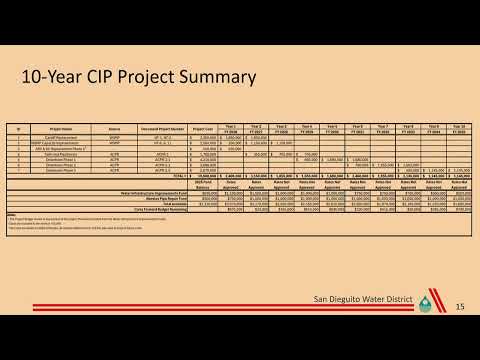
Staff outlined how the AC recommendations fit within the district’s broader 10-year CIP. The Cardiff replacement project (about 3,300 linear feet) is already in design; a water capacity improvements/upsizing project (about 2,400 linear feet) is scheduled to begin design in fiscal year 2026. The Faith and McKinnon project is planned for design in FY 2027 with construction in 2028–29; downtown Encinitas work is phased beginning in 2029. Cost estimates for later-year projects include an escalation factor; staff used a 3.6% inflation rate for out-year estimates.
Board members asked about seismic vulnerability, lifespan of replacement materials, model updates and funding. Consultants said they found no geotechnical soil conditions that singled out seismic or soil hazards as the primary cause of deterioration; instead, condition varied by segment and was influenced by internal pipe deterioration. Regarding replacement materials, staff noted PVC is the industry standard currently and has performed well over the past 40–50 years, though long-term life expectancy (e.g., 100+ years) is not yet quantified.
On funding, staff said near-term projects are largely included in the district’s rate planning and that the Water Infrastructure Improvement Fund and the district’s asbestos pipe repair fund are part of current financing. If replacement demand increases dramatically in the future, staff said other options — grants or bonds — could be considered. Staff recommended the board receive and file the condition assessment and replacement plan, and the board did so with no recorded objections.
District staff said they will continue sampling and will update the dynamic model as break data and new sampling results arrive to reassess priorities and inform future CIP decisions.