Get Full Government Meeting Transcripts, Videos, & Alerts Forever!
Get email alerts on the Microplastics Street Sweeping topic
No spam. Unsubscribe anytime.
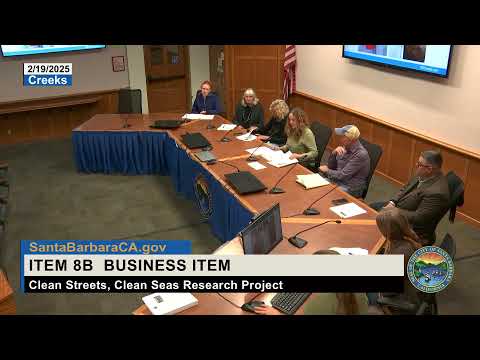
Creeks Division updates committee on 'Clean Streets, Clean Seas' microplastics study funded by NOAA Sea Grant
Summary
City staff and partners reported progress on a $1.2 million NOAA Sea Grant-funded study testing whether street sweeping and other interventions can reduce microplastic loads from urban runoff to creeks and the coast. Staff described sampling completed to date, laboratory methods and next steps.
Jill Murray, creeks supervisor for the City of Santa Barbara, updated the Creeks Advisory Committee on the city’s Clean Streets, Clean Seas research project, a NOAA National Sea Grant-funded study that aims to measure microplastic loads in urban runoff and test whether street sweeping and other practices can reduce those loads.
Murray said the project is a roughly $1.2 million grant shared among multiple partners and that Measure B contributed a $50,000 match for one contract. She named principal partners as the University of California, Santa Barbara (including Dr. Trish Holden’s laboratory and the Materials Research Laboratory), Cascade Water Resources, Southern California Coastal Water Research Project (SCCWRP), San Francisco Estuary Institute, the Moore Institute for Plastic Pollution Research, WSP and USC Sea Grant.
“Microplastics are less than 5 millimeters,” Murray said, and the project focuses largely on smaller fractions that are most environmentally mobile. The study has four primary objectives: (1) estimate how much microplastic enters creeks during storm events, (2) quantify how much microplastic street sweeping removes from street surfaces, (3) test street-sweeper performance in controlled street trials and (4) evaluate whether catch-basin trash capture devices remove or shred plastic.
What staff reported so far
- Year 1: contracts executed, sampling plans finalized and a simulated-rainfall flume study completed by partnering researchers (Southern California Coastal Water Research Project). That simulated-rainfall work suggested street sweeping may reduce microplastic in runoff in certain cases, staff said.
- Year 2 (under way): dry-weather and storm sampling completed at lower- and upper-watershed sites on Lower Mission Creek (sampling included pumping ~100 liters per sample and sieving/filtering), completion of three storm events of different magnitudes for the study’s load estimates, and ongoing laboratory analysis at UCSB including density separations, organic-matter digestion and spectroscopic analysis to characterize polymer types. Murray said the team purchased an OPTIR instrument for polymer analysis that now resides in UCSB’s Materials Research Laboratory.
- Methodology notes: staff explained they sampled at paired sites (upper and lower watershed) and will use the difference to estimate loads originating between those points; they also described efforts to minimize contamination (covered autosamplers, protected sieves) and to integrate samples vertically in the water column because different particle densities can stratify.
Next steps
Murray said the team plans a controlled, simulated street-sweeper trial (testing known quantities of mixed sediment and microplastic on a test surface and then measuring how much each sweeper type collects) and additional seasonal dry-weather sampling to capture temporal variation. Staff also said they completed storm sampling despite a potentially dry sampling window and that access to a new USGS stage gauge improved flow estimates at one sampling site.
Why it matters: recent studies cited by staff show impervious-surface runoff can dominate microplastic transport to receiving waters; the city said results could inform local street-sweeping practices, regional microplastic strategies and regulatory approaches, and could support improved protocols for measuring microplastics in stormwater.
Questions from the committee focused on sampling design and potential airborne emissions from sweepers; Murray said airborne transport is an important question and the city is exploring whether to add air monitoring to future tests in coordination with air-quality agencies and sweepers’ equipment-certification programs.
Ending
Staff asked the committee for continued interest as the multi-year study continues; the team expects further interim reports and a final synthesis once laboratory analysis and controlled trials are complete.