Get Full Government Meeting Transcripts, Videos, & Alerts Forever!
Get email alerts on the Zoning Village In The Park topic
No spam. Unsubscribe anytime.
Parkland approves 'Village in the Park' zoning district with limits on large retail and outdoor uses
Summary
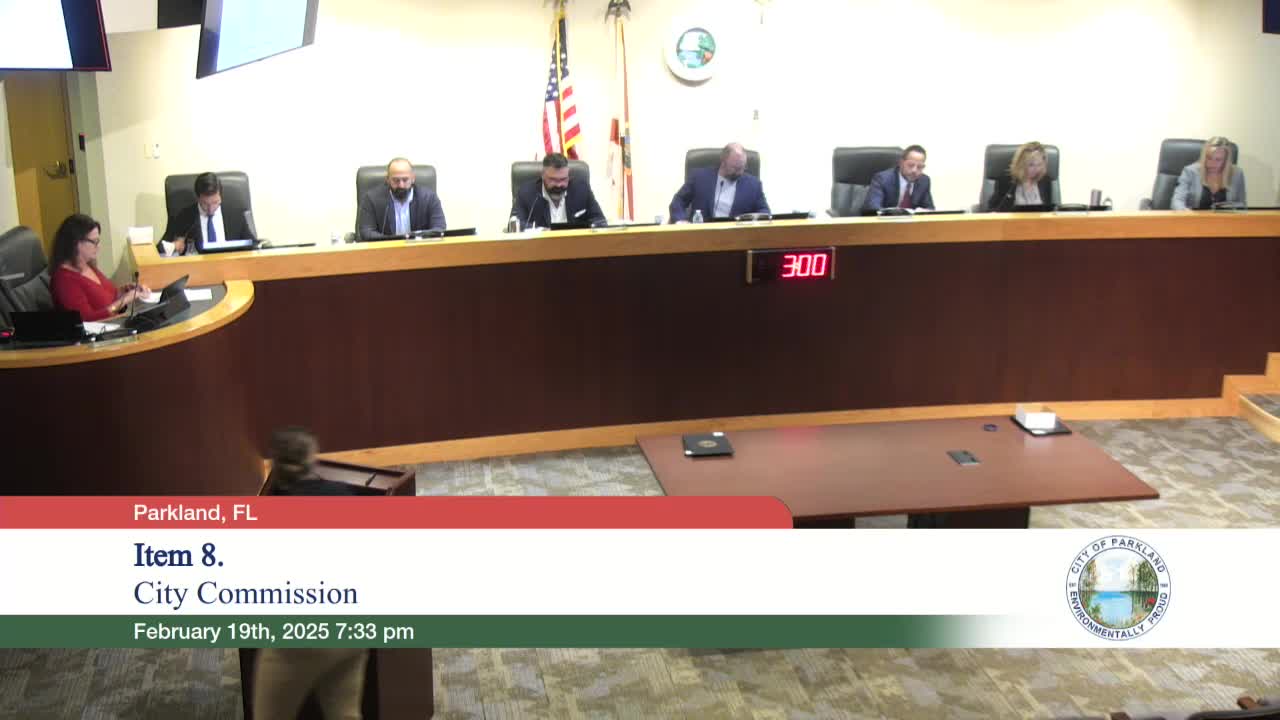
On Feb. 19 the City of Parkland Commission adopted Ordinance 2024-014 creating the Village in the Park zoning district and design guidelines, adding size limits and special‑exception requirements for certain grocery, entertainment and outdoor uses. The measure passed 4–1.
The City of Parkland Commission on Feb. 19 adopted Ordinance 2024-014, establishing a new Village in the Park zoning district and design guidelines for the cityby a 4to1 vote. Vice Mayor Israel moved to approve the ordinance with several additional options on size limits and special‑exception treatment for larger entertainment, grocery and training uses; Commissioner Kanterman seconded. Commissioner Murphy Salimoni voted no.
The ordinance amends the City of Parkland Land Development Code (Article 10) to create Division 85, a new mixed‑use commercial district that sets a use table, development standards and a number of guardrails intended to shape future developer proposals and the city—s upcoming request for proposals (RFP). Planning staff told the commission the changes reflect refinements made after the first reading and consultation with the project consultant and other reviewers.
Planning staff said the ordinance requires that "all uses [be] conducted entirely inside except for where there's expressly permitted being things like parking and loading, outdoor dining," and that the code now clarifies when outdoor activities are allowed. The final ordinance: limits big‑box retail, sets a 20% cap on floor area for any single tenant within the master plan site, and treats some larger or potentially higher‑impact uses as special exceptions rather than permitted by right.
Key features adopted include: - Grocery and food stores: grocery stores are permitted by right up to 25,000 square feet; specialty food stores were separated from general retail and limited in scope, with the code specifying that specialty food stores may sell wine for off‑site consumption but not liquor or beer for take‑home sales unless otherwise authorized. - Entertainment and amusement uses: a list of lower‑impact indoor amusement uses (arcades, bowling, rock climbing, etc.) are permitted by right; outdoor amusement uses are more restricted. Outdoor amusement and outdoor entertainment venues require a minimum 500‑foot separation from residentially zoned property unless an intervening county traffic way exists. - Indoor entertainment venues (comedy clubs, concert halls, movie theaters and the like) were approved with a square‑footage threshold included in the commission—s motion: venues up to 15,000 square feet permitted by right; larger indoor entertainment venues would require a special exception. - Alcohol: the ordinance allows alcoholic beverage establishments as accessory on‑site consumption uses in some cases, but maintains distance separations to schools, places of worship and childcare centers; on‑site consumption (served and consumed at the location) is treated differently from off‑premise retail sales. - Restaurants and retail: both full‑service and fast‑casual restaurants are permitted; drive‑through facilities are precluded. Retail establishments by right were limited in the motion to 10,000 square feet or less, with larger retail subject to special exception. - Other guardrails: event venues were limited by size in the use table (for example, indoor event venues less than or equal to 5,000 square feet), massage therapy remained a special exception, and a new tenant definition (separate lessee and/or business tax receipt) was added as direction.
Commissioners debated how prescriptive to make the new rules. Mayor Walker urged flexibility to attract high‑quality developers, saying the city should avoid "handcuffing" the project before developers present proposals. Several commissioners argued for retaining special‑exception review for larger anchors so the commission could require site‑specific conditions when a major use is proposed. Consultant John Ward, participating remotely, cautioned against being too restrictive and said the development agreement and RFP process also provide leverage to the city.
Vice Mayor Israel and other commissioners said permitting some uses by right at modest sizes could help market the project while reserving special‑exception review for larger or higher‑impact proposals. Planning staff told the commission the ordinance also includes design guidelines and a required development agreement associated with rezoning the city parcel to the new district.
The commission approved the ordinance with the added options described above; the record shows Vice Mayor Israel moved to approve and Commissioner Kanterman seconded. The ordinance will guide the RFP and the subsequent development‑agreement and rezoning steps in which the city will negotiate project details with the chosen developer.
Speakers quoted directly in this article appear in the speakers list below and spoke during the ordinance discussion and public meeting.