Get Full Government Meeting Transcripts, Videos, & Alerts Forever!
Get email alerts on the Ami Deployment topic
No spam. Unsubscribe anytime.
Austin Water says AMI rollout is nearly complete; portal estimates nearly 1.2 billion gallons saved by leak alerts
Summary
Austin Water reported Feb. 19 that its myATX advanced metering infrastructure deployment is 98.86% complete with 99.96% billable reads and that portal leak notifications are estimated to have saved about 1.199 billion gallons of water since 2021.
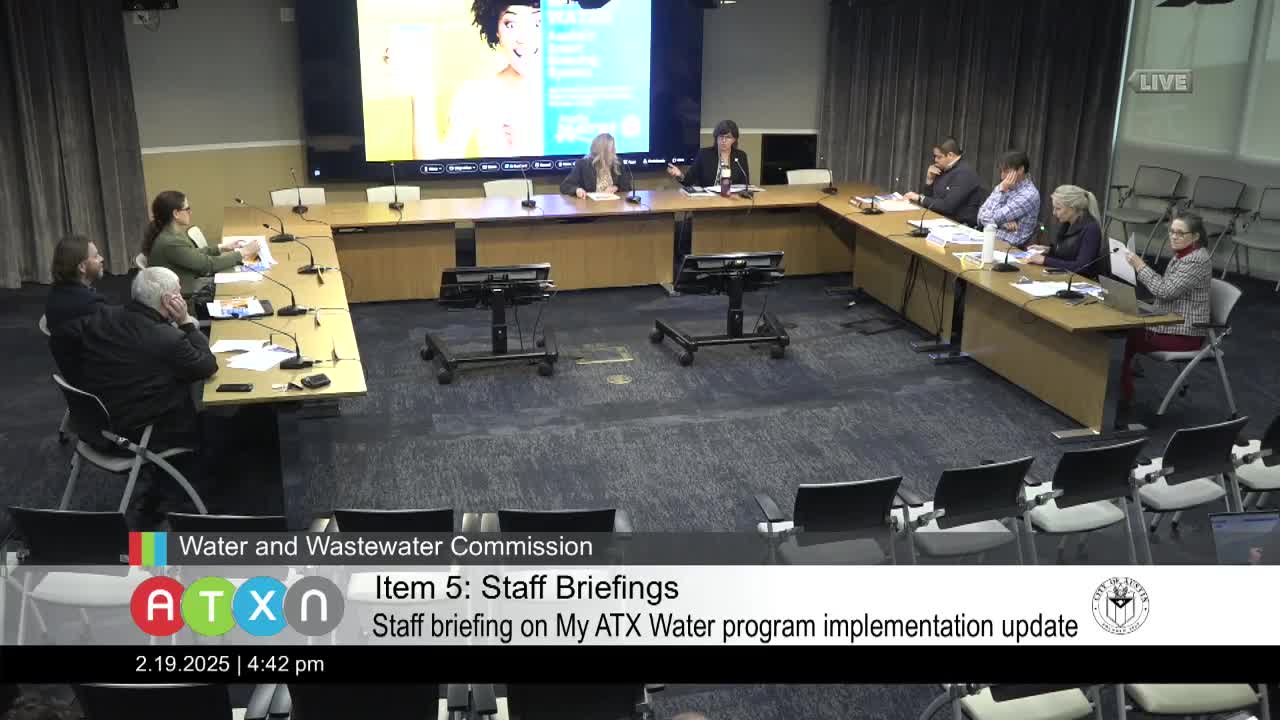
Randy Jenkins, assistant director of customer experience at Austin Water, told the Water and Wastewater Commission on Feb. 19 that the myATX advanced metering infrastructure (AMI) deployment is nearly finished and is already delivering customer and conservation benefits.
Jenkins said the utility has replaced roughly 258,957 meters systemwide, with 98.86% of the meter exchanges complete and an average of 99.96% billable reads being delivered to the billing system. He said all data collection units for the network are installed and operating, and that the system is configured so each meter can reach at least three data collectors to provide redundancy.
The customer portal and AMI communications have driven customer engagement, Jenkins said. He reported more than 5 million portal communications sent since deployment began, a portal recruitment open rate around 70% for install notices, and significant leak‑detection messaging: the portal has sent hundreds of thousands of continuous‑usage alerts and estimates customers and the utility together have saved about 1,199,000,000 gallons of water since 2021 through leak notifications and related actions.
Jenkins outlined the remaining work: just over 1,000 meter exchanges remain, including several hundred larger meters that are on backorder and slightly more than 500 small meters that require maintenance tasks before exchange. He said final work on obsolete fire‑demand meters will require a separate engineering and construction procurement.
Commissioners asked several operational questions, including how leak notifications are triggered and how many notifications are ultimately resolved. Jenkins said the threshold was adjusted during deployment to reduce false positives and that staff can provide the commission with the specific gallons‑per‑minute or continuous‑use criteria. He also described customer support processes, including a dedicated call center and a QA process that required two manual meter reads to validate AMI electronic reads before moving customers to meter‑to‑bill electronic reads.
Commissioners praised the conservation results and encouraged continued outreach. Jenkins said future work will focus on leveraging AMI for district‑metering, pressure monitoring and enhanced leak detection, and on integrating AMI data into conservation programs and operations.