Get Full Government Meeting Transcripts, Videos, & Alerts Forever!
Get email alerts on the Wildfire Risk topic
No spam. Unsubscribe anytime.
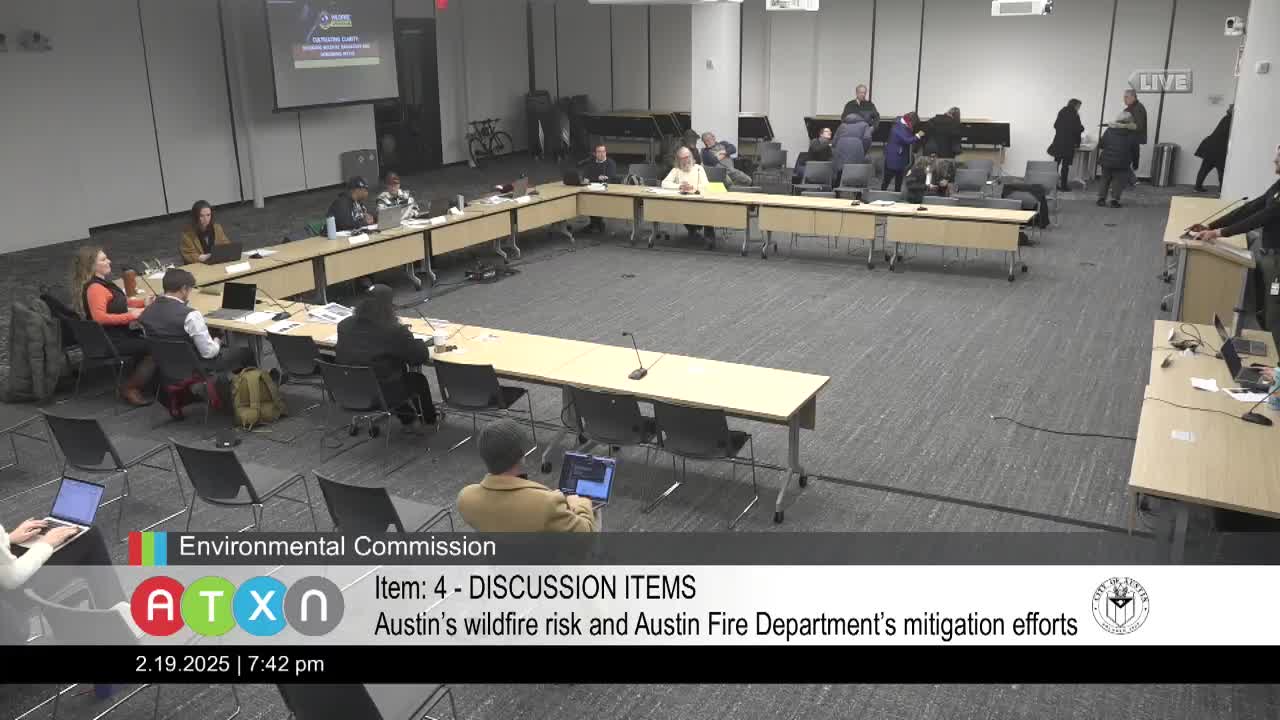
Austin Fire Department outlines wildfire risk, ember threat and prevention options at Environmental Commission meeting
Summary
Austin Fire Department wildfire division staff briefed the Environmental Commission on the city's wildfire exposure, ember-driven home ignitions and a three-pronged prevention strategy emphasizing home hardening, strategic fuel work and improved wildfire response.
Austin Fire Department wildfire staff told the Environmental Commission on Feb. 19 that Austin's configuration of wildland-urban interface (WUI) and the number of homes adjacent to wildland areas create a meaningful wildfire risk that requires a mix of landscape management, community preparedness and specialized firefighting capacity.
David Bach, wildfire division representative, said national risk summaries that rank Austin among high-exposure cities are driven largely by the number of homes near wildland fuels and by rising reconstruction costs. "No model is precise, but all models are very useful," he said, and added that in Austin the danger is typically not a single moving flame front but numerous ember-driven ignitions that can travel as far as 1.5 miles and, in his remarks, he cited the rule of thumb that roughly 90% of structure ignitions during wildfires are caused by embers rather than direct flame impingement.
Austin's wildfire mitigation approach follows a three-part national framework: fire-resilient landscapes (strategic fuel management), fire-adapted communities (home hardening and public awareness) and effective firefighting (trained personnel and apparatus). Bach described shaded fuel breaks ' narrow, strategically placed strips that reduce fire intensity as a wildfire approaches homes ' and said they are not the same as wholesale clear-cutting. He estimated the cost of constructing a shaded fuel break "in contractor terms" at about $50 per linear foot and said these projects must be prioritized because treating the full 650-mile braided interface around Austin would be logistically and financially infeasible.
Fire department staff also described current preparedness steps: a citywide effort to train fire personnel in wildland interface response (local training and outside deployments through Texas mutual aid), a wildfire battalion with brush-capable apparatus stationed around the city, and ongoing evacuation planning with county and regional partners. Staff said about 1,100 Austin firefighters had completed specialized response training (RTI response to interface) and that the department maintains a mix of 54 pumping apparatus and aerial units; city staff noted aerial units provide overhead command and support that is critical in large incidents.
Public commenters and commissioners raised questions about ecological trade-offs and long-term landscape health. Craig Naser of the Sierra Club supported home hardening but urged caution around large-scale understory removal and noted risks to soil stability and habitat if tree cover and understory are removed indiscriminately. Nico Howard, a South Austin Creek Alliance board member, cautioned that some shaded fuel-break implementation had been overbroad in practice and that grass invasion, pesticide use and erosion became problems in spots where heavy machinery removed vegetation.
Commissioners asked for follow-up materials. Staff said Austin adopted a WUI code in 2020 that applies to homes built in the designated WUI zones and that an updated WUI code (based on 2024 national model code language and including a 0-to-5-foot ember ignition zone around structures) has completed stakeholder review and is expected to be considered for adoption in the coming months. Staff said the update aims to clarify code language and strengthen measures that reduce ember ignition risks on and immediately adjacent to structures.
Why it matters: Austin's mix of dry seasons, expanding development in wildland-adjacent areas and a braided wildland-urban interface means the city faces repeated, localized wildfire threats. Department staff emphasized that prevention requires combining homeowner action, strategic landscape measures and emergency response capacity rather than relying on a single approach.
The commission did not take a formal vote on the wildfire briefing but requested follow-up on the WUI code update timeline and expressed interest in continued engagement on shaded fuel break best practices and incentives for home hardening.