Get email alerts on the Water Reuse Billing topic
No spam. Unsubscribe anytime.
Commission backs ordinance to allow engineered wastewater ‘flow factor’ billing for on‑site reuse systems
Summary
The commission recommended amending City Code Chapter 15‑9 to add a wastewater flow factor billing method for on‑site water reuse systems and to offer evaporative‑loss cooling‑tower customers the option to use flow‑factor calculations; the vote was unanimous.
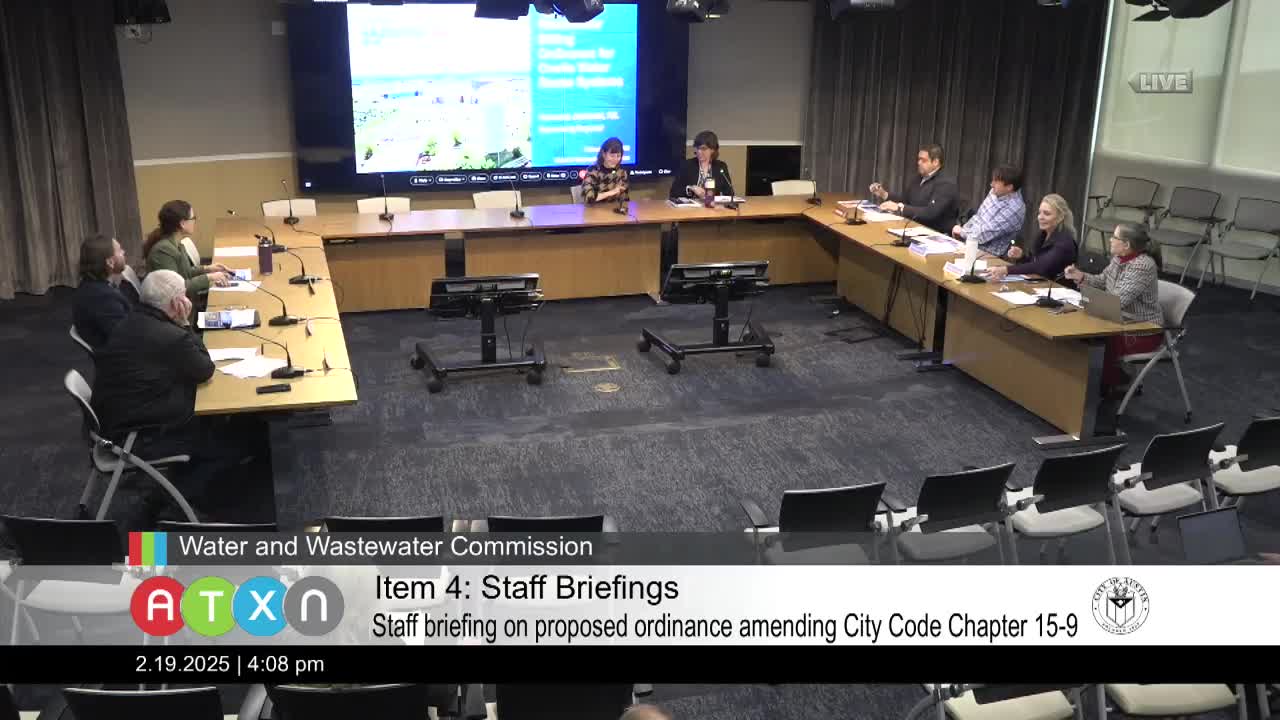
The City of Austin Water and Wastewater Commission on Feb. 19 voted unanimously to recommend approval of an ordinance amending City Code Chapter 15‑9 to authorize a wastewater flow factor billing method for customers with on‑site water reuse systems and to allow customers with evaporative losses from cooling towers the option to apply for flow‑factor billing at renewal.
Catherine Jasinski, supervising engineer on the reclaimed and reuse plan review team, told commissioners the change is intended to resolve a billing challenge created by on‑site reuse projects required under the Go Purple program. "The Go Purple program...includes code changes related to on‑site water reuse and reclaimed water connections for commercial and multifamily, new development projects," she said, describing the program’s goal of increasing reclaimed water use and extending drinking water supplies. Staff said incentives for some projects are funded by a community benefit charge adding $0.15 per 1,000 gallons to retail water bills to support reclaimed water system expansion.
Jasinski explained that because Austin does not meter wastewater directly, projects that capture rainwater, condensate or graywater and send it to toilets and irrigation complicate a simple gallon‑for‑gallon billing approach. Relying on extra private meters to capture wastewater from nonpotable systems creates extra hardware, maintenance and manual billing work. As an alternative, staff proposed allowing an engineered wastewater flow factor based on project water‑balance calculations submitted with permits.
Using the flow factor, wastewater billed to a customer equals the domestic meter read multiplied by an engineering‑calculated factor that represents the wastewater volume expected to reach the sewer collection system. Jasinski presented an illustrative example in which the domestic fixtures produced 25% of indoor water use while nonpotable toilet supply produced 75%, yielding a factor of 4 — meaning four gallons of wastewater per gallon read on the domestic meter.
Staff noted peer utilities have used engineered approaches: San Antonio Water System offers engineered calculations for commercial customers, and San Francisco planned a similar method but reverted to private meters because of billing‑system constraints. Austin staff said the city’s water‑balance calculator is reviewed by city engineers and validated with demand modeling.
The ordinance would add flow‑factor billing as a fifth wastewater billing method in Chapter 15‑9. For projects required by code as part of Go Purple (for example, large commercial or multifamily projects, or those with cooling towers and certain distance to reclaimed mains), staff said the flow‑factor method would be mandatory; for evaporative‑loss cooling‑tower customers, staff proposed an option to apply for the flow factor at their five‑year renewal using their accumulated meter data.
Commissioners asked about program safeguards and possible fraud. A city engineer who spoke during the meeting recommended project submittals be sealed by a licensed engineer to add accountability; staff said they will review submissions and look for inconsistencies, and that existing permit and plan‑review processes would detect outliers. Commissioners also discussed graywater scenarios and residential incentives; staff said the flow‑factor method can accommodate graywater and that the current proposal applies to commercial on‑site reuse systems, not a widespread residential wastewater credit, though commissioners suggested exploring incentives for residential graywater in the future.
Commissioner Maxwell Gaines moved to recommend the ordinance; Commissioner Marardi seconded. The commission recorded a unanimous vote to recommend approval. Staff said the ordinance carries no direct physical impact and that an affordability impact statement prepared for the ordinance was neutral.
AI generated
The text on this page is AI generated. Summaries, highlights, analysis, and video transcripts are all produced from the original source material.
AI can make mistakes, so if you spot one, and we will fix it for everyone.
Note: the source content is unaltered by us. Any content source we link to, be it a video, an audio recording, or a document, is presented exactly as its publisher released it. That publisher is usually a government body, sometimes an individual official or another organisation.