Get Full Government Meeting Transcripts, Videos, & Alerts Forever!
Get email alerts on the Parks Concessions topic
No spam. Unsubscribe anytime.
Environmental Commission approves concessions report’s environmental components, urges transparency and delays Phase 2 of Trail Conservancy agreement
Summary
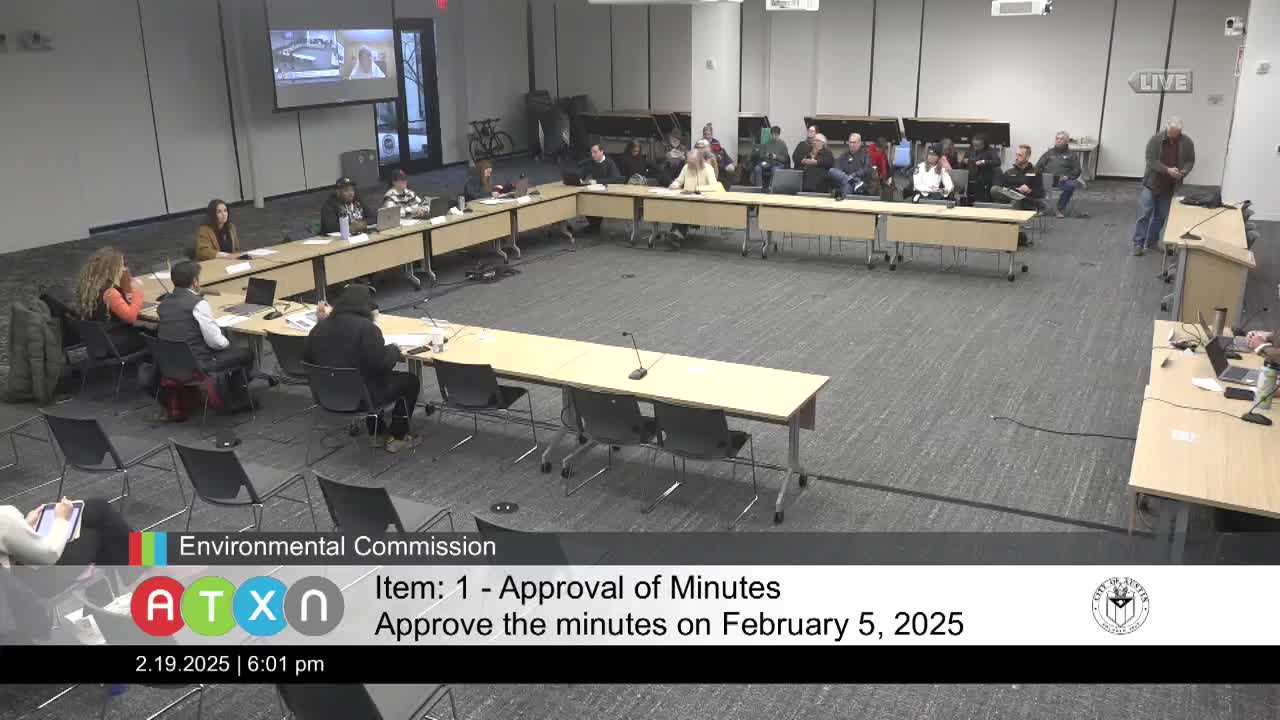
The Austin Environmental Commission on Feb. 19 approved the environmental components of the Parks and Recreation Department's 2024 annual concessions report for Town Lake (Lady Bird) Metropolitan Park, and issued several recommendations asking City Council to expand oversight, require greater public reporting and delay implementation of Phase 2 of the park operations and maintenance agreement with the Trails Conservancy.
The Austin Environmental Commission on Feb. 19 approved the environmental components of the Parks and Recreation Department's 2024 annual concessions report for Town Lake (Lady Bird) Metropolitan Park, and issued several recommendations asking City Council to expand oversight, require greater public reporting and delay implementation of Phase 2 of the park operations and maintenance agreement with the Trails Conservancy.
The commission voted to approve the environmental parts of the report while noting the report met the narrow requirements of City Code Sec. 8-1-73 but lacked information the commission said is needed for fuller public and environmental review. Commissioner John Breimer moved the main motion; it passed 8-1 with Breimer dissenting. The motion asked Council to pursue a code amendment requiring concession reports for parks beyond Lady Bird Lake, to create a citizen advisory committee on concessions, and to require clearer reporting on concession revenues and environmental work.
The action follows extended public comment from concession operators, neighborhood leaders and conservation groups who said the Parks Department's report did not make clear how concessions'revenues will be spent if managed by noncity partners. Holly Reed, a member of the Parks and Recreation Board and its Contracts and Concessions Committee, told commissioners: "Please do not approve this annual concessions report." Reed said the Trails Conservancy's Phase 2 of a Park Operations and Maintenance Agreement (POMA) would allow the nonprofit to manage and take revenue from multiple Lady Bird Lake boating concessions and that the 2024 report understates the reach of Phase 2. Reed cited a figure in the report showing total concession revenue of $1,002,009 in 2024 and said she was concerned those funds would not remain visible in city financial reporting if collected and spent by third-party nonprofits.
Concession operators and longtime vendors also spoke. Dorothy Barnett, representing Zilker Park Boat Rentals, said her family business of 56 years would face loss of local control and threatened business continuity if concessions were shifted to a nonprofit manager: "This transfer is all but a done deal in phase 2 of the POMA that gives them authority to manage all watercraft concessions. Think of that. How do you just take someone's business, the sweat and labor for over 56 years, and transfer it to someone else?" Laura Massengale, who identified herself with Zilker Park Boat Rentals, emphasized the business's volunteer work and that operators routinely repair flood damage at their own expense.
Other public commenters pressed the commission to withhold full approval until more financial and environmental detail is provided. Ricardo Shavana, who said he has a background in international finance, raised questions about the Expedition School concession and about nonprofits'reported finances, saying the Expedition School's nonprofit filings showed revenues under $50,000 while it claims to operate or control assets the public value at much higher levels.
Parks staff and the department's director, Jesus Aguirre, told the commission the Trails Conservancy must supply financial and reporting documentation required by the city when it manages assigned concessions, and that the POMA includes annual implementation documents (AIDs) that list operations, maintenance and programming activities. Staff said AIDs are reviewed by multiple city departments and that the Trails Conservancy reported more than $3 million in direct costs for operations, maintenance and programming in the most recent AID; staff said volunteer stewardship value is additional. Staff also reiterated that when a concession contract is assigned to the Trails Conservancy, the city continues to require the same reporting and audits that would be required of a private concessionaire.
Commissioners voiced several recurring concerns: (1) inconsistent environmental and financial reporting requirements across concession contracts; (2) lack of clear, publicly accessible documentation about how revenues collected by third-party managers will be spent; (3) whether the Trails Conservancy's POMA grants managerial control too quickly without demonstrated capacity; and (4) potential conflicts when former city staff move to partner organizations. Commissioner Kevin Sullivan, referring to the city code language, asked staff whether the report included the specific items required by City Code Sec. 8-1-73 (names of concessions, income/expenditure statements, total watercraft rentals and a statement of problems caused by a concession). Staff said the report included the items required by code and that minor corrective actions reported to staff (for example signage corrections) were not listed as "major problems" in the annual report.
The commission adopted several recommendations to send to City Council and the Parks and Recreation Board, including: asking Council to amend City Code Sec. 8-1-73 so concession reporting covers parks beyond Lady Bird Lake and requires an environmental impact assessment for concessions; creating a citizen advisory committee to oversee concessions across city parks and public lands; and delaying implementation of Phase 2 of the Trails Conservancy POMA pending an environmental review of Phase 2 impacts and a financial review of the Trails Conservancy's capacity to meet environmental commitments. Commissioner Breimer proposed a second recommendation to delay renewal of the Expedition School contract until the commission could review environmental impacts of potential new locations; that second recommendation did not receive a second and was not adopted.
Why it matters: many public commenters and several commissioners said that shifting management and revenues from city-run concessions to nonprofit partners changes how park revenues are tracked and raises accountability and equity questions. The commission's formal recommendations now go to City Council and the Parks and Recreation Board for consideration.
The commission paired its approval of the environmental components of the 2024 concessions report with a series of new requests to staff and Council intended to increase transparency and oversight; commissioners said they will reconsider the 2025 report if it does not reflect the requested additions and expanded environmental focus.