Get Full Government Meeting Transcripts, Videos, & Alerts Forever!
Get email alerts on the Human Services topic
No spam. Unsubscribe anytime.
San Antonio prepares $24.8M human services RFP; council debates minimum awards, crisis-nursery set-aside and outreach
Summary
City staff proposed issuing a biannual consolidated funding solicitation covering roughly $24.8 million for delegate agencies; councilmembers pushed back on raising the minimum award, sought more community engagement and debated a proposed set-aside for a crisis nursery and whether to protect designated homelessness funding.
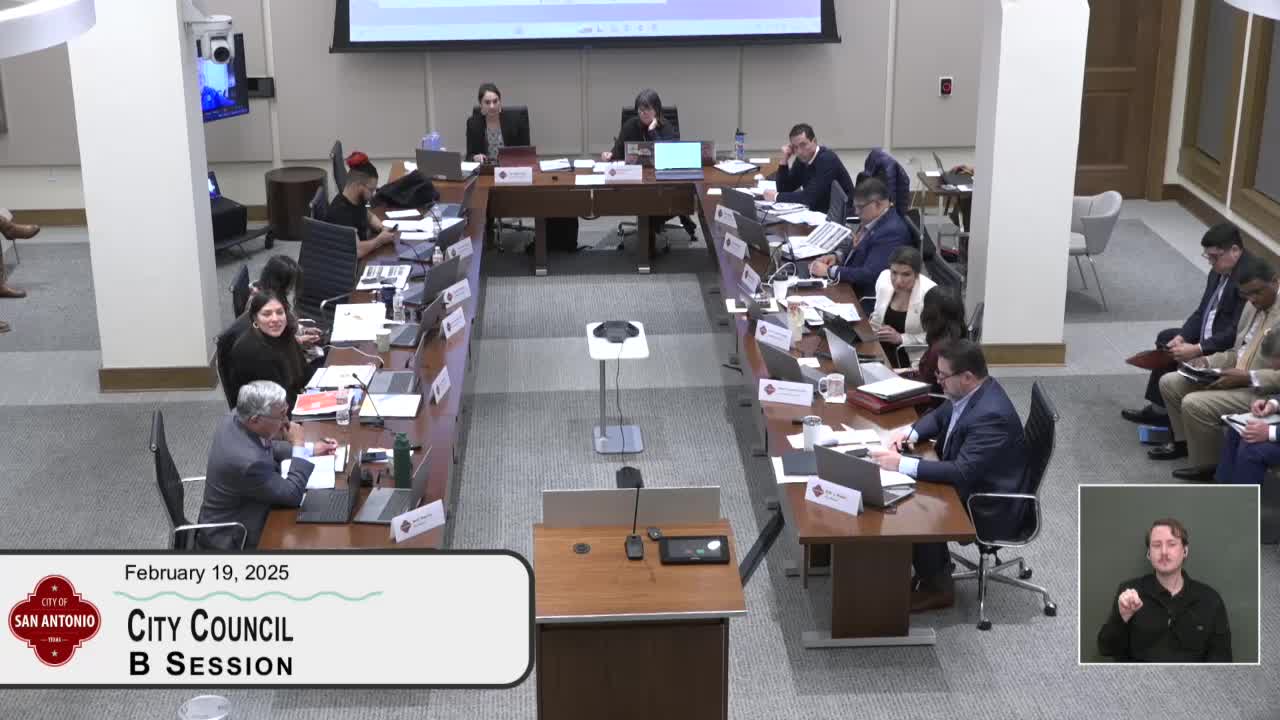
City staff told the City Council on Tuesday they plan to issue a biannual consolidated funding solicitation for human-services delegate agencies with an estimated two-year contract value tied to roughly $24.81 million in FY25 baseline funding. The Human Services Department asked the council for input on several policy options, including a proposed $100,000 annual minimum award, a possible crisis-nursery set-aside and continuing designated funding for homelessness and youth programs.
Jessica (Department of Human Services) said the consolidated funding process — first implemented in 2005 — distributes competitive and designated awards to nonprofit partners that provide social services aligned with city priorities. The FY25 adopted budget included about $25 million for the process, which funded 52 agencies across 83 programs; staff estimate the FY26/FY27 cycle will reach more than 60,000 residents.
Key policy proposals facing council input included: whether to keep existing funding priorities, whether to continue about $9.7 million of designated funding for youth and homelessness (including the Haven for Hope campus and Center for Health Care Services), whether to raise the minimum annual award from $50,000 to $100,000 and whether to set aside funds (proposed as a separate solicitation) for a crisis nursery if the feasibility study to be awarded in March supports that model.
Jessica described a schedule staff proposed for the RFP: release on March 3, a 45-day application window closing April 18, pre-submittal and technical-assistance sessions March 17–20, evaluation and scoring in May–June, and recommendations included in the city manager’s proposed FY26 budget in August. The department recommended two-year contract terms that would be renewable based on performance and funding availability.
Councilmembers expressed broad support for the consolidated funding process but a sharp divide emerged on the proposed increase to the minimum award. Several councilmembers and nonprofit representatives urged caution. Councilmember McKee Rodriguez and others said smaller neighborhood nonprofits sometimes rely on city grants in the $25,000–$50,000 range and warned that raising the floor without increasing the overall pool would shrink the number of funded organizations.
“What we heard from organizations … is it is so time consuming to fill out metrics,” said Councilmember McKee Rodriguez summarizing nonprofit feedback; councilmembers repeatedly asked staff to reduce duplicative reporting and to align city metrics with major funders such as United Way to ease administrative burdens.
Other councilmembers argued the city should prioritize maintaining funding levels for high-demand services. Councilmember White proposed reallocating some of the consolidated funding to public safety—saying he would like to “cut this $24,810,000 budget, by a quarter” to accelerate hiring officers—drawing objections from colleagues who said social-services investments are crime prevention and core to the city’s safety net.
Staff previewed several process improvements intended to reduce nonprofit burdens and strengthen oversight: standardizing and reducing the number of performance metrics reported, using risk assessments to tailor monitoring frequency, providing earlier notice of monitoring visits, and including lived-experience evaluators on scoring panels.
Jessica also asked for council input on two procedural options carried over from prior cycles: holding applicant input sessions (so applicants may address council before awards are adopted) and an abbreviated non-communication period for council members. Several councilmembers asked for additional briefings and suggested delaying the RFP release by a week or two to enlarge outreach and allow more small organizations to prepare applications.
On homelessness, Jessica noted that the proposed FY26 baseline assumes roughly $24.81 million in total funding (about $20.4 million general fund and $4.4 million in grants). The department recommended keeping $9.7 million in designated support for youth and homelessness — a line that includes $5.13 million for Haven for Hope campus operations and $1.96 million for Center for Health Care Services operations. Councilmembers said they wanted one more discussion on the homelessness report and the Haven for Hope operations before locking in designated amounts.
The department will finalize the RFP after council input, hold pre-submittal conferences March 17 and technical assistance March 18–20, close applications April 18, score in May–June and include recommendations in the manager’s proposed budget in August. Jessica also said a crisis-nursery feasibility study will come to council in March and, if supported, a separate solicitation for that program would be issued after the study is complete.