Get Full Government Meeting Transcripts, Videos, & Alerts Forever!
Get email alerts on the Public Safety topic
No spam. Unsubscribe anytime.
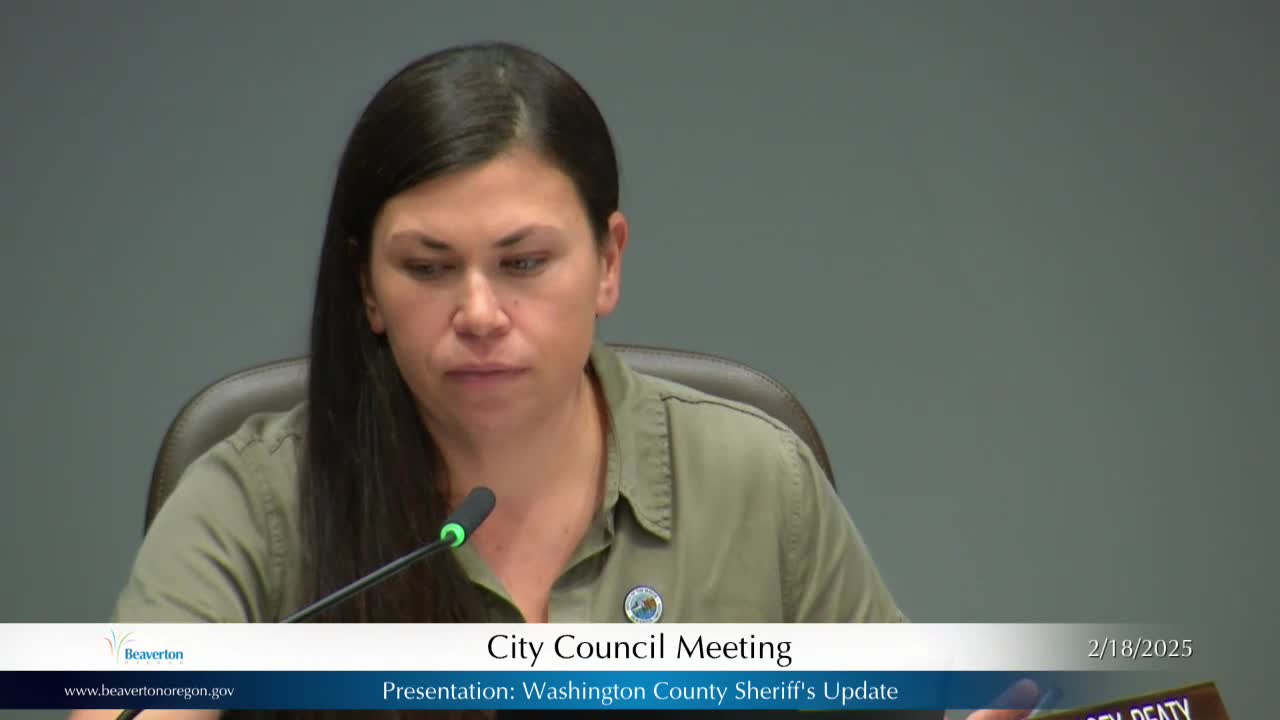
Washington County sheriff briefs Beaverton council on jail staffing, infrastructure repairs and a November public‑safety levy
Summary
Washington County Sheriff Caprice Massey described jail capacity constraints, infrastructure repairs, expanded mental‑health response teams and plans for a jail‑capacity study and a public safety local option levy on the November ballot.
Washington County Sheriff Caprice Massey and Undersheriff John Cook gave the Beaverton City Council an update on the sheriff's office, detailing staffing changes, infrastructure repairs to the county jail and countywide public‑safety initiatives.
"Wherever you live, we serve you," Sheriff Massey said, opening her overview of county services, which cover the county jail, court security, search and rescue and municipal contract policing for several small cities. She noted the sheriff's office provides the only county jail in Washington County, serving roughly 616,000 residents.
Massey outlined the jail situation: the facility, built in 1998, currently has three housing units closed for reasons including reduced staffing after the COVID period and ongoing major infrastructure repairs. "We currently have 388 available beds," she said, noting the county is undertaking roof replacement, HVAC and water‑piping work and fire‑alarm upgrades; those repairs are scheduled to continue through mid‑2026. To allow phased construction, the sheriff said two housing units will remain closed at a time while work proceeds.
Staffing and recruitment improved over the past year, Massey said: the county has about 21 jail deputies in training and the Beaverton Police Department has been an active partner in moving recruits into appropriate roles. The sheriff also said the jail is building an additional courtroom within the law enforcement center to house a newly assigned county judge, temporary measures that have displaced some staff offices.
Undersheriff John Cook described interagency response teams, including a mental‑health response team that pairs deputies or officers with clinicians (now eight teams countywide), a Westside Interagency Narcotics Team focused on large narcotics trafficking cases, and a tactical group (SWAT, negotiators, remotely operated vehicles) that deploys frequently. Cook said the county has seen large seizures of fentanyl and methamphetamine and highlighted the widespread carriage of naloxone (Narcan) by officers as a life‑saving measure.
Looking ahead, the sheriff's office has contracted a vendor for a jail‑capacity study to assess future bed needs through 2055 and is preparing for a public safety local option levy to appear on the November ballot. Massey said the levy would support countywide criminal justice services, including the DA's office, juvenile services, community corrections, the jail and sheriff's patrols.
Council members asked whether the capacity study accounts for court space and building condition; Massey said the study will consider those needs and that the county board has supported immediate infrastructure repairs. Councilors also asked how the sheriff's office interacts with the planned Center for Addiction Triage and Treatment (CATT); sheriff staff said the CATT should improve continuity of care for people as they transition in and out of custody.
Why it matters The briefing outlines county priorities that affect Beaverton residents: jail capacity and repair needs, interagency public‑safety collaboration, and a proposed November levy that would fund key criminal‑justice functions countywide. Infrastructure work and staffing decisions will affect how many beds are available and how jail services are delivered over the next year.