Get Full Government Meeting Transcripts, Videos, & Alerts Forever!
Get email alerts on the Utility Rates topic
No spam. Unsubscribe anytime.
Council rejects proposed tiered water-rate resolution after public hearing
Summary
After a public hearing with customers and agency representatives, the Beaverton City Council voted 2–5 against adopting Resolution 4,906, a proposal to implement a tiered water-consumption rate and new meter charges.
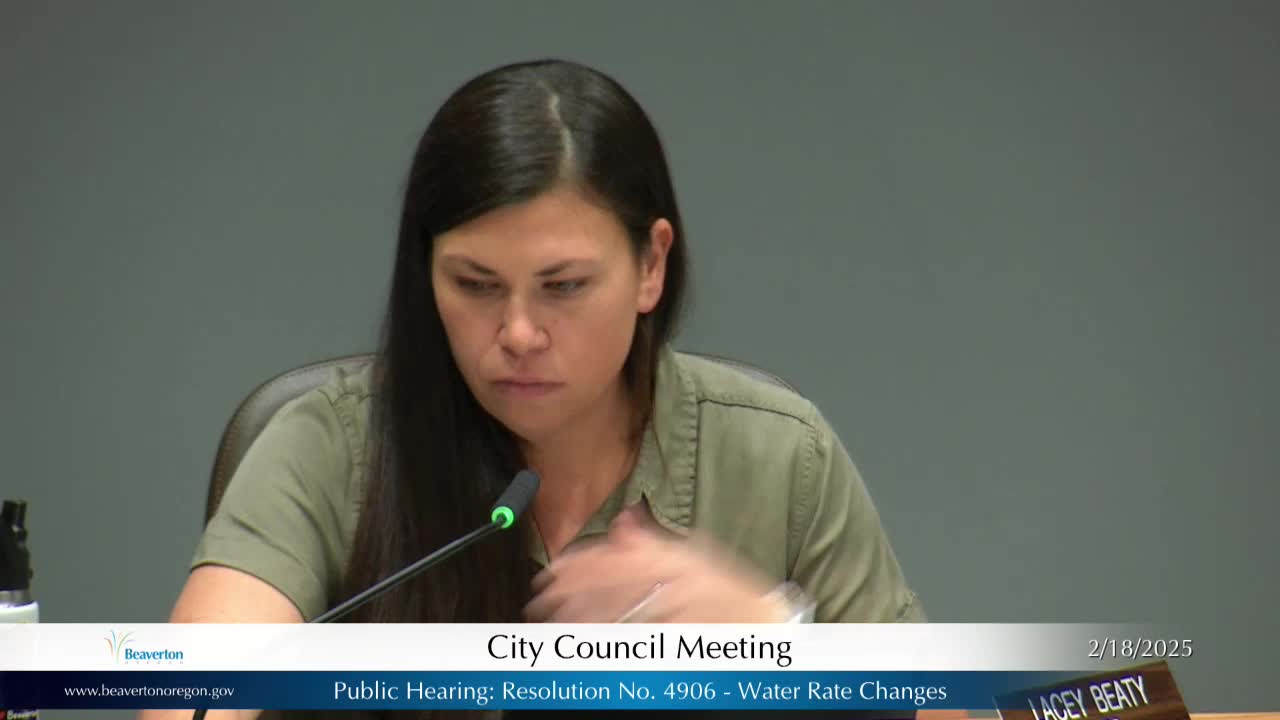
The Beaverton City Council voted down a proposal to adopt a tiered water rate structure, rejecting Resolution 4,906 (Agenda Bill 25,027) in a 2–5 roll-call vote after a public hearing that drew residents, a parks district representative and technical questions about data and billing.
City staff presented the proposal as a way to align rates with water-service costs and to add tiered rates for single‑family residential customers. "Before you tonight is a resolution to implement a new rate structure for the City's water utility, designed to recover the costs of providing water to the various customer classes and including tiered rates for the single family residential customer class," said Susan Cole, assistant director in the city's finance department.
Supporters of tiered rates told council the structure could encourage conservation and make bills fairer; critics and several council members said more information was needed about how the change would affect public agencies and whether the city's billing data and software were ready. "I support the implementation of a tiered rate structure for single family residential customers as it promotes water conservation," said Brandon Roberts, a Beaverton resident who testified. But Roberts also told council he had “serious concerns that the current proposal does not equitably source revenue from all customer classes and relies on inaccurate or incomplete data.”
Public agencies raised operational concerns. Ayesha Panis, representing the Tualatin Hills Park & Recreation District (THPRD), said the district spends roughly $600,000 annually on water and that the proposed new "public facility" category would sharply increase its costs. "These increased costs could lead to some challenges for us in maintaining our spaces," Panis told council, asking the city to meet with public providers before adopting higher rates for heavily irrigated public facilities.
Other speakers raised different issues: a longtime resident said she was worried about smart‑meter radios and water‑treatment chemicals; another resident asked why utility bills must include capital investment costs rather than being funded through taxes.
Council discussion split along lines of confidence in staff analysis and concerns about partners and billing. Mayor Beatty and a majority of council members said they wanted more time to address billing issues and to engage partners such as THPRD and the school district. "I think it would be premature to adopt the rate schedule without circling back on that conversation," one councilor said during deliberations. Two council members voted in favor of the resolution; five voted against it, and the motion failed.
Next steps were not set during the meeting. Councilors asked staff to bring back additional information — including follow‑up on billing anomalies, how the rate structure would affect public agencies, and whether the billing system can implement the proposed tiers — before reconsidering a rate change.
Votes at a glance - Resolution 4,906 (Agenda Bill 25,027): Resolution Establishing the Water Consumption Rates and Meter Charges and repealing Resolution 4,854 — Motion to adopt failed, vote 2 yes, 5 no.
Why it matters Water-rate structures affect household budgets, park and school operations, and the city's capacity to fund and maintain water infrastructure. Council members said they support affordability goals, but they also said they need clearer data, partner outreach and billing assurance before changing rates that will take effect as the city continues multi‑year investments in the water system.