Get Full Government Meeting Transcripts, Videos, & Alerts Forever!
Get email alerts on the Banking Regulation topic
No spam. Unsubscribe anytime.
Sen. Tim Scott says Senate Banking Committee will pursue regulatory rollback, capital formation and insurance fixes
Summary
Sen. Tim Scott, R-S.C., told an interviewer the Senate Banking Committee will prioritize rolling back what he called "oppressive" regulations such as Basel III, promoting capital formation for small businesses, expanding homeownership incentives and addressing stress in the insurance market, including the National Flood Insurance Program.
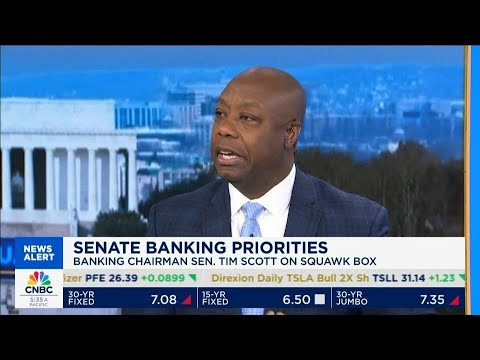
Senator Tim Scott, R-S.C., chairman of the Senate Banking Committee, said in a televised interview that the committeewill make rolling back certain financial regulations a top priority and will pursue policies to spur capital formation, expand homeownership and address strains in the insurance industry.
Scott said the committee plans to "reset" bank regulation to a "responsible level" and singled out Basel III, the international capital standard, as an example he views as overly restrictive. "We want a responsible level of regulations, not an oppressive level of regulations," Scott said, adding that higher capital requirements can make mortgages harder to obtain and limit small-business lending.
Why it matters: Scott warned that elevated capital requirements can accelerate consolidation among community banks, shrinking the number of independent institutions that make smaller, relationship-based loans. He noted that the number of U.S. banks has fallen from about 14,000 in the 1980s and early 1990s to roughly 4,000 today, and said further consolidation would push borrowers toward nonbank lenders and fintech firms.
On capital formation, Scott said he is forming a working group to study how to improve access to capital for small businesses and said he hoped Dave McCormick would lead that effort. "My theory is that as a small business, it changed my life," Scott said, arguing that easing regulatory barriers and refreshing capital rules would help entrepreneurs raise funds in their hometowns.
Scott also discussed homeownership and said rising interest rates had placed ownership "outside of reach" for many Americans. He suggested using Community Development Block Grant (CDBG) funds to provide incentives for states and localities to create more opportunities for potential homeowners.
Insurance market stress was another topic Scott raised. He described the U.S. system as a state-regulated framework he called "fantastic," but warned that catastrophic natural disasters have made actuarial pricing difficult in some markets. Scott pointed to high homeowner insurance premiums in Florida—he cited an average homeowner rate of about $6,300and said California and Florida face different challenges from wildfires and flooding. He also warned the National Flood Insurance Program (NFIP) has lost billions and noted that three states (South Carolina, Florida and Louisiana) account for more than 40% of NFIP premiums.
Scott said states must follow mitigation plans and that federal and state officials should have a comprehensive conversation about rate sufficiency so insurers remain the "first line of defense" rather than taxpayers. "We've gotta figure out how to make sure that the insurance companies remain the first line of of defense for this nation. It cannot be the taxpayers," he said.
No formal committee actions were recorded during the interview. Scott described policy priorities and proposed next steps, including creating the capital-formation working group. He did not announce specific legislation or a committee vote timetable.
Scott closed by saying the committee would try to balance regulatory relief with oversight: regulators should continue to hold banks accountable "when necessary," while easing impediments that he said discourage smaller banks from serving local borrowers.
Looking ahead, Scott said the committee will engage insurers, state regulators and other stakeholders to assess rate sufficiency and mitigation practices and to pursue legislative or regulatory changes as appropriate.