Get Full Government Meeting Transcripts, Videos, & Alerts Forever!
Get email alerts on the Financial Inclusion topic
No spam. Unsubscribe anytime.
Sen. Tim Scott, as Banking Committee chair, says he will push to free trillions in capital for disadvantaged communities
Summary
Sen. Tim Scott outlined plans to expand access to capital for minority and disadvantaged communities, including changes to credit scoring, community banking, SBIC licensing and federal contracting, and said he will press the Small Business Administration on barriers to minority investment.
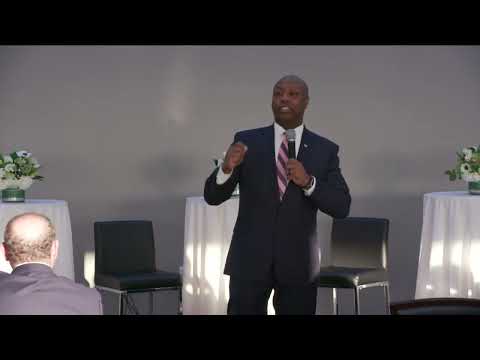
Sen. Tim Scott, R-S.C., said he will use his new role as chair of the U.S. Senate Committee on Banking, Housing and Urban Development to press for changes intended to increase capital flowing to minority and disadvantaged communities, and described a menu of policy priorities he said could unlock “a trillion” to “$2,000,000,000,000” for those neighborhoods.
Scott framed the effort as one of financial inclusion and small-business growth, telling a public forum that his “goal is to set the kind of parameters that allows for $1,000,000,000,000 of capital to be set free in disadvantaged communities in the next 10 years. I believe we can get to $2,000,000,000,000.”
He said specific policies he plans to pursue or revisit include expanding what counts toward credit scores, easing regulatory disincentives that make community banks reluctant to lend, raising the asset threshold used to define community banks, and reducing barriers to Small Business Investment Company (SBIC) licensing for investors who look like the communities they serve.
“If a brother pays his rent on time, should it count?” Scott said, arguing that rent, utility and cell-phone payment history should be included in credit files. He added that two of the three major credit bureaus had already begun to accept some of that information after conversations with his office, and that he plans to pursue a legislative solution so the change is “embedded in law.”
On banking regulation, Scott said the pressure regulators place on large, systemically important financial institutions can make banks averse to risk and shrink credit access for entrepreneurs. He told the audience that easing safe-harbor or other supervisory constraints on community banks could increase lending to small businesses in their home markets, and proposed raising the community-bank asset cap from $3 billion to $25 billion to broaden which institutions qualify.
Scott also pointed to SBIC licensing — a federal Small Business Administration (SBA) program that backs privately raised funds — as a practical lever for minority investment. He said only a small fraction of SBIC licenses are held by people “who look like this,” and said he would ask SBA leadership to prioritize removing regulatory hurdles that limit minority participation in SBICs.
On federal contracting and market structure, Scott criticized the long-term effect of large contracts that drive consolidation. “Initially the price goes down,” he said, “but long term, if you only have one or two players, the price goes up.” He argued for breaking contracts into smaller parts so more small and minority-owned firms can compete.
Scott linked capital access to household wealth and homeownership statistics as an example of scale. He said that if Black homeownership, which he cited as about 41%, rose toward the upper 40s, “you can see $700,000,000,000” in additional housing equity — a calculation he stated came from on‑the‑spot math and suggested should be checked.
He presented entrepreneurship and financial education as complements to regulatory and program changes, saying part of his plan’s “$2,000,000,000,000 bucket includes education” and urging earlier classroom exposure to business, investing and property ownership.
Scott also referenced prior policy work — saying he sponsored legislation to address heirs' property issues for Black farmers, and cited the Opportunity Zones and criminal-justice reforms as examples of policies he views as successful — as part of a broader explanation for focusing on capital and small-business growth.
On next steps, Scott said he would press SBA leadership directly. He told attendees that the new SBA director, Kelly Leffler, “should stop by” the group’s reception and that he would ask a colleague to speak with her about priorities to reduce SBIC barriers.
Remarks in the session combined personal anecdotes, policy prescriptions and appeals to bipartisan, market-focused approaches. Scott called for a focus on “green” (economic opportunity) rather than red or blue politics and emphasized competition and community-level decisionmaking as ways to expand access to credit and contracts.