Get Full Government Meeting Transcripts, Videos, & Alerts Forever!
Get email alerts on the Digital Assets topic
No spam. Unsubscribe anytime.
White House and Congress launch bicameral effort to craft federal digital‑assets framework; stablecoin bill filed
Summary
Administration and congressional leaders announced a bicameral working group to draft a federal regulatory framework for digital assets and said they will prioritize stablecoin legislation, member education and related market‑structure work.
The White House and congressional leaders announced a bicameral working group on digital assets and said they will push for federal legislation to clarify how stablecoins and other digital assets are regulated in the United States.
The announcement, made at a Capitol Hill press event, said the administration’s executive order on digital assets directs an interagency effort to propose a federal regulatory framework covering issuance and operation of digital assets, including stablecoins. David Sacks, the White House AI and digital‑assets adviser, said founders and firms are asking for clarity so they can “abide by” enforceable rules.
Why it matters: leaders at the event said clearer rules could keep innovation onshore, make it easier for regulators to supervise firms and help separate legitimate businesses from bad actors. The group is bicameral and intercommittee, involving House and Senate committee leaders and subcommittees to harmonize market‑structure work and stablecoin approaches.
“The number one thing they need from Washington is regulatory clarity,” David Sacks said. He also described the administration’s intent to form an internal working group and noted the first priorities will include stablecoin legislation and a study of a potential Bitcoin reserve.
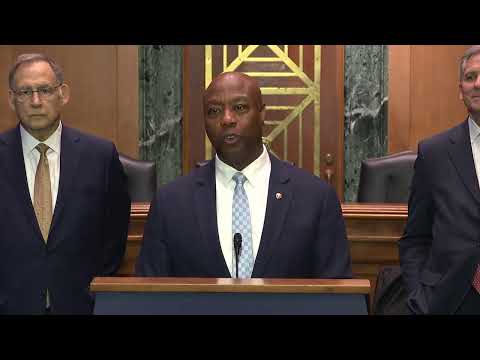
Sen. Tim Scott, Rep. French Hill and Rep. Glenn “G.T.” Thompson joined others at the event to describe the partnership between House Financial Services, House Agriculture, Senate Banking and Senate Agriculture committees. Rep. French Hill said the House will build on the prior Congress’s work on the market‑structure bill often referenced as “FIT ’21” and that the House has created a digital‑asset subcommittee to continue member education and drafting.
Sen. Bill Hagerty filed a stablecoin bill the same day, participants said; Rep. French Hill and other House leaders described plans to produce a House draft that would be substantially similar and to use amendment and education processes to reach agreement.
Committee leaders described several near‑term priorities: member education for new members of Congress, technical hearings, an amendment process for the Hagerty draft, and harmonizing the market‑structure work begun under FIT ’21 with the stablecoin text. Rep. French Hill said the digital‑asset subcommittee will focus on market structure while Hagerty’s bill advances the stablecoin discussion.
Officials at the event emphasized law‑enforcement and anti‑money‑laundering standards. One panelist said prior FIT ’21 drafting included “strict AML standards” comparable to analog financial services, and that BSA/AML considerations will remain central to any bill.
Speakers also referenced recent crypto failures while arguing for onshore rules. “It’s probably not a coincidence that the single biggest fraud in the history of crypto, which was FTX, was based in The Bahamas,” Sacks said, arguing that locating innovation onshore could aid oversight.
The administration said its internal working group will evaluate a range of policy options, including a feasibility study of a possible sovereign Bitcoin reserve; Sacks said that study is among the first items the working group will examine but that the group is in early stages pending confirmations of some cabinet officials.
Leaders said they will try to preserve bipartisan support in the House and engage Democrats in the Senate process as they move quickly. Rep. G.T. Thompson and others said they expect the work to move rapidly, with one chairman noting an objective to advance bills through the Senate within the first 100 days of the new Congress.
Next steps identified at the event included committee drafts and hearings, a coordinated amendment process around the Hagerty stablecoin bill, member education through the new subcommittee, and executive‑branch technical assistance to legislators. No formal legislation passed at the event and no votes were taken.
The rollout of the bicameral effort, and the decision to prioritize stablecoins while continuing market‑structure work, sets out a congressional and executive branch path for federal digital‑asset legislation in the coming months.