Get Full Government Meeting Transcripts, Videos, & Alerts Forever!
Get email alerts on the Protected Bike Lanes topic
No spam. Unsubscribe anytime.
Residents, advocates clash over Spruce and Pine protected bike-lane proposals
Summary
At the oversight hearing and in public comment, some neighbors urged caution about concrete or continuous barriers on Spruce and Pine citing access and loading concerns; advocates and family members of crash victims urged stronger physical separation citing safety evidence and successful examples elsewhere.
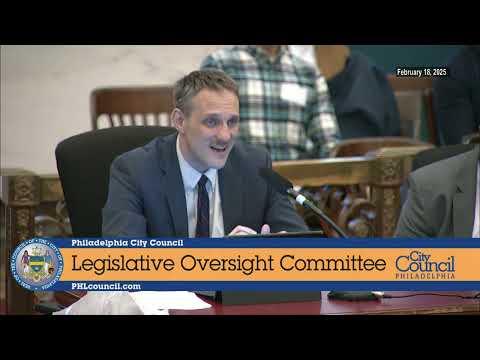
Debate over protected bike lanes on Spruce and Pine Streets in Center City surfaced during the Committee on Legislative Oversight hearing Feb. 18 and in public testimony that followed.
Advocates from the Bicycle Coalition of Greater Philadelphia, Philly Bike Action and families of crash victims urged City Council and OTIS to prioritize physically protected bike lanes and concrete separations where feasible. Nicole Bernay, policy director for the Bicycle Coalition, told the committee that protected bike lanes “shrink the size of the road which makes people go slower” and that bike lanes are a traffic-calming tool. Pediatric colleagues of the late Dr. Barbara Bridal (killed while riding in a bike lane last year) said in public comment that a “truly protected” lane might have prevented the fatal collision.
Neighborhood residents and a newly formed civic group, Friends of Pine and Spruce (FOPS), contended that continuous concrete barriers as currently proposed would block loading and delivery access, conflict with promises residents say were made when earlier bike-lane configurations were installed, and raise accessibility and legal concerns for homeowners with garages and people with disabilities. Richard Herskovitz and Kim Williams, FOPS members who live in Society Hill and adjacent blocks, said prior mayoral statements had promised limited curb-side access for short-term loading, and they called for full stakeholder consultations before expensive changes are built.
Key facts and claims discussed - Cost and options: OTIS staff discussed a range of separation options, from flexible posts (cheapest but maintenance intensive) to concrete curb separation (highest quality, “you can easily be over a million dollars a mile for actually concrete curb separated,” OTIS staff said). Council requested a menu of protection options and lifecycle costs for budget discussions. - Legal and operational concerns: FOPS witnesses argued that a strict “no stopping in bike lane” policy was being enforced citywide and said enforcement without exemptions could interfere with garage access, deliveries and disability drop-offs. They warned of potential property-rights and accessibility claims if access were effectively eliminated. - Equity and priority questions: Several council members and public witnesses pressed that Vision 0 capital spending should focus first on the city’s high-injury network — an area advocates say accounts for a disproportionate share of traffic deaths — before large investments are made on lower-injury streets.
Voices for stronger protection and rapid deployment Bicycle and pedestrian advocates, families and some council members argued that stronger physical protections reduce deaths and serious injuries and called for faster deployment of proven countermeasures on high-injury corridors. Philly Bike Action urged daylighting intersections, curb extensions and lane rebalancing as cost-effective, high-impact measures and recommended the city “mandate safety improvements for every street when it’s repaved.”
What’s next Council members asked OTIS to provide a clear cost menu and timeline for different separation options, and to explain whether concrete separation would be used only on new projects or retrofitted onto existing bike lanes. OTIS agreed to provide additional details for the upcoming budget process and to continue community engagement.
Ending The exchange highlighted an ongoing tension in city transportation planning: balancing neighborhood access and delivery needs against advocates safety proposals for physical separation that supporters say can be lifesaving.