Get Full Government Meeting Transcripts, Videos, & Alerts Forever!
Get email alerts on the Second Look Act topic
No spam. Unsubscribe anytime.
Maryland lawmakers hear emotional testimony on ‘Second Look’ bill letting long‑serving prisoners petition judges after 20 years
Summary
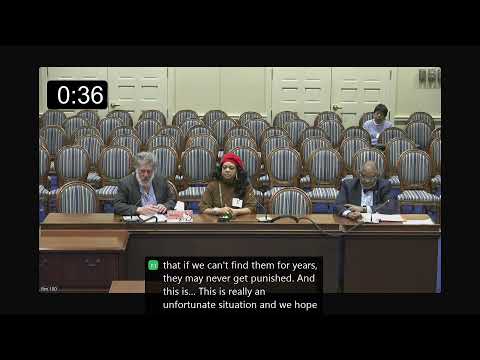
Maryland’s House Judiciary Committee heard hours of emotional testimony Feb. 18 on House Bill 853, a “Second Look” measure that would let people serving very long sentences petition a judge for reconsideration after serving 20 years.
Maryland’s House Judiciary Committee heard more than four hours of emotional testimony on House Bill 853 on Feb. 18, as dozens of released people, family members and legal advocates urged legislators to give judges a formal path for reconsidering lengthy sentences. Sponsors said the bill, part of a wave of “second look” legislation nationally, would allow an individual sentenced to life or very long terms who has served at least 20 years to petition a court for a sentence reduction.
Supporters, including the bill sponsor, Delegate Cheryl P. Pasteur, and people released under other programs, framed the measure as a narrowly crafted judicial review that would not guarantee release but would allow judges to consider evidence of rehabilitation, changed circumstances and whether a reduced sentence would be consistent with public safety.
The bill gives petitioning prisoners a statutory route to ask a judge to reconsider a sentence once they have served 20 years. If the judge grants a hearing, the court would consider factors including the nature of the original offense, the petitioner’s role in the crime, their disciplinary record and evidence of rehabilitation. The proposal would not automatically restore parole or shorten sentences; judges could deny relief and retain the original sentence.
Why it matters
Proponents said existing remedies are fragmented, rarely available and often ineffective for people serving extremely long terms. “The premise of this bill is to allow an individual to demonstrate rehabilitation before a judicial officer who is in the best position to review the sentence,” said Olinda Moyd of American University’s reentry clinic. Dozens of people who testified described years or decades of rehabilitation work inside prison and urged lawmakers to create a predictable judicial review process so judges could weigh present evidence instead of only relying on the circumstances and predictions in effect at the original sentencing.
Released men who spoke described long records of education, mentoring and community work after decades in custody. “I was remorseful the moment I committed the act, but it took me another decade to say that publicly,” said Anthony Mohammed, recounting a 29‑year term he served before release. Alex Bailey, who identified herself as a survivor of violent crime, told the committee many survivors support “second look” provisions that prioritize rehabilitation, and cited national polling that many crime survivors prefer rehabilitation over perpetual punishment.
The committee also heard wide testimony from criminal justice scholars, public defenders and civil‑rights groups documenting stark racial disparities in Maryland’s use of long prison terms and calling for judicial review as a fairness mechanism. “Maryland incarcerates the highest percentage of Black people in the country,” said Enid Emmanuel of the ACLU of Maryland, asking the committee to issue a favorable report.
Concerns raised
Opponents — including several victims and family members — warned that reopening sentences would retraumatize victims who must repeatedly attend hearings. “My life had such a different plan until Dec. 23, 2011,” said Theresa Darvish, whose son was murdered. “My son will never return to his home. No murder should be given a free ride home.” Law enforcement and some prosecutors’ groups urged caution about mandatory changes that would limit prosecutorial discretion, and several witnesses pressed for careful drafting to protect victims’ notice rights and avoid unintended offsets to existing remedies.
Legal and procedural questions
Panelists debated how the new route would relate to parole commissions and existing post‑conviction remedies. Advocates said the measure fills a gap: some existing procedures are administratively constrained, limited to narrow legal claims or require prisoners to take risky appeals that could increase sentences. Supporters pointed to examples in other states and to low recidivism among people released under similar programs.
Next steps
The committee took extensive testimony and did not vote on the bill at the hearing. Delegate Pasteur and advocates said they would continue to work with colleagues and prosecutors to refine the language, including clarifying victims’ notice rights, the timing of petitions and procedural protections for both petitioners and survivors. No hearing date or committee action was announced at the close of testimony.
Quotes
"The premise of this bill is to allow an individual to demonstrate rehabilitation before a judicial officer who is in the best position to review the sentence," Olinda Moyd, director of American University Washington College of Law’s decarceration clinic, told the committee.
"I served a total of 29 years, 7 months and 29 days before I was released, approximately two years ago under the Juvenile Restoration Act," testified Anthony Mohammed. "I'm very pleased to say that the families of the victims in my case were in favor of rehabilitation, and they forgave me."
"Maryland incarcerates the highest percentage of Black people in the entire country," said Enid Emmanuel of the ACLU of Maryland, urging lawmakers to consider racial disparities in long sentencing.
Context and background
Several panelists noted that courts and legislatures nationwide have steadily moved toward mechanisms for revisiting very long sentences. The Juvenile Restoration Act is already a Maryland law that created a path for some people sentenced as youth; HB 853 would create a separate judicial review avenue for those serving adult long terms once they have served a statutory minimum of years.
Ending
The hearing laid out the main arguments for and against creating a statutory second‑look judicial review in Maryland: advocates emphasized fairness, rehabilitation and the limits of current remedies; many survivors emphasized the harm of reopening sentences; prosecutors and judges pressed for careful drafting. Lawmakers said they would continue consultations on notice and procedural safeguards before any vote.