Get Full Government Meeting Transcripts, Videos, & Alerts Forever!
Get email alerts on the Vision Zero topic
No spam. Unsubscribe anytime.
Council oversight hearing probes Vision 0 progress as city officials outline enforcement, projects and outreach
Summary
City officials and advocates at a Philadelphia City Council oversight hearing described recent safety measures — including automated enforcement and infrastructure projects — while council members pressed for clearer timelines, spending plans and a list of capital projects on the high-injury network.
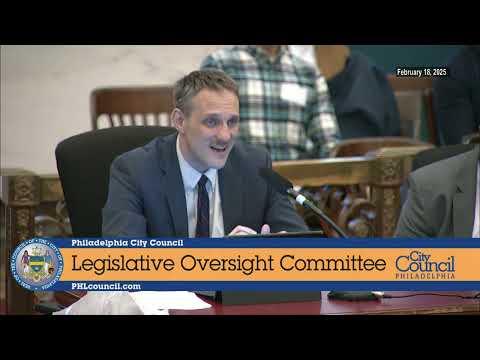
Philadelphia City Council’s Committee on Legislative Oversight held a public hearing Feb. 18, 2025, on Resolution No. 240700 to review the city’s progress toward Vision 0, the municipal program aimed at eliminating traffic deaths.
The hearing featured testimony from Christopher Pawalski, director of policy and strategic initiatives in the Office of Transportation and Infrastructure Systems (OTIS), and Rich Lazer, executive director of the Philadelphia Parking Authority (PPA). Pawalski described the administration’s programmatic and community-engagement work and framed infrastructure and automated enforcement as complementary tools; Lazer outlined near-term enforcement rollouts led by the Parking Authority.
The discussion centered on why Philadelphia has not reduced annual traffic fatalities and what the city will do next. Pawalski told the committee that the mayor’s March 2024 executive order recommitted the city to Vision 0 and set several key tasks, including programming safety improvements on every mile of the city’s high-injury network and producing a new five-year action plan by Oct. 31, 2025. He said the administration concluded the city was not on track to reach its earlier 2030 target and that the broader goal timeline has been recalibrated to 2050: “I don’t think I’m saying that 2030 was probably never a realistic goal to eliminate traffic fatalities,” Pawalski said.
Why it matters: Philadelphia has sustained an elevated number of traffic deaths since 2020. Pawalski told the committee the city has been “flat for the last 2 to 3 years at about a hundred and 20 fatalities.” He also cited racial disparities in crash outcomes, saying hospitalization rates for Black Philadelphians after crashes were higher than for white residents.
Initiatives and evidence the administration cited - Automated enforcement: Pawalski and Lazer described expansions of automated enforcement. Lazer said the PPA will expand speed-camera enforcement to Broad Street and that bus-lane camera enforcement is slated to begin in late spring or early summer. Lazer said Roosevelt Boulevard speed cameras have “reduced speeding by a dramatic 93% and reduced crashes by 36%.” - Infrastructure projects: OTIS and the Streets Department are pursuing Complete Streets projects and capital safety countermeasures such as the Penrose roundabout, which Pawalski said is expected to produce an “80% reduction in injury crashes” at that intersection. - Education and community engagement: OTIS said it is developing school-based traffic-safety curriculum (K–5 in classrooms now, middle- and high-school modules under development), a stipend-paid ambassador program, online surveys and community roundtables to inform the five-year plan. - New investigative tools: Pawalski noted the Philadelphia Police Department’s crash-investigation unit has begun using cell-tower and automated license-plate-reader data in hit-and-run investigations.
Council concerns and requests Council members repeatedly pressed OTIS and Streets officials for specifics: an itemized list of Vision 0 capital projects on the high-injury network, a clear spend plan for any additional funds, and a schedule that shows when individual safety measures would be designed, funded and constructed. Pawalski acknowledged capital projects often require extensive community engagement and that “a 3 to 5 year time frame for any capital project is pretty typical,” but he agreed to provide longer-form documents requested by council.
Budget questions and the $5 million figure Council members asked whether the administration would seek to restore a $5 million Vision 0 budget line discussed in prior budget cycles. Pawalski said the office had no specific spending plan for that amount at the hearing but described what $5 million could buy: “$5,000,000 could pay for 2 neighborhood slow zones,” continued cushions and concrete separation or maintenance for bike lanes. He said OTIS could produce a menu of options and lifecycle-cost analysis ahead of budget deliberations.
Enforcement and implementation details from the Parking Authority Lazer described multiple PPA programs in operation or being expanded: bus lane camera enforcement, smart loading-zone pilots (an expected 25 loading zones using about 80 cameras, with a charger model that would begin charging a small fee after a 3-minute grace period), broad expansion of bike-lane enforcement through a bicycle-patrol unit, and an ADA Mobility Access Initiative that has issued more than 40,000 mobility-related violations. He said PPA has also towed more than 870 ghost vehicles and over 4,000 unregistered nuisance vehicles in recent sweeps.
Legal and institutional constraints Committee members and witnesses cautioned that state law constrains city action in some areas — for example, where automated speed enforcement may be used and how speed limits are set statewide. Pawalski said Pennsylvania’s motor-vehicle law requires speed studies and 80th-percentile settings that can complicate local speed reductions and called for legislative changes at the state level.
Next steps and requests (committee “homework”) Council members asked for several items to support budget and oversight decisions: a comprehensive accounting of Vision 0 spending across departments; a list of completed and planned capital projects on the high-injury network; a clearer staffing and operating-cost breakdown for Vision 0 work; and timelines for school-based curriculum rollout and for enforcement program expansion. Pawalski and the Streets Department agreed to work with council on those items.
What the hearing did not produce No formal votes were taken. The hearing served as an oversight review and information-gathering opportunity rather than as a decision point; council members repeatedly asked staff for follow-up documents and specific spending plans.
Ending Council members said Vision 0 and traffic-safety funding will be central topics during the upcoming budget cycle and set expectations that OTIS, Streets and the Parking Authority provide the requested lists and cost breakdowns before budget deliberations.