Get Full Government Meeting Transcripts, Videos, & Alerts Forever!
Get email alerts on the Education topic
No spam. Unsubscribe anytime.
Senate restores preschool access, broadens eligibility in Wyoming Freedom Scholarship debate
Summary
Wyoming senators debated and adopted two amendments to House Bill 199, including restoring preschool eligibility and removing a means test, after extended floor debate about constitutionality, program scope and funding.
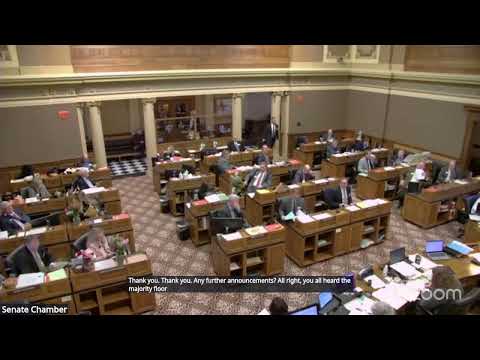
Senators on Tuesday adopted two floor amendments to House Bill 199, the Wyoming Freedom Scholarship Act, restoring pre-kindergarten eligibility and removing a means test that previously limited who could receive education savings accounts.
The amendments were offered during second reading and passed after extended debate. Senator Hutchings moved Second Reading Amendment No. 1, which would restore the bill language that preserves the pre-K portion of the education savings account (ESA) program; that amendment was adopted on a roll call of 26 ayes and 5 no. Senator Brennan then moved Second Reading Amendment No. 2, which deleted a Committee of the Whole amendment and restored a universal $7,000 benefit for each eligible student; that amendment passed on a roll call of 21 ayes and 10 no.
The debate focused on whether the program should remain means-tested — limited by income — or be universal. Supporters said restoring the pre-K component and removing the means test would expand educational options and help literacy. “There are already 44 children enrolled,” Senator Brennan said while urging colleagues to restore pre-K language and keep that portion of the program. Senator Scott argued for removing the means test on principle, saying education should be broadly available and that restoring universal access would avoid setting a precedent of income-based limits.
Opponents warned of constitutional and administrative risks if the program became universal. Senator Schueller warned that opening the program “wide up” could leave the bill vulnerable to legal challenge and said returning to a universal $7,000 per student program would “probably, hopefully, pass constitutional muster” less readily than the amended, means-tested version. Senator Landon and others pressed on operational details such as participation in extracurricular activities and whether monies could be used for public-school functions; proponents said districts and families could negotiate participation agreements and that testing requirements for constitutional proficiency remain in the bill.
Senators also discussed how the ESA funds would be classified for constitutional purposes. Multiple senators cited provisions of the Wyoming Constitution during the debate, including Article 7 (public education provisions) and Article 16 (restrictions on loans or donations of public credit), and referred to the U.S. Supreme Court’s Espinosa decision in argument about equal treatment of religious providers. Senator Pearson and others argued administratively that universal eligibility would be simpler and less intrusive than income verification.
After the two amendment votes, the bill was returned to the floor for third-reading consideration. Sponsors and supporters said the amendments restore policies favored in prior legislative action and that program rules requiring proficiency testing in the U.S. and Wyoming Constitutions remain in place as written. Discussion on constitutional objections and means-testing continued on the floor; proponents repeatedly described the measure as a scholarship for students rather than a direct transfer from school funds.
Senators indicated additional implementation questions remain, including whether districts and private providers would coordinate extracurricular access and how state scholarships such as Hathaway might interact with private institutions. The floor debate stretched for more than an hour and included a wide range of procedural and constitutional arguments.
Looking ahead, sponsors asked colleagues to support the amended bill on third reading so the measure could proceed through the legislative process and—if enacted—be implemented in accord with statutory and administrative rules.