Get Full Government Meeting Transcripts, Videos, & Alerts Forever!
Get email alerts on the Fleet Management topic
No spam. Unsubscribe anytime.
Josephine County discusses fleet O&M rates, depreciation and replacement reserve at budget workshop
Summary
At a February budget workshop, Director Brandis presented options to change minimum billed mileage and extend vehicle depreciation schedules. Commissioners requested per-vehicle mileage and cost data and trailed-year comparisons to inform departmental budgets and the county's roughly $1.2 million vehicle replacement reserve.
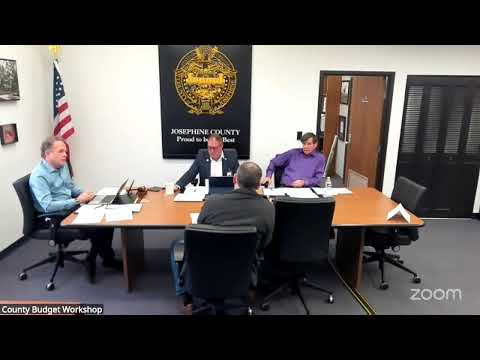
Josephine County commissioners met in the Commissioners' Conference Room on a Tuesday in February for a budget workshop focused on the county fleet’s operating-and-maintenance (O&M) charges, depreciation schedule and replacement reserve. Director Brandis presented several billing iterations and depreciation scenarios and commissioners asked staff for detailed mileage and cost comparisons to support department budget calculations.
Brandis outlined two proposed minimum billed-mileage thresholds—3,600 and 4,200 miles per year—and a proposal to lengthen depreciation schedules for passenger vehicles and light trucks (one option in the packet applied a longer schedule using a 21,000-mile assumption). Brandis said those changes would modestly lower the total depreciation revenue captured while leaving the core O&M revenue that pays for shop operations largely intact. He noted an example fleet-year comparison showing total fleet revenue moving from roughly $1.929 million to about $1.886 million under one option.
The presentation used a sample purchase price of $37,000 (the size used for proposed compact SUVs to replace lighter-duty passenger rigs) and modeled inflation at 3%, 4% and 5% to illustrate how future replacement costs could rise. Brandis described the department’s method for calculating depreciation as the difference between an assumed purchase price and a projected resale/recovery value at a chosen replacement interval (for example, estimating a $17,000 depreciation capture on a $37,000 vehicle when projected resale value at five years is about $20,000).
Commissioners pressed for more granular data before approving any changes. One commissioner asked for per-vehicle operating costs for public works’ non-hour-metered vehicles (for example, F-250-class pickups) because several identical vehicles in the fleet appeared to show different cost profiles. Brandis said staff would provide the per-hour or per-mile costs and the historical hour-meter/odometer data for the past 12 months and agreed to supply comparative data for multiple fiscal years so commissioners could assess trends.
Staff and commissioners agreed on the following data requests and near-term steps: production of mileage/cost comparisons for non-hour-metered public works vehicles, a trailing multi-year data set to show trends (the discussion settled on providing data for fiscal years 2023–2025 and the current year-to-date), and an updated five-year capital purchase projection to compare against the equipment reserve balance. Brandis also noted the county’s equipment reserve has been approximately $1.2 million recently (historically as low as about $300,000 several years ago) and that the county typically purchases roughly $700,000–$800,000 of vehicles in a typical year.
Directors and commissioners discussed trade-offs between stretching replacement intervals (for example, moving to 10-year useful lives) and increased O&M costs that can follow older vehicles. Brandis said there is a balance to strike: longer service life reduces annual depreciation collections but can raise repair costs and risk shop downtime; conversely, shorter replacement intervals keep vehicles under warranty longer but increase replacement funding needs. “I’m not comfortable going a whole lot lower than that,” Brandis said when describing how low the reserve-funded operating balance should fall.
The county also reviewed how blended fleet pools spread repair costs across vehicle classes (Brandis gave an example where a single transmission failure in a pooled class could raise the pooled O&M rate for that vehicle class for all users). Commissioners and staff noted the workshop timeline: final O&M rates are needed quickly because departments begin preparing budgets this week, so staff agreed to email the requested data as soon as possible for review at upcoming budget and administrative meetings.
No formal motions or votes were taken during the fleet discussion; commissioners directed staff to produce the requested cost and mileage reports for use in budget preparation and to provide the five-year capital projection for comparison with the equipment reserve balance.