Get Full Government Meeting Transcripts, Videos, & Alerts Forever!
Get email alerts on the Transportation Funding topic
No spam. Unsubscribe anytime.
Mississippi commissioners say HB 1 would provide recurring funds to maintain roads, avoid federal penalties
Summary
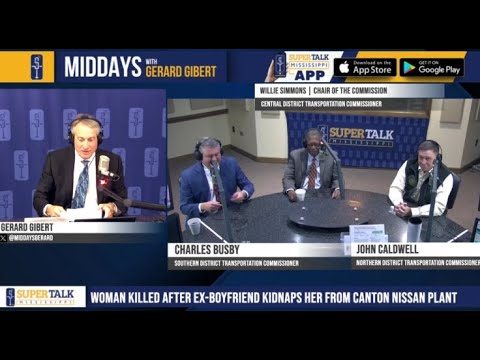
Transportation Commission Chair Willie Simmons and commissioners John Caldwell and Charles Busby told a radio roundtable that House Bill 1 (HB 1) could secure recurring revenue for the Mississippi Department of Transportation (MDOT), help preserve roads and bridges and reassure federal grantors that the state can match and maintain projects.
Commissioner Willie Simmons, chair of the Transportation Commission, said House Bill 1 (HB 1) could supply recurring money the state needs to maintain highways and bridges and to secure federal funding.
"We don't see party, highways and bridges. We see highways and bridges that need money," Simmons said, describing cooperation across the commission's three districts. He told the Element Well Studio roundtable that MDOT's budget is about $1,400,000,000 and the department employs roughly 2,700 people.
The commissioners discussed HB 1's approach to raising revenue for transportation, including a proposed 5% sales tax on motor-fuel purchases that supporters estimate could produce roughly $350 million to $400 million a year before accounting for changes to existing streams. Simmons and the other commissioners said the bill would replace or alter some current funding, including an $80,000,000 share currently coming from the Mississippi Lottery Corporation.
"We truly need recurring dollars," Simmons said, adding that federal partners want to see a state planning program and recurring revenue so the federal government will not withhold grant funding. "Our budget is, like, 51% fed, 49% or so state funding. So we need dollars that we can plan with and show the feds that the state of Mississippi is invested in the future."
Commissioner John Caldwell, who represents the northern district, said MDOT and commissioners prioritize projects by listening to constituents, consulting local elected officials and using departmental planning data on traffic and safety. "We listen. We travel the area. We know our own areas, and we know where the needs are," Caldwell said.
Caldwell also clarified MDOT's responsibilities: "MDOT is responsible for every state highway and every federal highway. So if it's a state route, US route, federal Interstate Highway, that's ours," he said, distinguishing those roads from county "state aid" roads, which belong to counties.
Commissioner Charles Busby, who represents the southern district, acknowledged public frustration about apparent inefficiencies and said MDOT continues to search for cost savings, including reducing bond debt. "You may see two or three guys standing around, but maybe they're not," Busby said about field crews and urged caution in assuming visible activity equals wasted expense.
The commissioners warned that failing to secure recurring funding could delay projects and raise long-term costs for taxpayers and drivers. Simmons recalled a 2018 special session and said the federal government can threaten to withdraw money if critical work is not completed, particularly on bridges.
They also discussed how revenue proposals in HB 1 would be distributed. The commissioners said parts of the plan would increase funds flowing to counties and municipalities; for example, one component discussed on the show would add a county-level 1.5% sales-tax increase on non-grocery items with proceeds tied to state aid and local infrastructure, while other funds would be dedicated to state highways. The commissioners emphasized that local governments have major infrastructure needs and often request more money than is available: when MDOT accepted applications under the ERBF bond program in 2018, they said requests exceeded the $250,000,000 bond by more than $1 billion.
On operations, Busby thanked Caldwell for sending northern snowplows to the Gulf Coast during unexpected winter weather, saying crews in Districts 6 and 7 handled the response well. The commissioners also said workforce shortages make routine maintenance more difficult in some counties, noting that some counties have far fewer maintenance staff than needed and that low staffing can impede safe pothole repair and other basic work.
No formal votes or policy decisions were taken during the radio appearance. The commissioners said they expect the House and Senate to refine HB 1 during the legislative process and expressed hope the Legislature will enact a measure that provides recurring transportation revenue.
The Transportation Commission members who spoke on the broadcast—Simmons, Caldwell and Busby—urged legislators to adopt a stable funding source rather than relying on one-time transfers or surplus budgets to pay for infrastructure.