Get Full Government Meeting Transcripts, Videos, & Alerts Forever!
Get email alerts on the School Budget topic
No spam. Unsubscribe anytime.
Stratford board reviews superintendent's proposed FY26 budget; members ask for one more workshop
Summary
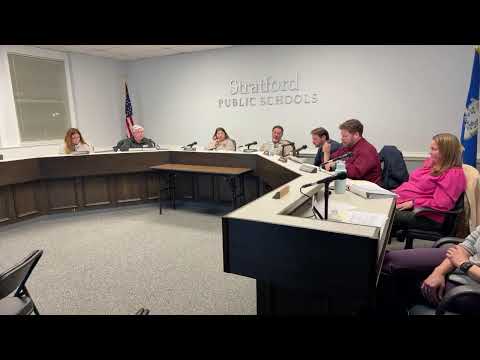
The Stratford School District Board of Education held a budget workshop Feb. 5 to review the superintendent's proposed fiscal year 2026 budget, focusing on salaries and benefits, curriculum and professional development and special education.
The Stratford School District Board of Education held a budget workshop Feb. 5 to review the superintendent's proposed fiscal year 2026 budget, focusing on salaries and benefits, curriculum and professional development and special education.
District staff told the board that salaries and benefits constitute the largest share of the budget. "Salaries and benefits total almost 76% of our total budget," said Miss Managini, a district budget presenter, while introducing the salary-and-benefits section.
That figure reflects negotiated wage and step increases the district expects to absorb next year, staff said. Staff highlighted three salary areas with notable increases: curriculum-writing and related positions, pupil-support services (largely the restoration of elementary librarian positions that had been funded through a town allocation in FY25) and student activity coaching — the latter driven in part by difficulties hiring athletic trainers and a shift of some expenditures from contracted services to payroll.
Curriculum and professional development were a central focus of the evening. Dr. Chiazza, speaking from the curriculum team, told the board the district wants to restore funding cut in recent years and invest in a renewed curriculum revision cycle. "These budgets are directly aligned with our district priorities," Dr. Chiazza said, listing meaningful learning, planning for future success and exceptional talent as guiding priorities. He said about 52% of high school courses and similar shares at middle and elementary levels have not been revised in more than five years and proposed funding to pay curriculum-writing at $45 per hour starting July 1 for up to 1,500 hours of work.
On professional learning, staff said the district plans to expand training already used for K'0 literacy into middle-school grades and continue training on restorative practices and leadership development tied to the district's new professional-growth evaluation framework.
Special education leaders told the board the district's special-education appropriation shows an overall reduction of roughly 6% from the prior fiscal year but an increase in clinical costs for in-district services. Staff said a methodological change in budgeting and other offsets explain why tuition lines decreased even while some service costs rose. The presenter also urged board members to advocate with the state for higher reimbursement rates under the state's excess-cost statute, saying the district had used conservative assumptions in its net budgeting.
"We are being very conservative in our net budgeting," said Miss Borges, the special-education presenter, adding that if the state reimbursed at higher historical rates the town could receive materially greater aid. She told the board the district used several conservative scenarios: one hypothetical full funding calculation would return approximately $4.7 million to the town; another scenario pegged to a lower reimbursement rate yields about $3 million; and a proposed change to a different reimbursement formula could yield roughly $7.2 million.
Board members asked questions and sought clarifications on multiple lines, including noncertified salaries, unemployment-liability budgeting and grant-funded positions. Staff noted that the American Rescue Plan Act previously reduced the district's unemployment liability and that, without that credit, the district expects higher unemployment expenses (staff cited a budgeting level of $250,000). Staff also pointed to one-time and recurring savings, including an almost $400,000 retiree-health savings from a prior renegotiation that reduced the net impact of insurance increases.
Board members discussed the identification of Flood Middle School as a state "focus" school. Staff said the designation stemmed from a decline in a small high-needs subgroup in one cohort year and that the district has since put supports in place: full-time math interventionists, increased collaboration time for math teachers, department-head expansions and active parent outreach. "They have been growing every year," a staff presenter said of Flood's index and certain grade-level results, while acknowledging the work is ongoing.
The finance committee's recommendation to forward the proposed 2.66% to 2.68% district budget to the full board was moved and seconded during the workshop, but the maker withdrew the motion to allow another workshop so outstanding questions could be answered. The committee and staff agreed to schedule one additional workshop before the finance committee's formal recommendation to the board. The workshop schedule will be finalized and distributed by email.
The meeting closed with a routine adjournment vote passed unanimously.
Looking ahead, staff asked board members to submit outstanding questions via a shared spreadsheet so presenters could prepare detailed responses for the next workshop and the subsequent finance-committee and full-board meetings.