Get Full Government Meeting Transcripts, Videos, & Alerts Forever!
Get email alerts on the Utility Programs topic
No spam. Unsubscribe anytime.
Imperial Irrigation District outlines expanded rate-assistance, rebates and water projects in Brawley presentation
Summary
Imperial Irrigation District officials briefed the Brawley City Council on public benefits programs, new senior discount rules, grant awards, outreach plans and regional water and power projects including a planned 2,100-acre-foot reservoir and 100 MW of battery storage.
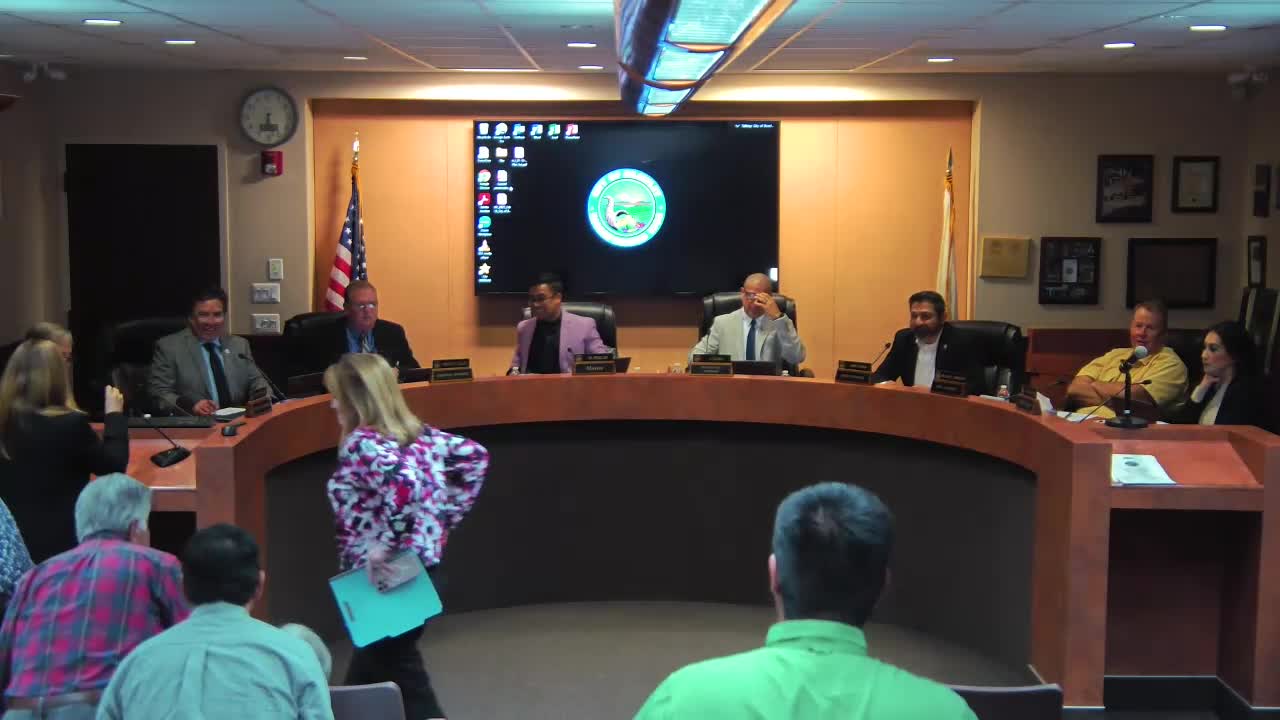
Imperial Irrigation District (IID) officials presented their public-benefits programs and recent planning work to the Brawley City Council, including expanded outreach and funding moves aimed at helping low-income and senior customers with energy costs.
In a presentation Wednesday, IID Division 3 Director Gina Young Dockstader and staff described programs funded by a state-mandated public benefits charge, new rebate and weatherization offerings, and larger water- and power-system projects in the valley. “IID offers a variety of public benefits programs to help customers offset their energy costs,” Assistant Power Manager Sabrina Barber said while outlining rebates, a weatherization program and rate-assistance options.
Why it matters: IID’s public-benefits work allocates ratepayer funds for energy efficiency and direct bill relief, and the utility’s planning for additional storage and reservoirs could change local water- and energy- system capacity over the coming years.
Key program details and local awards
- Tree for All / public green-space grants: IID’s Tree for All grants offer up to $35,000 per project. Dockstader said two projects located in the city of Brawley were awarded funds: the Housing Authority received $25,000 and the Riverside Cemetery District was awarded $35,000. Dockstader said applications will reopen in March and that the city of Brawley is eligible to apply for parks or other shared green spaces.
- Energy rewards and appliance rebates: IID moved to an online application process for appliance rebates (iid.com/rebates) and offers a refrigerator recycling program that pays $50 per working refrigerator or freezer, up to two appliances per customer per year.
- Weatherization: IID’s All Weather Energy Savings program provides a free home energy assessment and up to $1,000 in installed measures for qualifying residential customers; customers enrolled in IID’s low-income assistance program receive an additional $500 in measures.
- Rate-assistance programs: IID maintains a Residential Energy Assistance Program providing income-qualified discounts of 20% for customers under 60 and 30% for customers 60 and older. An “e-green” add-on supplies an additional roughly 3–6% discount to enrolled customers so they can receive some renewable-energy benefits even if they cannot do rooftop solar.
- New “SHIELD” program for seniors: Barber and Dockstader described a new senior health-and-income discount called SHIELD. The program will provide a discount to customers age 60 or older whose combined medical and pharmaceutical expenses exceed 10% of annual income; household income to qualify is up to $65,000. IID staff said SHIELD is expected to roll out on March 4.
Outreach, application support and funds reallocation
IID told the council it has increased digital and traditional outreach and is making application assistance available through public-affairs staff and finance/call-center personnel. Dockstader said staff will be present at community events and can bring on-site enrollment to locations such as senior clubs.
IID also reported a board-approved reallocation of $10 million from the public-benefits fund: $5 million to rate assistance and $5 million to energy-efficiency measures. Dockstader told the council that $2 million of that reallocation has already been earmarked for the rate-assistance program and that staff are designing an online generic form to streamline enrollment while preserving consumer privacy requirements.
Power- and water-system projects described
IID staff also showed ongoing and planned infrastructure work in and near Brawley, including undergrounding on the Best Canal, reservoir planning and a large upcoming reservoir on East Highland. Water Department Manager Mike Pacheco described an East Highland reservoir planned at about 2,100 acre-feet — roughly five times the size of the valley’s current largest reservoir. Pacheco also described a dredging approach for Galliano Reservoir to remove silt without taking the reservoir fully out of service.
On the power side, Power Manager Matt Smelser said IID has completed recent local distribution and street-lighting projects, has around 50 megawatts of battery capacity through owned and procured resources, and is evaluating solicitations for additional storage. Staff said they expect to award additional battery storage contracts and referenced a target solicitation in the roughly 100 megawatt scale under evaluation.
Rates, ECA and refunds
IID board members and staff explained recent rate decisions. Dockstader summarized the board’s rate-setting approach and the energy cost adjustment (ECA) decision: the ECA was rolled into base rates and set to 0 for two years so that the separate ECA charge will not be above 0 during that period; the board adopted a policy that would trigger changes if the ECA rose above a set threshold.
Staff also described an overcollection that occurred in 2024 because actual generation and purchase-power costs were lower than projected. Dockstader said the utility plans to return overcollected ECA money to the ratepayers and that the board approved a holistic plan for deploying refunds and program funds at its March 4 meeting.
Council interactions and next steps
Council members asked about staff capacity for application assistance, the timeline for SHIELD, delineation of IID versus city-maintained street lights, and options for expanding assistance beyond seniors. Dockstader said staff will continue to collect feedback and consider future program adjustments.
Dockstader said IID will schedule periodic 2-on-2 meetings (two IID board members with two city council members) to maintain ongoing coordination. “We will get that 2-on-2 scheduled in the books,” Dockstader said.
Ending note
IID staff offered to provide more detailed maps and follow-up materials to the council and emphasized outreach to seniors and community organizations to boost enrollment and awareness of the expanded assistance and efficiency programs.