Get Full Government Meeting Transcripts, Videos, & Alerts Forever!
Get email alerts on the False Voting topic
No spam. Unsubscribe anytime.
Committee amends, advances bill to broaden false-voting statute and let Secretary of State request sheriff investigations
Summary
The committee advanced House Bill 154 to clarify that Wyoming’s false-voting law covers voting in another state and to allow the Secretary of State to request county sheriff investigations; the panel adopted amendments narrowing one phrase and rejected a proposal to require the Secretary to act only "in conjunction with" county clerks.
The Senate Corporations, Elections & Political Subdivisions Committee voted to report House Bill 154, which clarifies that Wyoming’s false-voting statute covers voting in another state and lets the Secretary of State request investigations by county sheriffs, after debate and a pair of amendments.
The bill would amend existing law to state explicitly that "voting or offering to vote more than once in an election" includes voting in another state and then voting in Wyoming in the same federal election. It also adds language allowing a county sheriff to investigate acts of false voting at the request of the Secretary of State.
Why it matters: Backers said the current statutory language is unclear about whether criminal penalties apply when someone votes in another state and again in Wyoming for the same federal election; they argued the change closes that gap and gives the Secretary of State a clear channel to prompt local investigations when information first comes to the state office. Opponents said the change could expand the Secretary of State’s role into county election administration and duplicate or conflict with existing complaint channels.
What supporters said Secretary of State Chuck Gray told the committee the statute is "unclear" as written and that clarifying the reach of the false-voting provision would make enforcement more straightforward: "While the statute criminalizes double voting within Wyoming, there's at least a very strong argument that it is unclear on another jurisdiction"; he said the amendment to allow the Secretary to request sheriff investigations was "in line with the statutes." Representative Marlene Brady, sponsor of HB154, said the change would allow the Secretary to initiate investigations if information reached the state office directly.
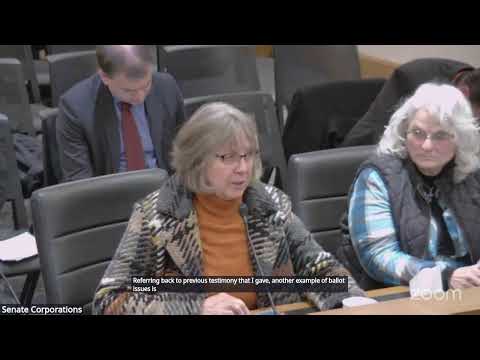
What opponents said Gail Simmons (Civic 307 / Y Vote) recommended removing the Secretary of State reference in subsection E and keeping enforcement at the county level; she argued the change "inserts the Secretary of State into the administration of county elections" and could be duplicative. Several county clerks said they had no formal position but noted concerns that sheriffs may view their investigative responsibility as tied to county clerks rather than the state office.
Committee amendments and votes - The committee removed a second occurrence of the phrase "or offering to vote" in subsection 4 (an amendment offered by Senator Landon), after lawmakers expressed concern about criminalizing honest mistakes such as a voter who had already returned an absentee ballot but then appeared at a polling place. - A proposed change to require the Secretary of State to work "in conjunction with the county clerk" when requesting an investigation failed on a committee vote.
Recorded vote: The committee reported HB154, as amended, to the floor by a 3–2 recorded vote. Senator Dockstader and Senator Steinmetz were recorded voting aye; Senator Landon and Chairman Case voted no; one aye vote was recorded for a senator whose name was not audible in the transcript. Committee members said the Secretary of State’s office and county clerks should continue to coordinate on investigations.
Ending: The bill will proceed to the Senate floor. Committee discussion flagged topics for further consideration, including whether the change expands the Secretary’s role in county-level election investigations and how to avoid criminalizing inadvertent conduct by older voters who returned absentee ballots and later attempted in-person voting.