Get Full Government Meeting Transcripts, Videos, & Alerts Forever!
Get email alerts on the Ballot Drop Boxes topic
No spam. Unsubscribe anytime.
Senate committee advances bill to bar unattended ballot drop boxes after debate and amendments
Summary
House Bill 131, a proposal to clarify that Wyoming law does not allow unattended ballot drop boxes, advanced out of the Senate Corporations, Elections & Political Subdivisions Committee after public testimony and several amendments.
House Bill 131, a proposal to clarify that Wyoming law does not allow unattended ballot drop boxes, advanced out of the Senate Corporations, Elections & Political Subdivisions Committee after public testimony and several amendments.
The committee approved an amendment that would permit a secured receptacle — described by its sponsor as akin to a bank "night drop" — that deposits ballots inside a courthouse or other government building and is accessible only to the county clerk or a sworn designee. The amendment requires that the receptacle be under video surveillance and checked daily, restricts the receptacle to ballot use only, and requires a memorandum of understanding (MOU) for use of government buildings other than the county courthouse. Members also adopted language adding a sworn-designee requirement and a separate amendment that allows possible reimbursement from available federal funds for costs tied to compliance.
Why it matters: Supporters said the bill would remove a security risk they view as inherent to unstaffed drop boxes and create uniform statewide rules. Opponents warned the change could limit access for voters who rely on drop boxes to avoid unsafe or impractical trips to county clerk offices.
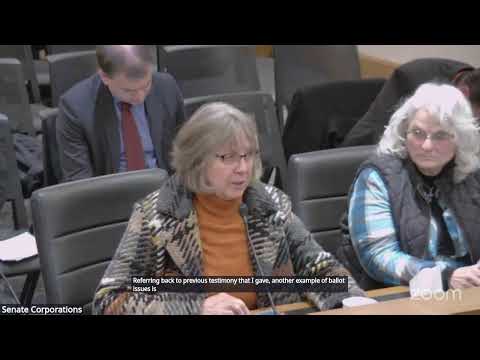
What supporters said Jason Snead, executive director of Honest Elections Project ACTION, urged committee members to "advance this measure" and said "unstaffed drop boxes are a uniquely insecure method of returning a ballot." He cited news reports of vandalism and said passive measures such as cameras and bolting boxes are insufficient: "Cameras are no substitute for a person." (Testimony: Jason Snead.)
Joey Corenti, executive director of Rural Wyoming Matters, said he favored the bill’s direction because cameras alone are reactive and because drop boxes can be inconvenient for rural residents who may drive hundreds of miles to a courthouse. He supported the amendment that would allow a secured receptacle inside a courthouse or other government building, provided clerks retain custody of ballots and chain-of-custody procedures are preserved. (Testimony: Joey Corenti.)
What opponents said Phyllis Roseberry and Linda Burt spoke against banning drop boxes. Roseberry said she opposed the bill because she sees no evidence of widespread fraud in Wyoming and said county clerks have described drop boxes as safe and secure. Linda Burt, representing the Wyoming Coalition Against Domestic Violence and Sexual Assault, said drop boxes provide an important voting option for survivors who may not receive mail at home or who cannot safely appear at public locations. (Testimony: Phyllis Roseberry; Linda Burt.)
Committee action and amendments - Sponsor accepted an amendment to allow a secured exterior receptacle that deposits ballots into a secure interior location; the receptacle must be used only for ballots, be under surveillance, be checked daily, and require an MOU to use other government buildings. - The committee added language that a ballot delivered to a clerk must be delivered to the county clerk or the county clerk’s sworn designee. - The committee adopted a provision permitting reimbursement from available federal funds appropriated to the Secretary of State for expenditures made to comply with the section, intended to reduce the risk of an unfunded mandate.
Vote: The committee reported the bill to the floor by recorded vote, 3–2. Senator Dockstader and Senator Steinmetz were recorded voting aye; Senator Landon and Chairman Case voted no; one aye vote was recorded for a senator whose name was not audible in the transcript. Senator Steinmetz indicated willingness to carry the bill on the floor with the sponsor’s agreement. (Roll call recorded in committee transcript.)
What happens next The measure, as amended, will move to the Senate floor for consideration. Committee members who spoke indicated they expect further debate on implementation details and on balancing access for rural and vulnerable voters with security concerns.
Ending: The committee’s action resolves committee-level consideration but leaves several implementation questions for the floor and for rulemaking, including the details of what documentation or procedures clerks must follow to operate any permitted secured receptacle.