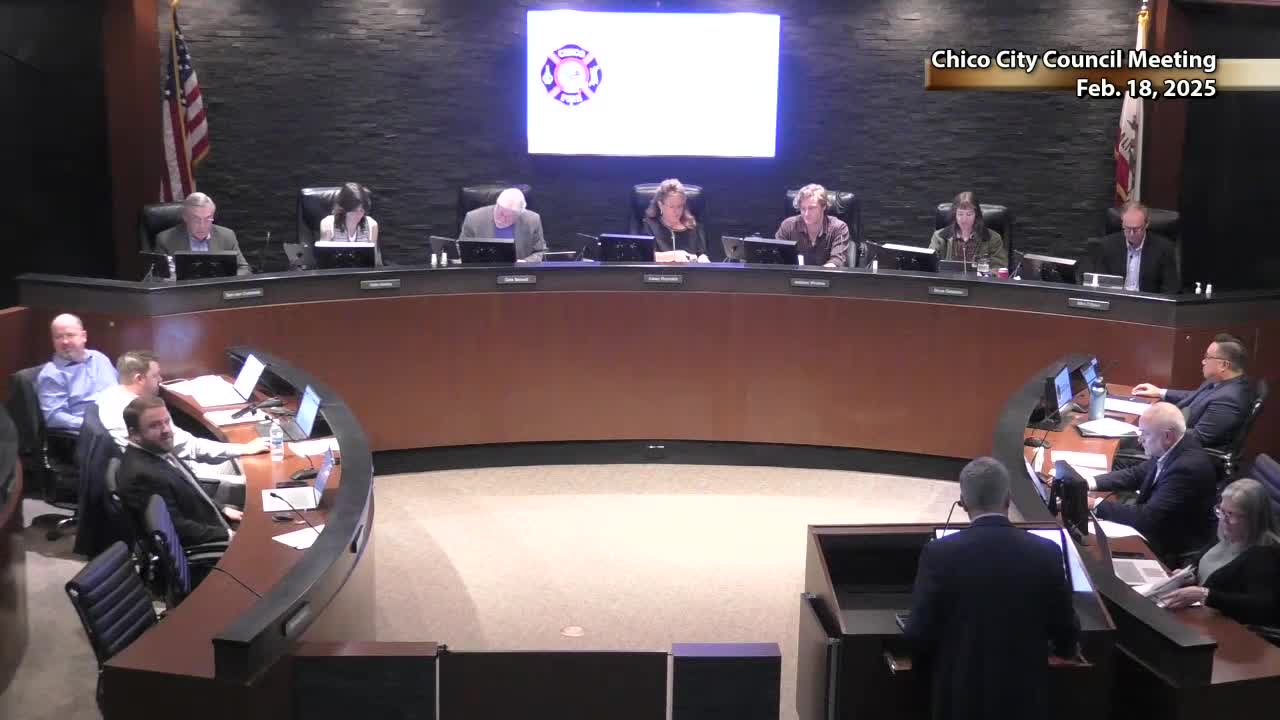
Chico fire chief presents feasibility study for proposed Station 6; estimated base cost $24 million

2341349 · February 18, 2025

Loading...

AI-Generated Content: All content on this page was generated by AI to highlight key points from the meeting. For complete details and context, we recommend watching the full video. so we can fix them.

Summary

Fire Chief Steve Standridge and consultants presented a feasibility study for a new Station 6 to improve response times in North Chico. The study estimates a full-build cost of about $24 million and offers several reduced-footprint options; no council action was taken.

Chico Fire Chief Steve Standridge on Tuesday presented a feasibility study for a proposed Fire Station 6 intended to reduce response gaps in the city’s rapidly growing northern neighborhoods. Standridge and consultant Michael Scott of RRM Design Group described the site design, operational layout and multiple cost options for the new facility.

The study, provided to council members the day before the meeting, places the “overall full design” cost at about $24,000,000. Scott described phased reductions that would lower the up-front cost—one reduced option was presented at about $18,400,000 and smaller configurations were shown down to $16,400,000—while cautioning that fewer apparatus bays would reduce the department’s ability to house and protect vehicles. “The overall full design is about $24,000,000,” Standridge said. “Reducing the bay does reduce ability to respond and ability to have apparatus in the bays.”

Why it matters: the city has seen what Standridge described as “extraordinary growth” concentrated in northern Chico, and the department’s call volume has risen substantially. Standridge told the council that the department ran roughly 7,500 calls in 2005 and about 15,000 calls in 2024. He said current staffing levels leave the city with fewer stations and fewer firefighters per shift than in earlier decades, creating geographic response gaps the new station would help close.

Standridge and Scott reviewed the station’s operational layout: secured apparatus bays, separate “hot” and “clean” zones to reduce firefighter exposure to carcinogens, gender-inclusive dormitory and bathroom designs, and a support area with decontamination and cleaning processes. Scott called the approach “the hot zone design,” describing vestibule air-pressure and separation strategies intended to keep living areas free of contaminants.

The team also outlined siting and design considerations: driveway circulation for large apparatus, overhead utilities and adjacency to a roundabout, and a fenced rear apron for apparatus and employee parking. Scott said the study’s cost estimate includes hard building and site costs plus soft costs such as permits, owner systems, contingency, furnishings and escalation. The consultant said the team used recent California station bids to derive an average of roughly $1,200–$1,500 per square foot for essential-service stations and assumed escalation of about 5% per year; he illustrated how that escalation would raise a $24 million estimate to approximately $25.3 million in one year and $27.9 million in three years.

Public comment from the Chico Firefighters union supported the priorities in the presentation. Mike Healy, representing Chico Firefighters Local 2734, urged the council to pursue both station construction and increased staffing, saying a North Chico 911 caller “would benefit from a strategic advantage” if a station were closer. Healy also urged that staffing increases be a top priority because reopening or staffing additional engine companies would have an immediate effect on daily operations.

No formal council action was taken on Station 6 during the meeting. City staff and consultants remained available to answer technical questions from council members, who asked about roundabout geometry, apparatus conditioning (heating vs. air conditioning), phasing to add bunks later, and the station’s expected life span. Standridge said modern stations are being planned for 50 years or more.

Clarifying details from the meeting: the full-design estimate of about $24,000,000 was presented by the consultant; lower-cost build options shown in the study ranged from approximately $18,400,000 to $16,400,000 depending on the number of apparatus bays and interior program reductions. The consultant used a 5% annual escalation assumption for projecting future costs. Standridge reported departmental call counts of roughly 7,500 calls in 2005 and about 15,000 calls in 2024 and said staffing is currently about 17 firefighters plus one battalion chief per shift (source: presentation by Chief Steve Standridge).