Get Full Government Meeting Transcripts, Videos, & Alerts Forever!
Get email alerts on the Public Safety topic
No spam. Unsubscribe anytime.
Fulshear Police report: traffic enforcement drives most stops; department submits annual racial-profiling analysis
Summary
The police chief presented the department's 2024 annual activity and the statutorily required racial-profiling report, showing 12,047 traffic stops and search hit-rates above national averages; chief said the department is compliant with state reporting requirements and is pursuing technology and recruiting improvements.
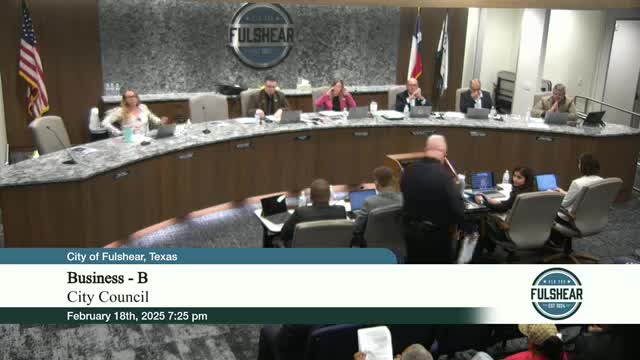
Fulshear Police Chief presented the department’s year‑end activity report and the city’s annual racial‑profiling analysis during the Feb. 18 council meeting.
Key figures from the chief’s report: The department logged 12,047 traffic stops, 8,803 incident reports, 289 traffic collisions and about 8,303 calls for service (self‑initiated and dispatched combined). The chief told council that roughly 82% of traffic contacts involved drivers from outside the city and about 18% were city residents. He said traffic enforcement and traffic‑stop interventions are a significant part of the department’s crime‑prevention strategy.
Racial‑profiling analysis: The police department contracted Dr. Alex Del Carmen to analyze traffic‑stop data, as required by state law. The department reported 4,624 citations and 7,377 warnings issued; total searches were 254 with 93 traffic‑related arrests. The contraband “hit rate” (searches that yielded contraband) is materially higher than national averages in several categories — the chief noted national benchmark hit‑rates are typically near 30% and that Fulshear’s reported hit rates were substantially higher for most groups, which the report interprets as supporting the existence of probable cause for searches rather than indicating discriminatory practice. The department’s overall conclusion in the submitted analysis: the department complied with statutory collection and reporting obligations and has racial‑profiling policies and public complaint/compliment processes in place.
Department operations and challenges: Chief Seymour described recruiting as the top department challenge and said the city is exploring sponsoring academy cadets. The department is upgrading its records-management system and evaluating expanded drone and LPR (license-plate reader) capabilities to speed investigations. The chief also highlighted community outreach: 130 public outreach events and nearly 2,600 lobby contacts in the prior year.
Council questions and follow-up: Council members asked about the rise in aggravated assaults (the chief said many were family‑violence related), clearance rates on major crimes, and whether collision and traffic‑stop numbers should be reported on a per‑capita basis as Fulshear’s population grows; the chief said his reporting already includes rates per thousand population where appropriate and agreed to provide context used in the comparisons. Council also asked about the department’s financial and technology plans to support recruitment and new capabilities.
Next steps: The department will continue quarterly reporting of metrics and pursue technology improvements; the racial‑profiling packet will be filed as required and is available with the city’s public records.