Get Full Government Meeting Transcripts, Videos, & Alerts Forever!
Get email alerts on the Ag Innovation Incubator topic
No spam. Unsubscribe anytime.
Consultant: Small, ag-focused incubator is most feasible for Caldwell but will require public and private support
Summary
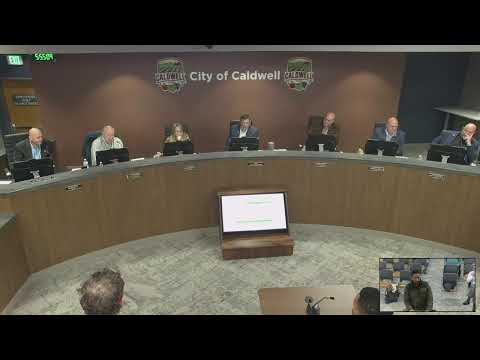
At a Caldwell City Council workshop, Points Consulting presented a feasibility study for an Ag Innovation Center, recommending a small, ag-focused incubator as the most financially plausible option while stressing it would need public subsidies and private partnerships to operate.
A feasibility study presented Wednesday to the Caldwell City Council recommended a small, agriculture-focused business incubator as the most feasible option for the city, but said the center would require continued public and private support to operate.
Brian Points, president of Points Consulting, told the council the study found the incubator concept could help grow local entrepreneurship but "it is, but it depends on how much, the city would want to spend on that to sustain it. Because it's not gonna It would need some form of public support, to, to be feasible. Right? It's not gonna completely cover its costs according to our analysis." The consultant said the small‑scale option is the only one in the study that produces a modest operating surplus under the assumptions used.
The study, funded by a $25,000 grant awarded to the city’s economic development department, tested three facility sizes and several operating scenarios. Points said projected earned revenue from facility rentals ranged from about $28,000 at the low end to about $124,000 at the high end, and total annual income in modeled scenarios ran roughly from $244,000 to $474,000. Even with those revenues and assumed grants or sponsorships, the pro forma showed only the small building option generating a slight surplus — a little over $15,000 per year under the consultant’s assumptions. A 25‑year loan at about 7% was used in the models.
The study also reviewed local market conditions and operating needs. Points said Caldwell’s industrial vacancy rates are very low and that there is a shortage of small, sub‑1,500‑square‑foot rentable spaces: "when you're talking about something that's less than 1,500 square feet for an office or for, something rentable, it really doesn't exist." The consultant advised that an ag‑focused incubator would likely perform best in flex/warehouse‑style space with loading docks rather than in downtown office space, noting production and shipping needs for many ag enterprises.
Points summarized operational requirements for success: a clear intake and graduation policy, on‑site staffing, mentorship and programming, and facility design aligned to the strategy. "What you have to understand is that you need to have a good strategy if this is gonna be pulled off. You can't just say, we're taking any kind of business, and they can stay here as long as they want," he said.
City economic development staff told the council that next steps would include furthering partnerships with higher education and local industry and returning with a funding plan if the council directs staff to move forward. Steven Jenkins, speaking for the department, listed potential private partners and local employers to approach, and framed the center as a retention tool: "our goal in economic development is to retain talent in the community. We don't want our ideas going to other communities or other cities outside of Caldwell." Jenkins suggested outreach to local firms to assess private sponsorship interest before asking for taxpayer funds.
Council members pressed the consultant on industry outreach. Councilor Stottick asked why the study team had not engaged major local agriculture companies and observed that their foundations might cover costs: "I would think that if you got the SIMPLOTS involved, the Crookham Seed[s], and all the other folks that it is we don't even need to approach the taxpayers on this because they might have enough funds in their foundations to support this thing." Points said the study had kept community engagement limited per the project scope, and staff said prior stakeholder work and future outreach could include those industry partners.
The study recommends starting small and scaling if the incubator proves successful, while noting that medium and large facility options look harder to justify without substantially more subsidy or sponsorship. The consultant made available a longer slide deck and the underlying pro forma for staff review and adjustment if the council wishes to pursue a specific site or funding package.
The workshop did not include a formal vote; staff requested direction from the council on whether to pursue partnerships and a funding plan for a small, ag‑focused incubator.