Get Full Government Meeting Transcripts, Videos, & Alerts Forever!
Get email alerts on the Economic Development topic
No spam. Unsubscribe anytime.
McKinney EDC highlights 2024 wins, outlines 2025 land, innovation and downtown plans; council to enter executive session on development deals
Summary
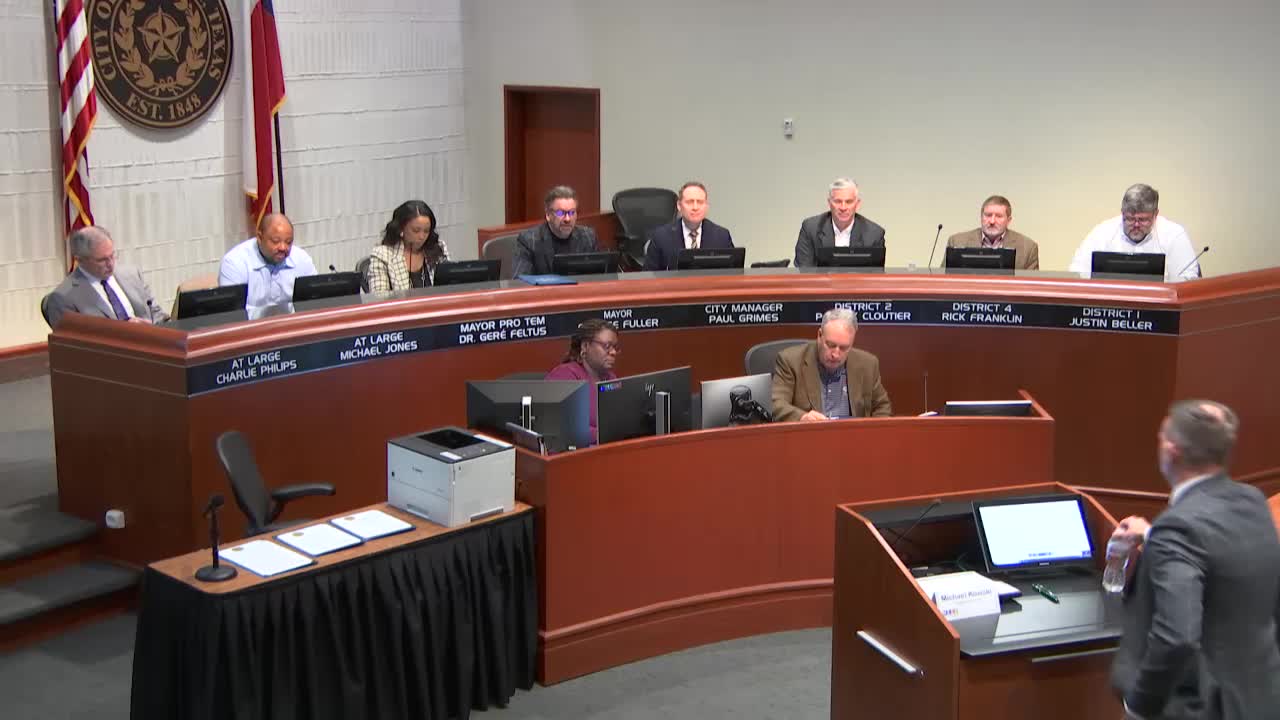
Tuesday in February 2025, at a joint meeting of the McKinney City Council and the McKinney Economic Development Corporation (MEDC), MEDC President Mike Korkowski delivered a review of 2024 accomplishments and outlined goals for 2025, and the council and EDC announced they would move into executive session to discuss real estate and economic development matters.
Tuesday in February 2025, at a joint meeting of the McKinney City Council and the McKinney Economic Development Corporation (MEDC), MEDC President Mike Korkowski delivered a review of 2024 accomplishments and outlined goals for 2025, and the council and EDC announced they would move into executive session to discuss real estate and economic development matters.
Korkowski, president of the MEDC, said the organization closed 15 projects in 2024, activated 82 acres of EDC-owned land, announced about $500,000,000 in projects and reported 1,800 jobs tied to those efforts. He asked the room to “celebrate 2024 and look at 2025 in more detail here,” and later said, “We’re firing on all cylinders, I would submit.”
Why it matters: the MEDC directs a portion of city sales tax revenue to economic development projects and works to attract companies, support local business growth and market McKinney to outside investors. The body’s work shapes downtown development, land use near the Sheraton/amphitheater site, and planned acquisitions that could affect city land holdings and future commercial development.
Presentation highlights and figures
Korkowski walked the council through MEDC metrics and program work. Items he cited included: 176 applications to the MEDC innovation fund in one year, recognition of McKinney as a Plug n Play AI hub, 47 startups funded through the innovation fund over five years, and an asserted $8,000,000,000 of projected economic impact over 20 years tied to MEDC-supported projects. He named private-sector wins the MEDC supported, including relocations or expansions by Maverick Power and Globe Life and corporate transactions involving AcroWire, SRS and Independent Financial. He also noted workforce-development dollars that he said totaled more than $650,000 brought to McKinney for training and upskilling.
Korkowski described MEDC’s five strategic pillars for 2025 as “Attract, Grow, Innovate, Lead, Engage,” and listed several near‑term priorities: purchase of at least 100 more acres of land, a labor-market study, a refresh of the innovation fund to expand office space for startups, updating incentive structures with an emphasis on downtown McKinney, and hosting larger signature events to raise the city’s profile. He also highlighted plans to better engage local school districts and to build an employee resource guide for prospective companies.
Korkowski identified specific projects and initiatives in his talk: a new outdoor amphitheater; the first surf resort and adventure park in the Dallas–Fort Worth area; expansion of District 121 office tenants; the Plug n Play partnership; and support for the McKinney Sheraton Hotel master plan. He said Plug n Play has identified McKinney as one of roughly 10 global AI hubs alongside cities such as Zurich and London.
Board context and tax explanation
Chairman Lochner Miller (identified in the meeting as the MEDC chair) described the MEDC’s role in the city’s funding structure and urged public clarity about the source of EDC funds. He said the EDC “was established specifically for the purpose of allocating sales tax dollars to projects” and emphasized that the sales-tax allocation is not a new tax, saying, “it’s 1¢ of a 2¢ tax that the city already gets from sales tax.”
Executive session and procedural actions
Near the end of the joint session, the body announced it would move into executive session under Texas Government Code sections 551.071 (consultation with attorney), 551.072 (deliberations about real property) and 551.087 (economic development). The posted executive-session topics included deliberations about 42.5348 acres in the George Fitzhugh survey (Tract 8), strategic real estate acquisitions, and economic development matters described in the agenda as Craig Ranch Resort Hotel, Hemispheres, Project Mirage and Project Terrigen. The EDC’s posted language matched the council’s announcement.
After the executive-session call, the meeting was recessed and later adjourned following a motion to adjourn that was seconded.
What the meeting did not include
No members of the public spoke during the public-comment portion of the joint session. There were no formal votes recorded on incentives, land purchases or other development agreements in the public portion of the meeting; those items were listed for discussion in the executive session and were not decided or disclosed in open session.
Next steps and outlook
The MEDC presentation framed 2025 work around downtown development, land acquisition and an expanded innovation program. The council and EDC’s move into executive session signals the bodies will deliberate in private on specific property and incentive matters before any public action is taken.