Get Full Government Meeting Transcripts, Videos, & Alerts Forever!
Get email alerts on the Impact Fees topic
No spam. Unsubscribe anytime.
Glenn Heights holds first reading of impact-fee ordinance after consultants outline up-to-$10,000 charge for new single-family home
Summary
City consultants presented a technical impact-fee study and a range of potential fees tied to a 10-year capital improvements plan; council held a public hearing, asked technical questions and signaled preliminary preference for a 50% credit cap but took no final vote on the ordinance.
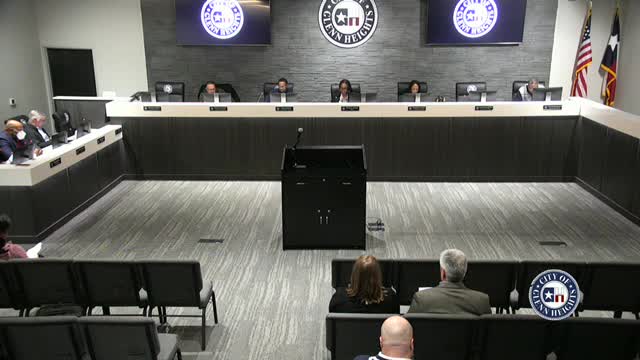
The Glenn Heights City Council on Wednesday held a public hearing and the first reading of ordinance O-04-25, a proposed impact-fee ordinance that would adopt land-use assumptions and a 10-year capital improvements plan (CIP) and allow the city to levy fees on new development to pay for additional road, water and wastewater capacity.
The ordinance, which would repeal and replace article 10.3 of the code of ordinances and add section A2.1 to the master fee schedule, was presented by consultants from Fries & Nichols and discussed at length by council members and staff. Council opened and then closed the hearing by unanimous votes; no final adoption vote was taken on the ordinance at first reading.
Why it matters: The study frames how new development would share the cost of major infrastructure projects included in the CIP. Adopting impact fees would shift some infrastructure costs from current taxpayers to new development; how much new development pays will depend on the council’s chosen collection rate (policy) within legal ceilings set by state law and the study’s technical calculations.
Consultants described the technical basis for fees and offered examples. Fries & Nichols presented planning-level cost estimates for the CIP and said the roadway component totals roughly $59.4 million in planning-level construction, right-of-way and financing costs; the firm identified $34.1 million in impact-fee-eligible water projects after filtering for growth-related capacity. The consultants applied a 50% credit in their example calculations — meaning, in the study’s illustration, half of eligible growth costs would be borne by the tax base and half would be recoverable through impact fees.
Using the study’s assumptions, the consultants computed a sample impact fee for a standard single-family dwelling (using Glenn Heights’ 3/4-inch meter as the baseline and a residential vehicle-mile service unit): approximately $6,147 for roadway impacts, about $3,400 for water and about $962 for wastewater — roughly $10,500 total per single-family dwelling at the maximum collection ceiling used in the study. A 30,000-square-foot retail center produced a sample total impact fee in the study on the order of six figures (road, water and wastewater combined) when assessed at the maximum collection rates shown in the presentation.
The consultants repeatedly described the numbers as planning-level estimates and emphasized that the law limits fees to costs attributable to growth over the 10-year planning window. They also described how service units are calculated: vehicle-miles for roads, meter-equivalents for water and wastewater, and a land-use trip-generation table tied to Institute of Transportation Engineers (ITE) rates to translate building size and type into vehicle-miles of demand.
Council members pressed on several technical and policy points. Questions included why sewer-related fees were lower relative to roads (consultants said existing system capacity and how much of future capacity is attributable to growth drives that result), how often the fee program must be updated (at least every five years), and how assessments and collections would be applied (assessment occurs when a permit is pulled; there is a 12-month grandfathering window for projects already approved in the pipeline).
Council members also discussed how the fees would be charged for irrigation meters: staff noted some homes in the city are required to have separate irrigation and domestic meters, which under the draft approach would each be assessed. Several councilmembers asked staff to consider charging a single water-related impact fee rather than applying an impact fee to irrigation meters in addition to domestic meters.
Next steps: Staff and the consultants will return with final ordinance language and fee tables for a second reading. Several councilmembers signaled a preliminary preference for adopting the study’s technical ceilings but collecting at a 50% credit level; on the water/irrigation question the council was split (a majority favored charging one water impact fee, while others favored charging per meter). Councilmembers were asked to submit any further preferences to the city manager before the second reading. No adoption occurred at first reading.
Meeting context: The presentation and Q&A occupied the council’s last and lengthiest agenda item; the council engaged in detailed technical questions and policy discussion but reserved final action for a future meeting.
Ending: The ordinance will return for a second reading with revised ordinance text and the council’s requested clarifications; adoption would require a subsequent formal vote.