Get Full Government Meeting Transcripts, Videos, & Alerts Forever!
Get email alerts on the Zoning topic
No spam. Unsubscribe anytime.
DeSoto council pauses vote on reduced Hampton Road character-code rezoning after mixed public response
Summary
City staff presented a reduced Hampton Road character-code zoning map; planners and the public offered both support and opposition. Council withdrew its motion and continued the item to March 4 so staff can verify protest thresholds and supply missing PD details.
The DeSoto City Council on Feb. 18 heard staff presentations and public comment on a reduced, reenvisioned Hampton Road character-code zoning map but did not act, instead continuing the matter to the council meeting on March 4 for additional information.
City Development Director Charles Brewer presented the history and scope of the charter-code effort and described a smaller boundary that focuses redevelopment on Hampton Road and immediate adjacent commercial corridors rather than the larger residential areas included in an earlier draft. Brewer said the reduced boundary was developed after public outreach and joint meetings with the Planning and Zoning Commission and the DeSoto Development Corporation.
The map presented would create five new HRCC districts—Urban Center, Urban General, Neighborhood Services, Urban Neighborhood and Neighborhood Transition—intended to concentrate mixed uses and higher densities along the corridor. Brewer told the council the reduced area contains roughly two dozen lots that staff flagged as potentially going from conforming to nonconforming uses under the new code; those property owners received special statutory notice tied to Senate Bill 929 (2023).
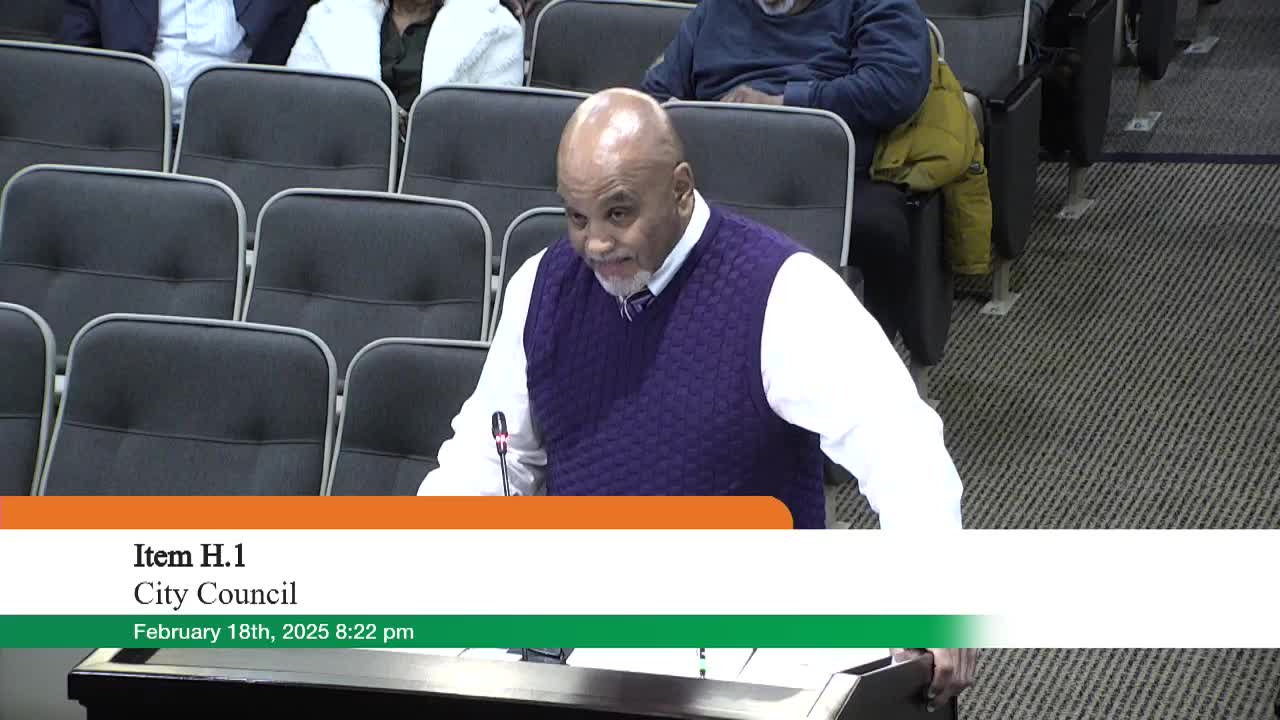
Members of the public and developers gave mixed comment. Supporters including developers and local business advocates said the code would help attract private investment and create a walkable, mixed‑use corridor similar to Bishop Arts or Trinity Groves. Opponents—many of them residential property owners within or near the proposed boundary—said they were not adequately informed or worried about losing uses allowed today.
Several council members and staff raised a procedural issue the packet did not fully resolve: under state law a sufficiently large, properly documented protest by property owners can change the voting threshold required to approve a rezoning. Staff reported it had received 9 written letters in support and 36 in opposition, but the council did not have the GIS‑verified protest calculation on hand to show whether the opposition met the statutory threshold that would require a supermajority or otherwise affect the vote.
Council questions also focused on four existing Planned Development (PD) areas inside the boundary. Staff recommended excluding four PDs (including the large DeSoto Marketplace PD) from the rezoning because several PDs include site‑specific deviations that would otherwise become legal nonconforming uses. Council members asked for clearer documentation of the PD provisions and who requested exclusion.
Because the council did not have the verified protest calculation and asked for more granular PD documentation, the motion to approve the ordinance excluding the PDs was withdrawn. The council directed staff to provide the missing protest map and a clearer summary of the four PDs and their deviations and scheduled the item to return to the March 4 meeting. Staff committed to deliver the requested project and protest information to council ahead of that meeting.
The review process to date includes a 2022 streetscape plan, consultant work and multiple public outreach events. The Planning & Zoning Commission recommended approval of the reduced rezoning (6–1) on Jan. 28; council action was continued after the Feb. 18 exchange.
Next steps: staff will verify the protest calculation against notified property owners, prepare a concise summary of the four PDs and their deviations, and return the rezoning item to council on March 4 for possible action. If the protest threshold is triggered, state law may change the vote requirement to adopt the rezoning.