Get Full Government Meeting Transcripts, Videos, & Alerts Forever!
Get email alerts on the Traffic Safety topic
No spam. Unsubscribe anytime.
Murphy Police cite speeding, increase enforcement in Maxwell Creek neighborhood
Summary
Police presented speed data showing more than half of vehicles exceeded the 25 mph limit in Maxwell Creek and said they will increase targeted enforcement, add stop-line markings and coordinate with public works on signage reminders.
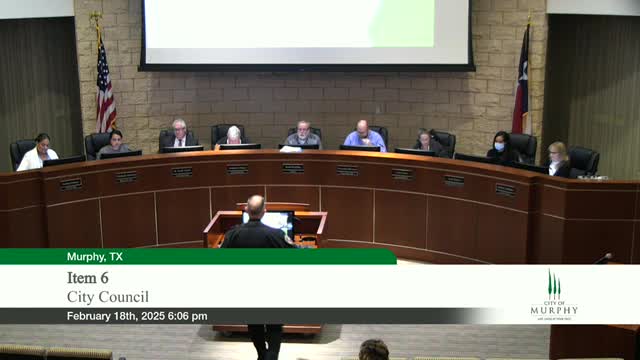
Chief Gibson of the Murphy Police Department told the City Council on Feb. 18 that a department study of Maxwell Creek found speeding — not running stop signs — to be the primary traffic problem in that neighborhood.
The presentation, given during the council—s presentations section, focused on data from a pole-mounted speed-measuring device and on in-person officer observations at the intersection of Camrose and Candlewood Trail. "We do not have a problem with stop signs," Chief Gibson said, adding that the department had recommendations to make stop signs more effective but that "we do have an issue with speed."
Why it matters: Council members and residents have raised repeated complaints on social media about speeding in Maxwell Creek and other recent subdivisions. The police—s data-driven approach will shape where officers are deployed and how the city communicates enforcement to residents.
The department reported that 53% of measured vehicles exceeded the posted 25 mph limit. Chief Gibson said officers recorded 3,914 vehicle speed measurements on the device, and cited two anomalous early-morning readings, including one vehicle recorded at 74 mph. The device does not display speeds to passing motorists but flashes lights when a vehicle exceeds the posted limit, Chief Gibson said. "When we have the numbers we can validate our purpose," he added.
Chief Gibson described the city's planned responses: a heavier, visible enforcement presence in Maxwell Creek; coordination with public works to paint a stop line at the Camrose and Candlewood intersection and add approach signage; continued use of the pole-mounted speed device to guide patrol placement; and follow-up by the police department—s new community-relations function on resident complaints.
The chief said roughly half of the speed violators identified lived in Murphy and that many of those contacted told officers that they were among the residents who had complained. He also noted that officers often receive complaints after enforcement begins. Investigator Gilbert was named by the chief as the staff member who will take part in future presentations and follow-ups.
Council members asked whether the department would expand the approach to other neighborhoods; the chief said the same methods would be used elsewhere and staff would accept suggestions for locations. A council member asked why the city does not use speed bumps; Chief Gibson said both police and fire oppose speed bumps because of response-time and vehicle-damage concerns and cited maintenance costs and liability as additional drawbacks.
The presentation included no ordinance or formal council action. Instead, it established a staff direction: the police department will increase targeted enforcement in Maxwell Creek, coordinate with public works on a painted stop line and signage, and use the department—s community-relations follow-up process on resident complaints. Chief Gibson said the department will present similar reports in the future when neighborhoods request them.
Ending: The council did not take a formal vote on the presentation. Police officials said the actions described are operational and will be implemented by city staff and the police department.