Get Full Government Meeting Transcripts, Videos, & Alerts Forever!
Get email alerts on the Un Reform Pact For The Future topic
No spam. Unsubscribe anytime.
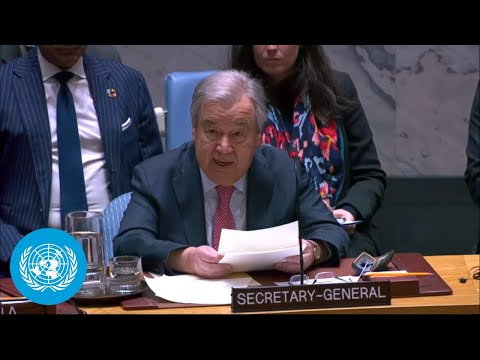
UN secretary-general urges Security Council reform, highlights 'Pact for the Future'
Summary
United Nations Secretary‑General António Guterres told the Security Council that the organization must update its structures and working methods to meet 21st‑century threats, urging member states to back the Pact for the Future and to strengthen peace operations, disarmament efforts and inclusion of developing countries.
United Nations Secretary‑General António Guterres told the Security Council that the United Nations must modernize its institutions and working methods to better prevent conflict, manage global risks and support development.
Guterres’ remarks — delivered as the organization marks its eightieth anniversary — focused on a multilateral reform package known as the “Pact for the Future,” which he said aims to strengthen peace operations, advance disarmament, and give developing countries greater voice in global decision‑making. “We have the hardware for international cooperation, but the software needs an update,” Guterres said.
Why this matters: Guterres framed reform as essential to addressing concurrent global crises — from the climate emergency and rising inequalities to the risk of nuclear conflict and the rapid spread of powerful technologies such as artificial intelligence. He urged members of the Council to rebuild trust in multilateralism and to work toward consensus so the U.N. can more effectively prevent and resolve conflicts.
Guterres reviewed several elements of the Pact for the Future he presented earlier this year. He said the pact prioritizes prevention, mediation and peacebuilding, and calls for clearer, sequenced mandates for peace operations with achievable objectives and viable exit strategies. “It also specifically calls on this council to ensure that peace operations are guided by clear and sequenced mandates that are realistic and achievable, with viable exit strategies and transition plans,” he said.
The secretary‑general said the pact includes a proposed “SDG stimulus” to help developing countries invest in people and renewable energy, and a global digital compact that would establish an AI governance body to bring developing countries into decision‑making for the first time. He also described the pact as containing “the first multilateral agreement on nuclear disarmament in more than a decade” and renewed calls to prevent chemical and biological weapons and arms races in outer space.
Guterres explicitly tied the need for reform to ongoing conflicts, naming the occupied Palestinian territory, Ukraine, Sudan and the Democratic Republic of the Congo as examples where peace is “getting pushed further out of reach.” He warned of the “clear and present danger” of nuclear war and described terrorism, violent extremism and a “dark spirit of impunity” as persistent threats.
On council composition, Guterres said the Security Council should reflect the geopolitical realities of today rather than the world of 80 years ago and called for enlargement and improved working methods that are more inclusive, transparent and accountable. “This council should be enlarged and made more representative of today's geopolitical realities,” he said.
Guterres pointed to past council achievements as evidence that collective action is possible, citing peacekeeping deployments and a recent “landmark resolution 27 19 supporting African Union led peace support operations through assessed contributions.” He urged members to “overcome the divisions that are blocking effective action for peace” and to summon “the same spirit” of cooperation that sustained the council through the Cold War.
A presiding representative thanked the secretary‑general after the briefing. No formal decisions, votes or motions were recorded in the transcript of the meeting.
The briefing emphasized inclusion of women, youth and marginalized groups in peace processes and stressed that sustainable peace requires sustainable development and fiscal reforms to better represent developing countries’ needs. Guterres concluded by calling on member states to strengthen and update global problem‑solving mechanisms “to make them fit for purpose, fit for people, and fit for peace.”