Get Full Government Meeting Transcripts, Videos, & Alerts Forever!
Get email alerts on the Disaster Recovery topic
No spam. Unsubscribe anytime.
Black Mountain council reviews $27 million damage inventory, approves Hilltop Road stabilization
Summary
Assistant Manager Jessica Trotman told the Black Mountain Town Council the town's damage inventory totals roughly $27 million and outlined FEMA, state and loan options. The council voted to fund a temporary stabilization of Hilltop Road, authorizing up to $300,000 to be taken from the town's paving line item.
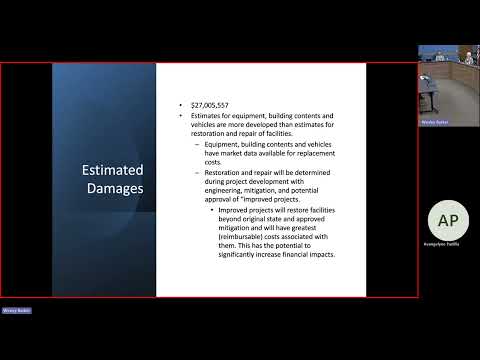
Assistant Manager Jessica Trotman told the Black Mountain Town Council on a recovery update that the town's preliminary damage inventory (DI) totals a little over $27,000,000, and that amount is a high-level estimate used to start project development with FEMA and the state.
The DI is not a lump sum the town can spend immediately, Trotman said. “We do not have $28,000,000,” she told the council, adding that the DI is a “very high level summary of damages” used to schedule site inspections and create projects for federal review and potential reimbursement.
Why it matters: The DI determines which projects the Federal Emergency Management Agency (FEMA) and the State will review for public assistance and which items the town will need to advance with its own funds until reimbursements are processed. Trotman warned that federal reimbursement rules apply to projects funded up-front and that insurance proceeds reduce FEMA reimbursements on the same items.
Trotman outlined the major funding streams and constraints the town is tracking: FEMA public assistance (a reimbursement model), a state cash-flow loan program (she said there’s currently $100,000,000 in the state pot), a DEQ loan restricted to water system and green infrastructure, insurance proceeds (about $2,100,000 received so far), grants, private lending and philanthropic support. She said the town has submitted its DI on time and has started project development and expedited FEMA projects; the town has received half of the expedited-project payments for some items.
On project timing and scope, Trotman said permanent repairs often require more extensive environmental, historic-preservation and procurement reviews than temporary fixes. “Restoration and repair, we will not really know the full scope of that until we get into project development,” she said. She added FEMA typically allows mitigation work that shows a cost-effectiveness benefit and that improved projects can significantly raise costs and are subject to FEMA approval.
Council members asked about revenue replacement for lost fees and sales-tax impacts. Trotman said no revenue-replacement program is currently available to the town and the town is documenting revenue losses in case such a program becomes available. Finance staff reported November sales-tax receipts were up about 5.3% from the prior year but cautioned that revenues will continue to fluctuate as recovery proceeds.
Hilltop Road stabilization and council action
Residents from Hilltop Road described accelerating erosion undermining the travel surface and utility lines. John DeWitt of Hilltop Road said the erosion had worsened over five months and pleaded for quick action: “Can you at least fix it? I have no idea how to fix it. I just need it fixed.”
Council members and staff discussed a temporary stabilization option estimated in the DI at $261,000 that could be procured under an expedited (temporary) project approach and would also count toward a future permanent repair. Staff said temporary stabilization focuses on geometric repairs, large stone placement, drainage piping and compaction sufficient to slow further collapse; permanent fixes will require surveying, engineering and possible rights-of-way or property acquisition.
A motion was made to proceed with the temporary stabilization project, capped at $300,000 to include engineering, and to fund it from the town’s paving line item rather than general fund balance. The council voted in favor; the motion carried. (Transcript shows the motion was moved and approved; specific mover/second and roll-call votes were not recorded in the transcript.)
What the vote does — and does not — do
The approved action authorizes staff to begin permitting, obtain temporary rights of entry, procure engineering and begin stabilization work under an expedited approach. Staff said temporary stabilization will not immediately reopen the road to full traffic; it is intended to stop further deterioration and to integrate with a later permanent repair. Staff estimated typical reimbursement timelines from FEMA and state programs at roughly one year but warned that timing is unpredictable and depends on federal and state prioritization and available inspection resources.
Next steps and transparency
Trotman said the town is preparing a prioritization matrix and scenario analyses for an upcoming retreat in March to help council members compare phasing and funding options. She emphasized documentation requirements for FEMA reimbursement and said staff are tracking all receipts, insurance and volunteer-related in-kind assistance for possible reimbursement eligibility.
Votes at a glance
- Motion to proceed with temporary stabilization of Hilltop Road, not to exceed $300,000 and to be funded from the town’s paving line item — approved (mover/second not specified in transcript).
- Multiple board appointments (Land of Sky Regional Council delegates; Asheville Regional Housing Consortium delegate; French Broad River MPO primary/alternate; Blackmon Center for the Arts primary/alternate; Chamber of Commerce primary/alternate) were each moved and approved by voice vote during the meeting; the transcript records “Aye” for each but does not record individual roll-call votes.
Council members and staff repeated that this recovery process will be multi-year and will require balancing regular municipal needs with recovery spending while waiting for reimbursements and additional state or federal aid.