Get Full Government Meeting Transcripts, Videos, & Alerts Forever!
Get email alerts on the Firearms Policy topic
No spam. Unsubscribe anytime.
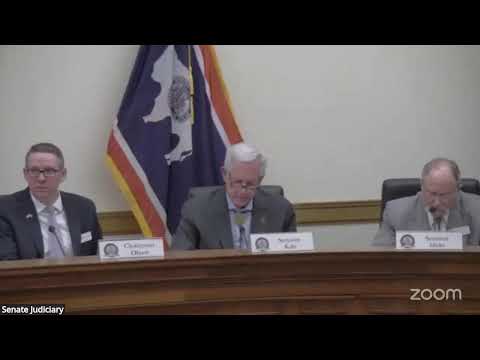
Senate Judiciary advances bill to repeal many gun-free zones; amendments add student and storage limits
Summary
The Senate Judiciary Committee on Monday voted to advance House Bill 172, a measure that would repeal certain gun‑free zone restrictions and allow some concealed carry on public property, after adopting amendments that bar enrolled K–12 students from carrying in their own schools and that tighten storage requirements.
The Senate Judiciary Committee on Monday voted to advance House Bill 172, a bill to repeal specified gun‑free zone restrictions on public property and to allow certain concealed carry in state public spaces and schools, after receiving more than two hours of public comment and adopting a series of amendments.
The committee voted 5‑0 on a roll call to pass the bill with amendments. Senator Kolb moved the bill; Senators Crago, Crum, Hicks, Cole and Chairman Olsen recorded aye votes when the clerk called the roll. The measure will move to the Senate floor with the committee’s changes.
Why it matters: HB 172 would change where people with concealed‑carry permits may carry on public property funded by taxpayers, including some government buildings and K–12 school facilities. Supporters said allowing concealed carry in those places gives law‑abiding permit holders a chance to stop attacks when law enforcement cannot arrive immediately. Opponents said the change increases risks for students and school staff, raises costs for districts to secure storage and facilities, and removes local control over school safety decisions.
Committee action and key amendments - The committee adopted an amendment by Senator Crago that prohibits any person authorized to carry a concealed weapon under the statute from carrying a concealed firearm into any elementary or secondary school facility if the person is enrolled as a student at any elementary or secondary school. The language mirrors a provision from last year’s draft and is intended to keep currently enrolled K–12 students from carrying into their own schools. - Senators adopted clarifying language (sponsored by Senator Crum) to ensure state‑owned but not otherwise licensed facilities would be included where the bill references licensed child‑care and similar facilities. - The committee revised storage language to require that, when firearms are not carried on a person and are stored on campus or in dormitories, they be kept in a lockbox or container that remains within the direct control of the permit holder at all times (the committee replaced an initially broader reference to “locking containers” with this direct‑control requirement). Senators also added volunteers to the employee‑carry provisions so rules applying to employees also apply to volunteers who regularly are on campus. - Multiple small technical and cleanup amendments were adopted after discussion.
Public testimony: themes and representative remarks Supporters: Witnesses who testified in favor said gun‑free zones make soft targets and that armed, trained civilians can stop attackers when police response is delayed. Cathy Russell, with the Wyoming Republican Party, said “This is defense of life. We have to be able to meet force with force.” Joey Curenti, a retired uniformed‑service small arms specialist, told the committee that many crimes the bill addresses already are criminal under Wyoming law and said permit holders should be allowed to carry to protect themselves and others. Aaron Doerr, representing Wyoming Gun Owners, summarized supporters’ view: the bill “gives our members a chance to defend themselves in areas they can’t do so currently.” Several witnesses associated with national organizations, including representatives who identified as affiliated with the National Rifle Association and Turning Point USA, also urged approval.
Opponents: School leaders, educators, and domestic‑violence advocates urged the committee to retain local control and to prioritize safety and mental‑health needs. Gillian Chapman, superintendent of Teton County School District, said she “stands in opposition to this bill as it increases the risk of violence, negatively impacts mental health, and impacts the ability to recruit and to retain staff.” Brian Farmer of the Wyoming School Boards Association asked lawmakers to explicitly prohibit students from carrying and to consider volunteers; his organization favors maintaining local control. A representative of the Wyoming Coalition Against Domestic Violence and Sexual Assault warned that “access to a firearm makes it five times more likely that a woman will be killed by her abusive partner,” and cited peer‑reviewed research when urging careful attention to domestic‑violence risks.
Evidence and research cited in testimony Witnesses debated competing studies and statistics: some witnesses cited high percentages of mass attacks occurring in designated gun‑free areas (figures commonly referenced in testimony), while others — including a witness who identified himself as a researcher at the Crime Prevention Research Center — said studies distinguishing active‑shooter events from other kinds of gun violence are necessary for accurate comparisons. Several witnesses referenced the U.S. Supreme Court’s District of Columbia v. Heller decision; committee members and witnesses discussed constitutional limits on the second amendment as framed in that opinion.
Discussion vs. decision Committee discussion centered on scope and enforcement: senators debated how to enforce student exclusions, how to define covered facilities (including state‑owned day‑care centers), and technical language about storage requirements for firearms kept on campus when not carried. Committee members repeatedly emphasized they were trying to preserve local control where feasible while addressing public‑safety concerns. After adopting the amendments described above, the committee voted to advance the bill to the Senate floor.
Votes at a glance - House Bill 172 — Motion to pass with amendments (moved by Senator Kolb): outcome — approved by committee; roll call: Senator Crago — aye; Senator Crum — aye; Senator Hicks — aye; Senator Cole — aye; Chairman Olsen — aye. (Result read on the record: “5 ayes do pass with amendments.”)
What’s next The bill will be carried to the Senate floor; one senator on the committee indicated an intention to carry it on the floor. Committee members discussed the possibility of additional floor‑level amendments (including language about airports) but did not adopt further changes in committee.
Reporting notes Testimony included a broad range of community voices: educators and superintendents, school board representatives, law‑enforcement veterans, representatives of advocacy organizations on both sides of the issue, students, and private‑citizen residents. The committee limited public testimony to two minutes per speaker and accepted both in‑room and online testimony.
Ending note Committee members said the bill addresses a contentious trade‑off between public safety and firearm access and will continue to be debated on the Senate floor with the amendments the committee adopted.