Get Full Government Meeting Transcripts, Videos, & Alerts Forever!
Get email alerts on the Fire Relief Fee Waiver topic
No spam. Unsubscribe anytime.
San Antonio council backs review of fee waivers and post-fire assistance after homeowners displaced by blazes
Summary
Councilmembers directed staff to explore fee waivers and a coordinated city assistance process for households affected by residential fires after hearing examples of displaced families and gaps in current support programs.
The San Antonio City Council on Feb. 17 directed staff to explore policies that would waive certain municipal fees for homeowners after residential fires and to establish a clearer city assistance process for families displaced by fires.
Councilmembers described multiple recent residential fires that displaced families and stressed the need for a coordinated municipal response. The council instructed staff to evaluate potential fee-waiver policies and to review existing assistance programs for gaps affecting homeowners.
Councilmember Rocha García raised specific examples of families displaced after recent house fires and told the council those households struggled with housing, clothing and other immediate needs in the days after a blaze. Councilmembers said that, according to material presented at the meeting, the city had recorded an average of 43 residential fires per month over the last two years; the council asked staff to examine how fee waivers might reduce rebuild costs for affected homeowners.
Presenters noted the city currently has a program that offers up to $3,000 for moving and rental assistance but that the benefit is aimed at renters, not homeowners. Councilmembers said the Department of Development Services (DSD) and Neighborhood and Housing Services Department (NHSD) currently coordinate assistance on a case-by-case basis; NHSD involvement typically occurs only when requested by DSD. Councilmembers and staff discussed working with partner organizations such as the Red Cross for immediate needs and local nonprofits for clothing and other donations.
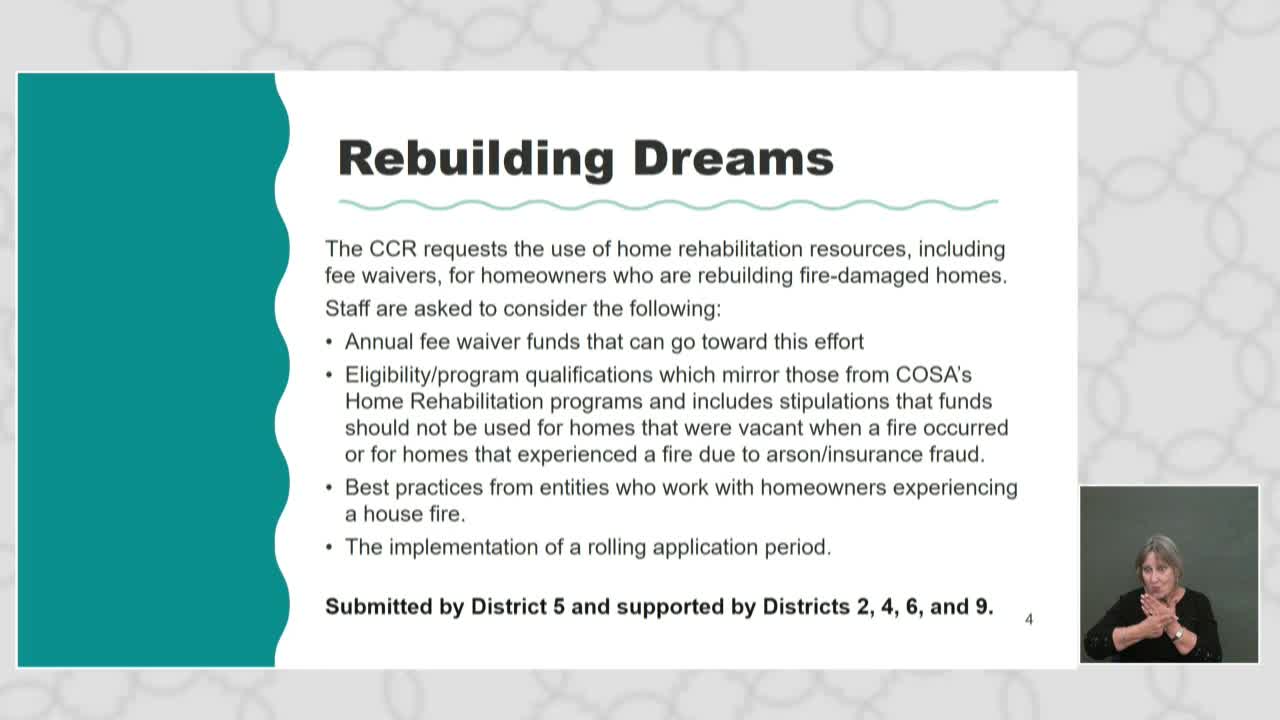
During discussion the council said the first citizen request (recorded as a CCR) was filed by District 5 and was supported, according to the meeting record, by Districts 2, 4, 6 and 9. A second CCR, filed by Districts 4 and 5, was noted as supported by other districts in the meeting record. The council moved and seconded the two items and voted to forward them to community planning and development staff for further study and potential policy drafting.
Council members asked staff to consider policy parameters, including qualifying events, what fees could be waived, and how to coordinate with nonprofit partners to provide immediate supplies and shelter. The council did not adopt a final fee-waiver ordinance at the Feb. 17 meeting; it approved a motion to study and develop possible policies and programs for future council consideration.