Get Full Government Meeting Transcripts, Videos, & Alerts Forever!
Get email alerts on the Music Industry topic
No spam. Unsubscribe anytime.
Committee hears bill to create Georgia Office of Music and 'Music Ready' community program
Summary
At its first meeting of 2025 the Creative Arts & Entertainment Committee considered House Bill 353, which would establish a Georgia Office of Music in the Department of Community Affairs and a Music Ready Community Initiative to support local music infrastructure and industry development.
At its first meeting of 2025, the Creative Arts & Entertainment Committee heard House Bill 353, a proposal to create a Georgia Office of Music within the Department of Community Affairs and launch a Music Ready Community Initiative to help cities and towns invest in local music economies.
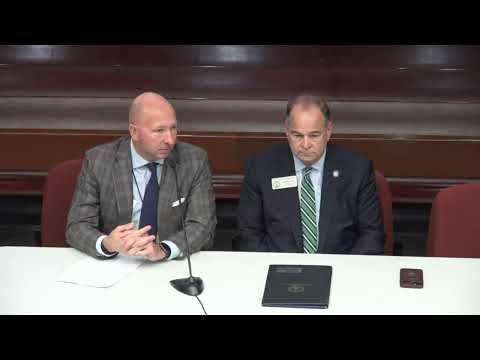
Representative Seebaugh, who presented the bill, framed the proposal as an economic and cultural development measure. "This is Georgia, where music isn't just entertainment, it's part of who we are," he said, and described a state office as a central hub to "support local musicians and venues through information sharing, grants, promote music tourism" and to "offer professional development for artists, venue owners, and music businesses." The bill text referenced by the author was LC 5900074 and is cited in this hearing as House Bill 353.
The proposal would place the new office inside the Department of Community Affairs (DCA) and create a Music Ready Community Initiative to help municipalities develop local music strategies, offer grants for infrastructure such as venues, rehearsal spaces and studios, and provide technical assistance to local governments. Seebaugh and witnesses repeatedly described the measure as "subject to appropriations." Seebaugh estimated a startup appropriation of about $2,500,000 to stand the office up; Brian Hudson, speaking for Georgia Music Partners, the Recording Industry Association of America and the Recording Academy, said initial staffing could be much smaller and suggested "maybe a couple hundred thousand dollars, maybe a half a million" to start.
Hudson, an industry representative who testified in support, said the office would be a coordination point for the many existing music organizations in the state and urged a focused, neutral government role. "We fully support this bill," he said, noting other states have placed music offices in different agencies and that DCA's focus on supporting local communities made it a fit for the "Music Ready Community" approach. He also compared Georgia to other states, saying Texas and Tennessee have used state offices to grow music-related economic activity.
Committee members questioned how the proposed office would differ from economic development efforts already underway by the Department of Economic Development and private organizations. Supporters replied that DCA's local-community focus — concentrating on downtown revitalization, infrastructure, and local workforce development — aligned better with an "inside-out" growth model for music, rather than an "outside-in" attraction model more typical of broader economic development efforts. Representative Hilton and others asked about the education and workforce role; witnesses said the office would coordinate with existing university programs but not supplant Regents or university authority over degree programs.
Members noted existing music programs at Kennesaw State University, the University of Georgia, Georgia State and SCAD, and cited examples of music-focused revitalization efforts such as Capricorn Records in Macon and private studios and producers returning to cities like Savannah and Valdosta. Hudson and other witnesses emphasized that small, local music businesses and venues across Macon, Athens, Savannah, Valdosta and Atlanta could benefit from a centralized point of contact.
Representative Seebaugh concluded by asking for the committee's favorable consideration. The chairman called for a motion; a motion and second were made and the committee voted on the motion. The transcript records a vote occurred, but the transcript does not record a clear roll-call tally or a final, explicit outcome on the record provided here.
The committee's discussion centered on whether a state office should serve as a neutral, coordinating hub for industry and local governments, the likely initial staffing and appropriation needs, and how the office would relate to universities and existing private organizations. No specific appropriation amount was enacted during this hearing; the bill remains at the committee stage pending further action.