Get Full Government Meeting Transcripts, Videos, & Alerts Forever!
Get email alerts on the Tax Exemption topic
No spam. Unsubscribe anytime.
Committee narrows pollution‑control tax exemption to exclude stand‑alone direct air capture facilities
Summary
House Revenue Committee advanced Senate File 61 after amending the pollution‑control property tax exemption to exclude facilities constructed solely to capture non‑point‑source carbon dioxide. Supporters said the change protects local tax bases while preserving exemptions for traditional pollution control equipment added to existing plants.
CHEYENNE — The House Revenue Committee on Monday advanced Senate File 61 after adopting language that clarifies the existing pollution‑control property tax exemption will not automatically exempt stand‑alone facilities built solely to capture carbon dioxide from the ambient air.
Senator Cale Case, sponsor of SF 61, told the committee the exemption originally was intended for “bolt‑on” pollution control equipment installed on existing facilities to meet regulatory requirements. He said direct air capture facilities — plants built only to remove CO2 from the atmosphere — could otherwise qualify under current statutory language and avoid paying property taxes despite imposing significant local costs.
The committee adopted an amendment clarifying the exemption does not apply to “facilities constructed for the sole purpose of capturing non‑point‑source carbon dioxide.” The change was described at the hearing as a compromise negotiated with industry groups; proponents said the amendment preserves the exemption for pollution control equipment attached to existing operations but excludes new, stand‑alone carbon capture plants from blanket exemption.
Why it matters: Under current law the pollution‑control exemption can apply to equipment required for an existing, taxable operation (for example, scrubbers retrofitted on a power plant). If a new direct air capture facility were treated as pollution control equipment for exemption purposes, local governments could face large new facilities on which no property tax would be collected — a concern raised by multiple speakers at the hearing.
Testimony and participants
- Sponsor: Senator Case said the bill’s initial purpose was to address the possibility that entirely new direct air capture facilities could qualify for the exemption and thereby avoid property taxes despite large local impacts for roads, services and schools.
- Industry and associations: Representatives of the Petroleum Association of Wyoming, the Wyoming Business Alliance, the Mining Association and the trona industry told the committee they opposed the bill as originally drafted but support the engrossed version with the amendment. Peter Obermueller (Petroleum Association) explained the exemption’s longstanding purpose is to avoid taxing equipment that adds no economic value to an existing facility. Randy McKay (Wyoming Business Alliance), Travis Detai (Mining Association) and Jody Levin (Trona Industry) said the amended language addresses concerns about unintended exemptions for new, taxable industrial facilities.
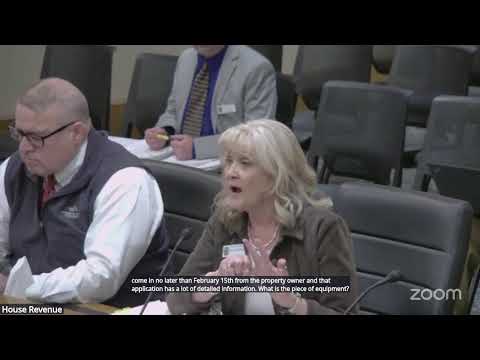
- Administration and process: Brenda Henson, director of the Department of Revenue, explained the pollution‑control exemption requires an application from the property owner (due by February 15) and that local county assessors or the Department of Revenue determine eligibility depending on whether the property is locally or centrally assessed. She said the department will promulgate rules as necessary to implement the amendment.
Key clarifications from the hearing
- Point vs. non‑point source: Committee discussion distinguished CO2 captured from a discrete industrial emitter (a point source) from CO2 captured from ambient air (a non‑point source). The amendment excludes non‑point, direct air capture facilities from qualifying for the exemption while retaining exemptions for pollution control equipment added to existing taxable operations.
- Economic value exception: Witnesses pointed out the statute already denies the exemption when the capture equipment produces an economic byproduct or marketable output; the amendment adds the non‑point‑source exclusion as an additional limit in cases where a new facility would otherwise be exempt.
Votes and outcome
- Committee roll call on Senate File 61 as amended: Aye — Campbell, Lean, Storer, Steivar, Chairman Locke; No — Brown, Lucas, Wirth; Excused — Riggins. The measure passed the committee and will advance to the House floor.
What the committee did not decide: The committee did not change the application or appeals processes described in current statute. The Department of Revenue and county assessors retain responsibility to review applications and determine whether specific equipment or facilities qualify for the exemption; determinations are appealable to the county board of equalization or the State Board of Equalization.
Ending: Committee members said the amended language strikes a balance between preserving exemptions that supported historic pollution‑control retrofits and preventing a total property‑tax exemption for large, stand‑alone carbon capture plants that could otherwise impose costs on local governments without contributing property tax revenue.