Get Full Government Meeting Transcripts, Videos, & Alerts Forever!
Get email alerts on the Property Tax topic
No spam. Unsubscribe anytime.
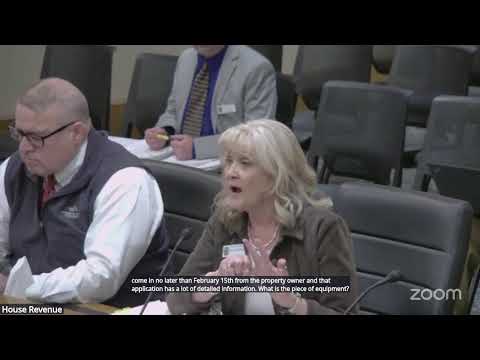
House Revenue Committee passes bill clarifying new residential property class, adopts 8.3% assessment and 8‑month owner-occupancy rule
Summary
The House Revenue Committee on Monday voted to advance Senate File 153, which transcribes the voter‑approved fourth constitutional property class for residential real property into statute and establishes initial assessment and owner‑occupancy rules.
CHEYENNE — The House Revenue Committee on Monday voted to advance Senate File 153, a bill that transcribes a voter‑approved constitutional change creating a fourth property class for residential real property into state statute and establishes immediate implementation details.
Senate sponsor Senator Bartle told the committee the bill’s purpose is to put the constitutional change — Article 15, Section 11 — into statutory language, define “residential real property,” and provide a starting definition for an owner‑occupied primary residence. “This bill brings into statute that fourth class or that class of residential real property,” Bartle said at the hearing.
Committee members adopted three changes to the Senate’s engrossed draft. The panel voted to reduce the residential level of assessment in the bill from a 9.5% placeholder to 8.3%; to change the owner‑occupancy threshold in the bill from six months to eight months; and to add a narrowly worded exception so active‑duty service members deployed outside the state are not disqualified by the occupancy requirement. The committee voted 8‑0 with one excused to pass the bill out of committee.
Why it matters: Voters passed a constitutional amendment in November creating a separate constitutional class for residential real property and authorizing a possible subclass for owner‑occupied dwellings. That constitutional change did not automatically add a statutory framework for assessors to use. Committee members and Department of Revenue staff said enacting statutory definitions now clarifies the taxing structure for the 2025 assessment schedules and avoids legal uncertainty about programs that reference residential classifications.
Key details and committee concerns
- Statutory replication of constitutional language: The bill inserts a residential real property class in statute and includes language enabling the legislature to create an owner‑occupied subclass. The sponsor emphasized the bill does not itself change the constitutionally permitted maximum mill rates; it puts the class into statute so future actions (rates, exemptions) have a statutory place to operate.
- Assessment levels: The bill originally carried a 9.5% assessment placeholder. Representative Lean moved an amendment to change that level to 8.3% (amendment passed). Senator Bartle and Department of Revenue staff explained constitutional constraints on how far the legislature may move assessment levels (the sponsor referenced a formula tied to the industrial rate), and the department provided an estimate that moving the assessment from 9.5% to 8.3% would reduce revenue to cities, towns and counties by about $20,000,000 (the department did not provide a special‑district estimate at the hearing).
- Owner‑occupied definition and timing: The engrossed bill used a six‑month occupancy test as a starting point. During questioning, committee members and proponents urged alignment with existing exemptions that use an eight‑month test to reduce confusion for property owners. Department of Revenue and county assessors warned that creating a distinct owner‑occupied subclass with a different assessment level could not be administered for the 2025 tax year because assessors are preparing roughly 175,000 assessment schedules and the application and notice processes for a new lower owner‑occupied rate would not be feasible on the current timeline. The committee therefore adopted the eight‑month occupancy language for the definition and added a provision protecting active‑duty military members deployed out of state from being disqualified by that requirement.
- Administrative clarifications: Ken Gill of the Department of Revenue’s Property Tax Division told the committee the engrossed draft aligns with the State Board of Equalization’s abstract codes (how structures and land are coded in the assessor system). The department supported creating the statutory class now while cautioning that implementing a separate owner‑occupied assessment level for tax year 2025 would not be administrable.
Votes and next steps
- Committee roll call on Senate File 153 as amended: Aye — Brown, Campbell, Lean, Lucas, Storer, Steivar, Warf, Chairman Locke; Excused — Riggins. Secretary announced the bill passed out of committee.
- Implementation timing: Committee members and department officials said leaving the residential class and owner‑occupied subclass language in statute — while keeping assessment levels the same for 2025 — would allow the Legislature to debate separate assessment levels in this session for implementation in a later tax year. Department staff said that if the Legislature intends to set a different owner‑occupied level for tax year 2026, placing the subclass language in statute now would let assessors and the department prepare rules and application processes during the interim.
What the committee did not decide: The committee did not set a separate owner‑occupied assessment rate for 2025; the change to 8.3% applies to the residential real property class as written in the amended bill. Committee members flagged further interim work to define short‑term rentals, income‑producing residential properties and other special cases.
Support and testimony
- In support: The majority leader testified in favor of the bill as a long‑term tool to address property tax concerns and offered language to tether the occupancy definition to existing statute while protecting deployed service members. County assessors and the Department of Revenue testified the engrossed bill, if left with a single assessment level for 2025, is administrable, and urged thorough interim work on definitions.
Ending: The committee moved the bill to the floor with amendments for further debate. Sponsors said they will coordinate on floor managers and on whether to propose additional amendments on the floor.